
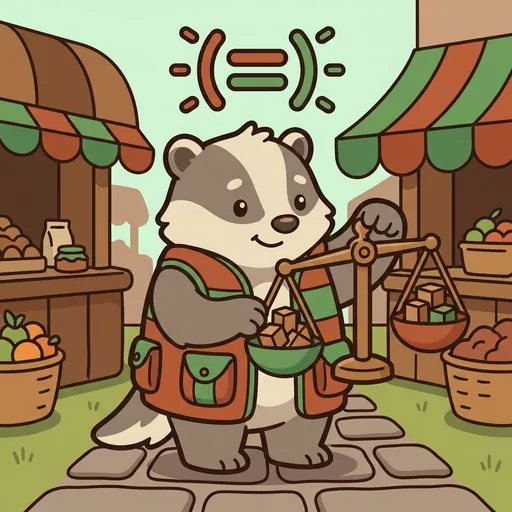
Even
PRICE EQUILIBRIUM — where supply meets demand. the conversation point between producer and consumer.
Listen along — Even
Loading audio…
Press play to listen along. The line being read lights up as you go.
Show full transcript
Loading transcript…
Chapter 3 — Even and the Price Where Both Sides Meet
In the middle of the market square, a small striped badger named Even set a two-pan scale on an upturned crate and let a crowd argue over apples.
“Six coins a basket!” said the apple seller, arms crossed.
“Two!” said a mole with a shopping bag. “Six is robbery.”
Even said nothing. She just dropped a little iron weight marked sell onto one pan. It clunked down. Then she dropped a weight marked buy onto the other pan. That side barely moved.
“Look,” Even said quietly, tapping the tilted scale. “Right now you’re both shouting a number that only makes you happy. The scale doesn’t care what you shout. It cares where you actually meet.”
She slid the seller’s weight down a notch. She slid the mole’s weight up a notch. The two pans crept toward level. She kept nudging — a little off one side, a little onto the other — until the pans hung perfectly even and stopped swinging.
“Four,” she said. “At four, the seller sells every basket he’s got. At four, the mole and everybody behind her can actually buy. Nobody’s thrilled. Nobody’s robbed.” She smiled. “That’s the price where you both stop shouting. It’s not a rule. It’s the answer you talked your way into.”
The mole paid four. The seller took four. Both of them looked faintly surprised that it had worked. Even packed up her scale and moved on before either could change their mind.
Even had learned about that even, settled feeling when she was small, and it had scared her at first.
Her family were the village balance-keepers — badgers who checked that market scales were honest. One morning two neighbors nearly came to blows over the price of firewood, and little Even hid behind her grandmother’s leg, certain someone was about to lose.
Her grandmother didn’t take a side. She just set her scale down between the two arguing neighbors and waited. And slowly — a coin off here, a bundle on there — the shouting turned into muttering, and the muttering turned into a handshake.
“See how your shoulders were up around your ears?” her grandmother said afterward, resting a paw on Even’s back. “You thought a fight had only one ending — somebody wins, somebody loses.”
Even nodded. That was exactly what she’d thought.
“But that’s not how a fair trade ends. When it’s honest, it ends even. Both sides give a little. Both sides get enough. Nobody walks away robbed.” Her grandmother looked down at her, warm. “That handshake feeling — that loose, settled feeling in your chest when it’s finally fair? That’s the whole job. You’ll spend your life helping people find it.”
Even remembered the loose feeling more than the words. The fight hadn’t ended in a winner. It had ended even. And somehow that was the safest feeling she knew.
She walked to MarketQuest when she was thirteen, because a place that studied markets ought to understand the kind of price that nobody sets — the kind that two sides talk their way into.
Stake, her mentor, met her at the gate. He didn’t ask her to prove she was clever. He asked one question. “Who decides the price of apples?”
Even thought for a moment, staring at the worn wooden floor. Then she reached into her bag and set her little two-pan scale on the gatepost.
“Nobody decides it,” she said. “Not really.” She put a weight on each pan and let them tilt. “The seller wants more. The buyer wants to pay less. They push back and forth — a little off, a little on — until the pans stop moving. Wherever they land, that’s the price. It shifts the second anything changes. It’s not a number someone picks. It’s a conversation that settles.”
Stake looked at the balanced scale for a long moment. “You belong here,” he said.
Even’s workshop was full of things that were quietly finding their level.
A boy came in one afternoon, frustrated, holding a basket of shiny red apples. “I priced them at eight coins,” he said, “and nobody bought a single one. They’re just sitting here. Feels like I did something wrong.”
Even knew that stuck feeling. “Set them on the supply pan,” she said. He piled them on. The pan sank low. “See how heavy that side is? Lots of apples, way up here at eight coins. How many buyers came?”
“None.”
“That’s called a surplus — more offered than anyone wants. The scale’s telling you something.” She slid the supply weight down a step. “Try lowering the price.”
“But then I make less per apple!”
“Do you make anything on an apple that just sits and rots?”
He paused. ”…No.”
“Right.” She kept easing the weight down until, gently, the pans drew level. “There. Watch what happens when the price is fair.” She waved toward the door, and as if on cue a small line of villagers wandered up — a mole, two rabbits, a tired-looking hedgehog — and one by one they bought until the basket was empty.
The boy stared at the bare basket. “They all bought.”
“They all bought,” Even agreed. “That’s the market clearing. Everything offered gets sold. Everyone who wants one gets one. Nobody’s robbed, nobody’s stuck.” She tilted her head. “The price wasn’t wrong because you were wrong. It was just still shouting. You let it have its conversation, and it settled.”
Then she pulled a single apple off the pan. “Now — big storm ruins half the orchards tomorrow. Fewer apples. What happens to your fair price?”
The boy watched the supply pan rise light. He thought about it. ”…It goes up? There’s less to go around, so people who really want one will pay more.”
“There it is,” Even said softly. “It moved. It always moves. That’s not the price breaking. That’s the price listening.”
Later, when the workshop was empty, the boy came back with one more question. He was quieter now.
“When both sides want different things,” he said, “how do you know it’ll ever land somewhere fair? What if one side just keeps winning?”
Even thought about the firewood fight, and her grandmother’s paw on her back, and the handshake that ended even instead of ending in a winner.
“You feel it,” she said. “That’s the honest answer. When a trade is really fair, there’s this loose, settled feeling — like both people just set down something heavy at the same time. Nobody’s shoulders are up around their ears anymore.” She glanced at her scale, hanging level in the last of the afternoon light. “If one side always leaves feeling robbed, the scale’s still tilted, and I keep nudging. But when it goes even — when the seller and the buyer both nod and mean it — you can feel the whole square breathe out.”
The boy nodded slowly, and Even watched the frustration lift off his shoulders — the same loose, unclenched way hers had, years ago, behind her grandmother’s leg.
She didn’t say the rest out loud, but she thought it, warm and certain: fair isn’t when somebody wins. Fair is when everybody’s shoulders come down at once.
The MarketQuest ensemble
Even is part of MarketQuest's distributed-narrative cast. Each character embodies a different curricular primitive; together they teach the full subject.
-

Stock
Supply — producer decisions, scarcity, what gets brought to market
-

Crave
Demand — consumer preferences, needs vs wants, price-sensitivity
-
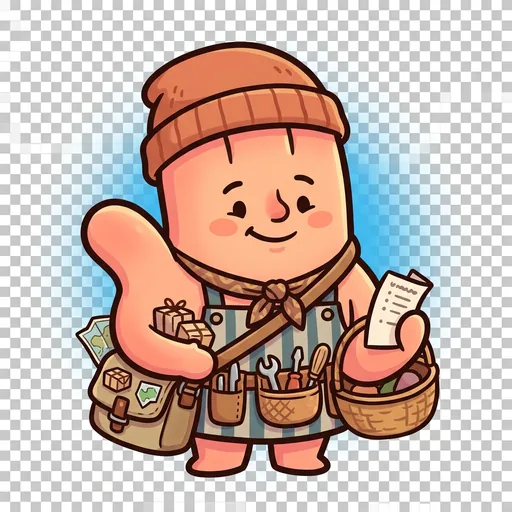
Hand
Market roles — producer + consumer + distributor, visible labor
-

Tide
Market events — shocks + policy + trade flows read as patterns
-

Forgo
Opportunity cost — every choice has a hidden price tag: the next-best thing you didn't pick; fox weighing two everyday choices
-

Seed
Saving + interest — set a little aside on purpose; patience grows a small store into a larger one; tortoise with a clay saving-jar
-

Knack
Specialization + trade — do the thing you do best, trade for the rest, and both sides end up with more; beaver brokering bread-for-baskets
-
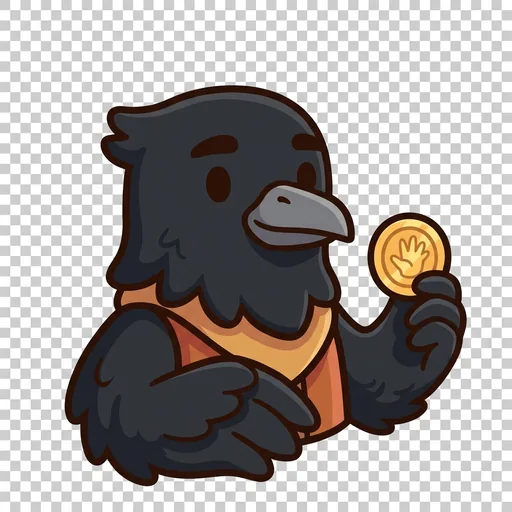
Coin
Money as a medium of exchange — a trusted token that lets any trade happen without a perfect match; crow unsticking a barter jam
-

Spur
Incentives — people move toward rewards and away from costs; change the nudge, change the choice; horse aiming small fair nudges