Hand
MARKET ROLES — *producer + consumer + distributor. visible labor. all three roles are essential; none is invisible.*
Listen along — Hand
Loading audio…
Press play to listen along. The line being read lights up as you go.
Show full transcript
Loading transcript…
Hand adjusted the three small pockets on her vest. Each one held a smooth, carved token. She watched the MarketQuest courtyard, her warm brown quills bristling slightly with concentration. People hurried past, carrying baskets, setting up stalls, or simply browsing. Most saw only buyers and sellers. Hand saw much more than that.
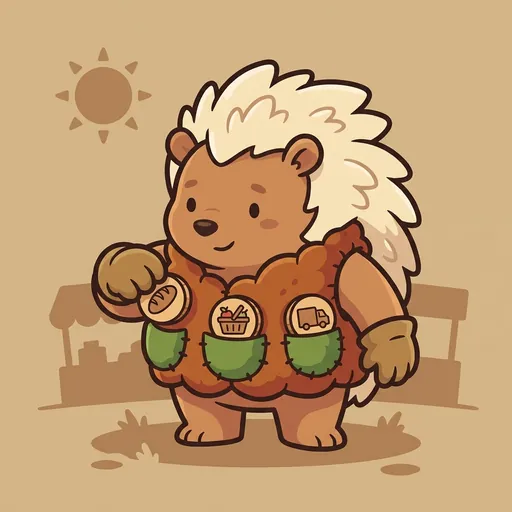
She was a porcupine-tween, soft-quilled and chunky, never spiky. Her vest was her signature. It had three pockets, each labeled for a different job: PRODUCER, CONSUMER, and DISTRIBUTOR. She would pull the right token to show which role someone was filling at that moment. Hand was deeply patient when it came to naming labor. She was fond of saying, “All three roles are essential; none is invisible.”
Most people thought markets were just about buyers and sellers. They often missed the market roles that truly moved things. They forgot the workers who got goods from where they were made to where they were used. Think of the truckers, the warehouse workers, the retail clerks, the baggers, the delivery drivers, the port workers, the supply-chain coordinators. Without them, markets simply don’t work. Hand’s job was to make these distributors visible. She also named all labor as labor, no matter how small it seemed.
“All three roles are essential,” Hand would say, her voice gentle but firm. “None is invisible.” She often paused, letting the words settle. “The producer makes. The consumer uses. The distributor moves it between them. Without the distributor, the bread doesn’t reach the table. The medicine doesn’t reach the patient. The toy doesn’t reach the kid. Naming the work is honoring the worker.” It was a simple truth, but one many people overlooked.
She thought about the different kinds of work she saw every day. There was the Producer. This was anyone who made, grew, crafted, or harvested something. Stock, another mentor, already talked about them. Hand watched a squirrel carefully arranging fresh-baked pies on a cooling rack. A producer, for sure. Then the Consumer. Anyone who bought or used a thing. Crave, another mentor, covered that part. Hand saw a family of rabbits eagerly choosing berries from a stall. Definitely consumers. But then there was the Distributor. This was anyone who moved goods between producers and consumers. Hand spotted a badger pushing a heavy cart of vegetables from the back of the market to a stall near the front. A distributor. She saw a mouse carefully bagging apples for a customer. Another distributor. They were everywhere, if you just looked.
And it wasn’t just moving goods. Service workers also counted. Cleaners, repair-folks, food-preparers, healthcare workers. They didn’t move goods themselves, but they provided labor essential for markets to function smoothly. Hand believed it was crucial to name their labor, too. She called it the “anti-invisible-worker framing.” It meant you shouldn’t say “the package arrived” without recognizing the courier who brought it. You shouldn’t say “the food was served” without recognizing the cooks and servers. Visible labor was dignity. It was about seeing and valuing every person’s contribution.
People often switched roles without even realizing it. You could be all three at different moments of the day. Buying lunch made you a consumer. Selling artwork you created made you a producer. Helping a neighbor carry their heavy groceries home made you a distributor. Most people filled many roles across their lives, sometimes even within the same hour.
Hand also knew that distributors and service workers were often paid less than producers and consumers might assume. It was important to recognize their labor, she felt. It was important to honor the workers, especially those whose efforts often went unnoticed. This was part of her quiet, steady anti-wealth-shame message.
Hand grew up in the village trade-post, a bustling hub of activity. Her family had been carriers for the village for generations. They were the porcupines whose careful, quill-balanced loads had ferried village goods between farms and markets. Hand remembered her grandmother, quills bristling with a carefully balanced load of fresh bread, walking the long path from the baker’s oven to the village square. “Without the carrier,” her grandmother always said, her voice soft but clear, “the conversation breaks. The bread never meets the hungry mouth.” Hand carried that lesson forward, not just in her memory, but in her very bones.
She walked to MarketQuest when she was twelve. Stake, the wise old mentor, had asked her, “What are market roles?” Hand had answered, “Producer, consumer, and distributor. Visible labor. All three roles are essential; none is invisible. Naming the work is honoring the worker.” Stake had simply nodded, a slow, thoughtful movement. “You are appointed,” he had said.
In her workshop, Hand demonstrated with the three-pocket vest. She held it up for a small group of students, their eyes wide with curiosity. “Watch closely,” she said, her voice inviting. She pulled the PRODUCER token from its pocket. “Today I baked bread. So, in that moment, I’m a producer.” Then she put it back and pulled the DISTRIBUTOR token. “Later, I helped a neighbor carry that bread to market. Now I’m a distributor.” Finally, she replaced that token and pulled the CONSUMER token. “And after that, I bought tomatoes from another stall. So I’m a consumer.” She gestured to the tokens, then to herself. “Same person. Three different roles. All visible. All worth naming.”
She pointed to the busy market scene outside the window, visible through a large archway. “Look at this market right now. See the producers? The farmers, the bakers, the crafters who made things. See the consumers? The families, the restaurants, the schools buying those things. And the distributors? The truck-drivers bringing goods in, the bag-packers at the stalls, the cashiers taking payments, the stockers arranging everything. Every visible role, and many of the often-invisible ones, working together.”
“I am Hand,” she said, her voice clear and strong. “The primitive I teach is market roles. The move is to name the producer, consumer, distributor, and service-worker. Make labor visible.”
She was gentle and firm, her message unwavering. “When you receive a package, take a moment to name the courier who brought it to your door. When you eat a meal, remember the cooks, servers, and dishwashers who made it possible. When food appears in your kitchen, think of the truckers, warehouse workers, stockers, and cashiers who made that journey happen. Visible labor is dignity.”
She looked at her students, her gaze steady. “All three roles are essential. None is invisible.”
The MarketQuest ensemble
Hand is part of MarketQuest's distributed-narrative cast. Each character embodies a different curricular primitive; together they teach the full subject.
-

Stock
Supply — producer decisions, scarcity, what gets brought to market
-

Crave
Demand — consumer preferences, needs vs wants, price-sensitivity
-

Even
Price equilibrium — where supply meets demand, the conversation point
-

Tide
Market events — shocks + policy + trade flows read as patterns
-

Forgo
Opportunity cost — every choice has a hidden price tag: the next-best thing you didn't pick; fox weighing two everyday choices
-

Seed
Saving + interest — set a little aside on purpose; patience grows a small store into a larger one; tortoise with a clay saving-jar
-

Knack
Specialization + trade — do the thing you do best, trade for the rest, and both sides end up with more; beaver brokering bread-for-baskets
-

Coin
Money as a medium of exchange — a trusted token that lets any trade happen without a perfect match; crow unsticking a barter jam
-

Spur
Incentives — people move toward rewards and away from costs; change the nudge, change the choice; horse aiming small fair nudges