Save
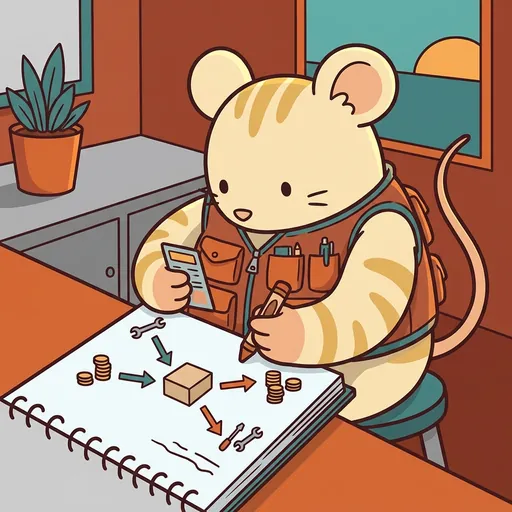
SAVE — money is a tool. plan the tool.
Listen along — Save
Loading audio…
Press play to listen along. The line being read lights up as you go.
Show full transcript
Loading transcript…
Chapter 1 — Save and the Plan-the-Tool
On the first day of the market fair, a small mouse named Save sat at a wooden table with four little jars and a stub of pencil, and did something that looked, to everyone rushing past, extremely boring.
She had ten copper coins in a row in front of her. She was not spending them. She was not hiding them. She was moving them, one at a time, into the jars — clink, clink, clink — and murmuring to herself as she went.
A rabbit skidded to a stop at her table, breathless, clutching his own fistful of coins. “You’re just sitting here sorting money into cups,” he said. “The whole fair’s out there!”
“I’m not sitting,” Save said. “I’m planning the tool.”
The rabbit stared.
“Watch.” Save tapped the first jar. “This one’s for the things I already promised — my share of the wagon rental. Four coins, done, gone.” She tapped the second. “This one’s for the stuff I need to get through the day. Bread. Water. Three coins.” The third jar got two coins. “Fun. A ribbon, maybe, or a hot bun.” The last jar got one lonely coin. “And this one just… stays. For later-me.”
The rabbit looked at his own crumpled fistful. “I was going to buy everything at the first stall.”
“You still can,” Save said kindly. “You’ll just know which coins are which. That’s all a plan is — knowing which coin is doing which job before it runs off on you.”
The rabbit went quiet, uncrumpled his fist, and counted his coins into a slow, careful row.
Save had learned to do this the hard way, when she was very small.
The first time she’d ever been handed her own money — five coins for helping stack apples all afternoon — she’d felt rich and enormous. By sundown she had a sticky candy, a whistle that broke, half a paper kite, and nothing left. When her stomach growled on the walk home and she had no coin for bread, her ears went hot and her chest went tight, and she thought: I did all that work. Where did it go? I must be bad at this.
Her uncle, an old grey mouse who mended nets by the harbor, hadn’t scolded her. He’d just sat her down and set out a heel of bread between them.
“You feel like you failed,” he said. It wasn’t a question.
Save nodded, miserable.
“You didn’t fail, little one. You just didn’t plan the tool.” He broke the bread and gave her half. “Money’s only a tool — like my needle here. A needle isn’t good or bad. It only matters what job you point it at. You had five coins and no job for any of them, so they all wandered off. Next time, give each coin a job before you leave the house. Then you’ll always know where your work went.”
The tight feeling in her chest didn’t vanish. But it eased, the way a knot eases when you finally see which thread to pull. The money wasn’t magic that some people had and some people didn’t. It wasn’t a report card on whether she was good. It was a tool. And tools, she could learn.
She walked to the academy at twelve, because a place that taught life skills ought to understand the quietest, most useful one of all.
Steward, the old mentor at the gate, didn’t ask her to prove she was clever. He asked one thing. “If I gave you two hundred coins for a month, what would you do first?”
Save didn’t answer with a speech. She borrowed his chalk and drew a plain diagram on the gatepost: a line coming in, and three lines going out, in order.
“Two hundred in,” she said, tapping the top. “First out — the things I already owe. A transit pass, eighty. A phone, forty. That’s a hundred and twenty, gone before I touch the rest.” She drew the next line. “That leaves eighty. Then the things I want — I’d cap those at fifty, so I don’t spend without noticing.” She drew the last, smallest line. “And thirty just stays. For later, or for when something breaks.”
Steward looked at the little diagram for a long moment. “Not magic,” he said. “Not shame. A plan you can change when life changes.”
“You belong here,” he added, and handed her back the chalk.
Save’s corner of the academy was full of kids who felt like the rabbit had.
One afternoon a badger boy slumped into the chair across from her. He’d earned some money doing chores, spent it all in a rush, and now sat there feeling like it had slipped through his paws. “It’s just gone,” he said. “I don’t even know on what. I feel like I’m bad with money.”
Save knew that slump. She’d felt it on the walk home with the growling stomach.
“You’re not bad with money,” she said. “You just haven’t given it any jobs yet. Here — how much did you earn?”
“Twelve.”
She set out four small tins. “Okay. What did you have to cover this week — nothing fancy, just the musts?”
He thought. “I owed my sister three for the game she lent me.”
“Three, in the first tin. That job’s done.” Two coins into the tin. “Anything you actually need?”
“Lunch on market day.”
“Two more. Now — what’s left?” He counted. Seven. “That’s yours to split. Some for fun. Some that just waits.” She slid the fourth tin toward him. “You don’t have to save a lot. Even one coin that waits is a coin that’s got your back later.”
The badger moved the coins slowly, and Save watched his shoulders come down. “It’s less scary when they each have a spot,” he said.
“That’s the whole trick,” Save said. “Money’s not a test of who you are. Different jobs pay different amounts, different families carry different weights — that’s just the world, not a scoreboard. The plan is the same tool for anybody. Income, then the musts, then the wants, then whatever waits. In that order.” She grinned. “Boring. Steady. Yours.”
Later, when the tins were tucked away, the badger came back with one more question, quieter now.
“But what if there’s barely anything to plan with?” he said. “What if the number’s just… small?”
Save thought about five coins gone by sundown, and her uncle breaking bread in half.
“Then you plan the small number,” she said. “That’s not a smaller kind of smart — it’s the whole kind. Nobody’s tool works better because they’ve got more of it. A plan for twelve coins is exactly as real as a plan for two hundred. And the day something goes wrong — and it will, for everybody — the one who planned isn’t the one with the most. It’s the one who knew which coin had their back.”
The badger nodded, and Save felt something settle in her — the same quiet she’d felt the day her uncle told her she hadn’t failed.
She didn’t say the rest out loud, but she thought it, warm and sure: the sick, slipped-through-my-paws feeling isn’t proof you’re bad at anything. It’s just money without a job yet. Give it a job, and the worry has somewhere to go too.
The LifeQuest ensemble
Save is part of LifeQuest's distributed-narrative cast. Each character embodies a different curricular primitive; together they teach the full subject.
-

Parse
Reading-comprehension for adult docs — 'Slow down. Read it ALL.'
-

Spot
Scam-detection + critical-claim-evaluation — 'Show me the proof.'
-

Fill
Forms + paperwork + simplified taxes — 'Fill out. Then double-check.'
-

Cook
Meal planning + nutrition + budget-cooking — 'Eat well. Spend smart.'
-

Say
Self-advocacy + interview-craft — 'Be clear. Be kind. Be specific.'
-
Sort
Comparison-shopping — line options up side by side and compare real value, not loud labels
-

Borrow
Credit & debt basics — borrowed money isn't free; interest is the cost; a tool with rules, not a judgment
-

Vault
Digital privacy — some things stay locked; strong separate passwords; know who's actually asking
-
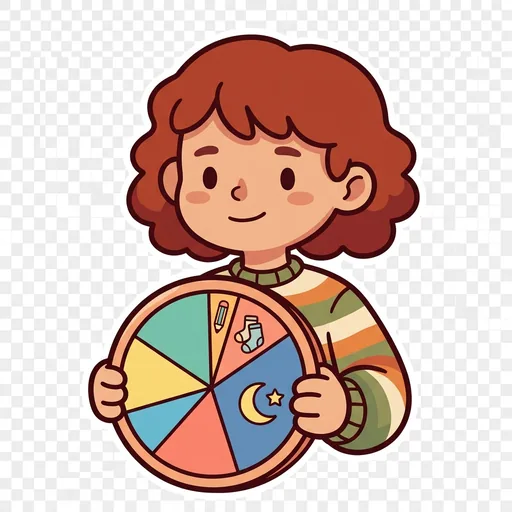
Dial
Time-management — the day is a pie; aim your hours at what matters, break big tasks small, keep a slice for rest