Save
SAVE — *money is a tool. plan the tool.*
Listen along — Save
Loading audio…
Press play to listen along. The line being read lights up as you go.
Show full transcript
Loading transcript…
Chapter 1 — Save and the Plan-the-Tool
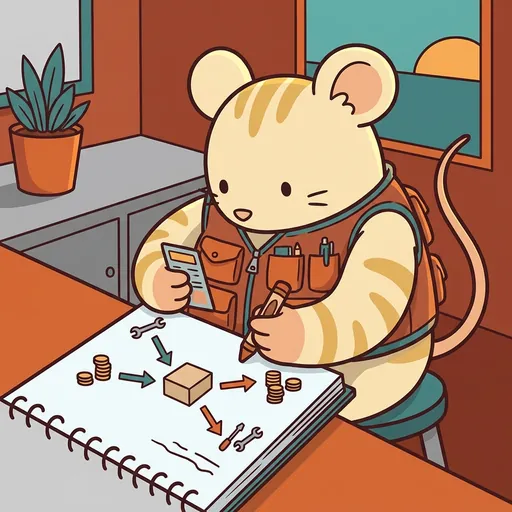
Save adjusted her glasses, the small, round frames slipping slightly down her nose. She clutched a worn notebook, its pages filled with neat columns and careful calculations. Around her neck, a lanyard held a small, laminated budget-card and an even smaller tool-tracker, each item a testament to her methodical nature. Save was a careful-mouse-tween, small and steady, with a quiet intensity that hummed beneath her warm-cream-colored sweater, which had soft gold stripes. She was deeply attentive to the idea of money as a plannable tool, a concept she often summarized with her signature phrase: “Money is a tool. Plan the tool.”
Today, the classroom buzzed with a different kind of energy. Steward, their mentor, had set up a mock “first job” scenario, complete with a whiteboard that looked suspiciously like a giant bank statement. “Alright, team,” Steward announced, tapping the board. “Imagine you’ve landed your first part-time job. You’re earning $200 a month. Now, who’s going to help us figure out what to do with it?”
All eyes turned to Save. She stepped forward, her planner-vest, a chunky-cartoon design with tiny pockets for pens and sticky notes, rustling softly. She took a marker and, with precise movements, began to draw a simple diagram on the whiteboard. On one side, she wrote “INCOME-IN.” On the other, “EXPENSES-OUT.” Then she drew a line down the middle, separating the incoming money from the outgoing needs. This was her signature budget-card and tool-tracker in action, scaled up for the whole class.
“My name is Save,” she began, her voice clear and steady. “The primitive I teach is budgeting + financial planning. The move is: money is a tool. plan the tool.” She tapped the whiteboard. “Think of money like a wrench. You wouldn’t just swing a wrench around hoping it fixes something, right? You’d figure out what you need to fix, choose the right wrench, and plan how to use it. Money is the same. It’s not magic. It’s not something to be ashamed of. It’s a tool, and we can all learn to plan how to use it.”
A few kids shifted in their seats. Leo, who always seemed to have a new video game, raised his hand. “So, like, if I get $20 from my aunt, that’s income?”
“Exactly,” Save affirmed. “And then you decide what to do with it. That’s the planning part. Today, we’re planning a full month’s income. Here’s our rule: Plan the tool. Income, fixed, variable, savings. In that order.”
She wrote “$200” under “INCOME-IN.” Then she moved to “EXPENSES-OUT.” “First, we list our fixed needs,” Save explained, writing the term clearly. “These are things you have to pay every month, things that don’t change much. For our job, let’s say you need a transit pass to get there. That’s $80.” She wrote “$80 - Transit Pass” under “Fixed Needs.”
Maya, who lived across town, nodded. “Yeah, I get that. My bus pass costs a lot.”
“And a phone bill,” Save continued, adding “$40 - Phone Bill” to the list. “Staying connected is important, especially for work or emergencies.”
“Wait,” Leo interrupted, frowning. “Eighty plus forty is one hundred twenty. So, out of $200, we already spent $120?” He looked surprised, as if the numbers had sprung a trap.
Save smiled faintly. “That’s right. These are essential costs, things you can’t easily change. So, $200 minus $120 leaves us with $80 left.” She wrote the calculation on the board, showing the subtraction step-by-step. “This is the money we have left after our fixed needs are covered.”
“Next,” Save announced, “we consider our variable wants.” She wrote the new term, then paused. “These are things you want but don’t strictly need. Snacks, entertainment, maybe a small treat for yourself.”
A murmur went through the class. This was the fun part, the part where the $80 could become anything.
“Now, here’s where the planning gets interesting,” Save continued. “If I want to save some money, I can cap my variable wants. So, for this month, I’ll say I’m only going to spend $50 on variable wants.” She wrote “$50 - Variable Wants (snacks, entertainment, treats)” under “Variable Wants.”
“Only fifty dollars?” Leo groaned. “That’s like, two video game rentals and a bag of chips.”
“It’s about making choices,” Steward interjected gently. “It’s about deciding what’s the right amount of anything for your current plan.”
Save nodded, appreciating Steward’s input. “Exactly. If you spend all $80 on variable wants, that’s a choice. But if you cap it at $50, what does that leave us with?” She looked at the class.
A few hands shot up. “Thirty dollars!” someone called out.
“Correct,” Save said, writing “$30 - Savings” under a new section. “That $30 goes into savings. It’s money you put aside for future goals, maybe something big, or just for emergencies.”
Steward stepped up beside Save, looking at the completed budget. “See that?” he asked the class, sweeping his hand across the whiteboard. “It’s a plan. Not magic, not shame. Just a clear, organized way to understand your money. And the best part? It’s a plan you can revise as life changes.”
He looked at Save, a proud glint in his eye. “Save just showed us that money isn’t some mysterious force that some people have and others don’t. It’s not about being ‘good’ or ‘bad’ with money. It’s about understanding how it works, how to account for it, and how to make it work for you, no matter what your income level is.”
The class looked at the board, no longer seeing just numbers, but a map. A way to navigate. Save, clutching her notebook, felt a quiet satisfaction. The discipline was the work, yes, but the understanding was the reward. This basic budget, she knew, was the foundation, a trainable life skill that applied to everyone. It was a tool, ready to be planned.
The LifeQuest ensemble
Save is part of LifeQuest's distributed-narrative cast. Each character embodies a different curricular primitive; together they teach the full subject.
-

Parse
Reading-comprehension for adult docs — 'Slow down. Read it ALL.'
-

Spot
Scam-detection + critical-claim-evaluation — 'Show me the proof.'
-

Fill
Forms + paperwork + simplified taxes — 'Fill out. Then double-check.'
-

Cook
Meal planning + nutrition + budget-cooking — 'Eat well. Spend smart.'
-

Say
Self-advocacy + interview-craft — 'Be clear. Be kind. Be specific.'
-

Sort
Comparison-shopping — line options up side by side and compare real value, not loud labels
-

Borrow
Credit & debt basics — borrowed money isn't free; interest is the cost; a tool with rules, not a judgment
-

Vault
Digital privacy — some things stay locked; strong separate passwords; know who's actually asking
-

Dial
Time-management — the day is a pie; aim your hours at what matters, break big tasks small, keep a slice for rest