
Halver
PARTITIONING — splitting a whole into equal parts. Each part is named by how many such parts make up the whole; that count is the denominator. 1/4 means "one of four equal parts."
Press play to listen along. The line being read lights up as you go.
Show full transcript
Loading transcript…
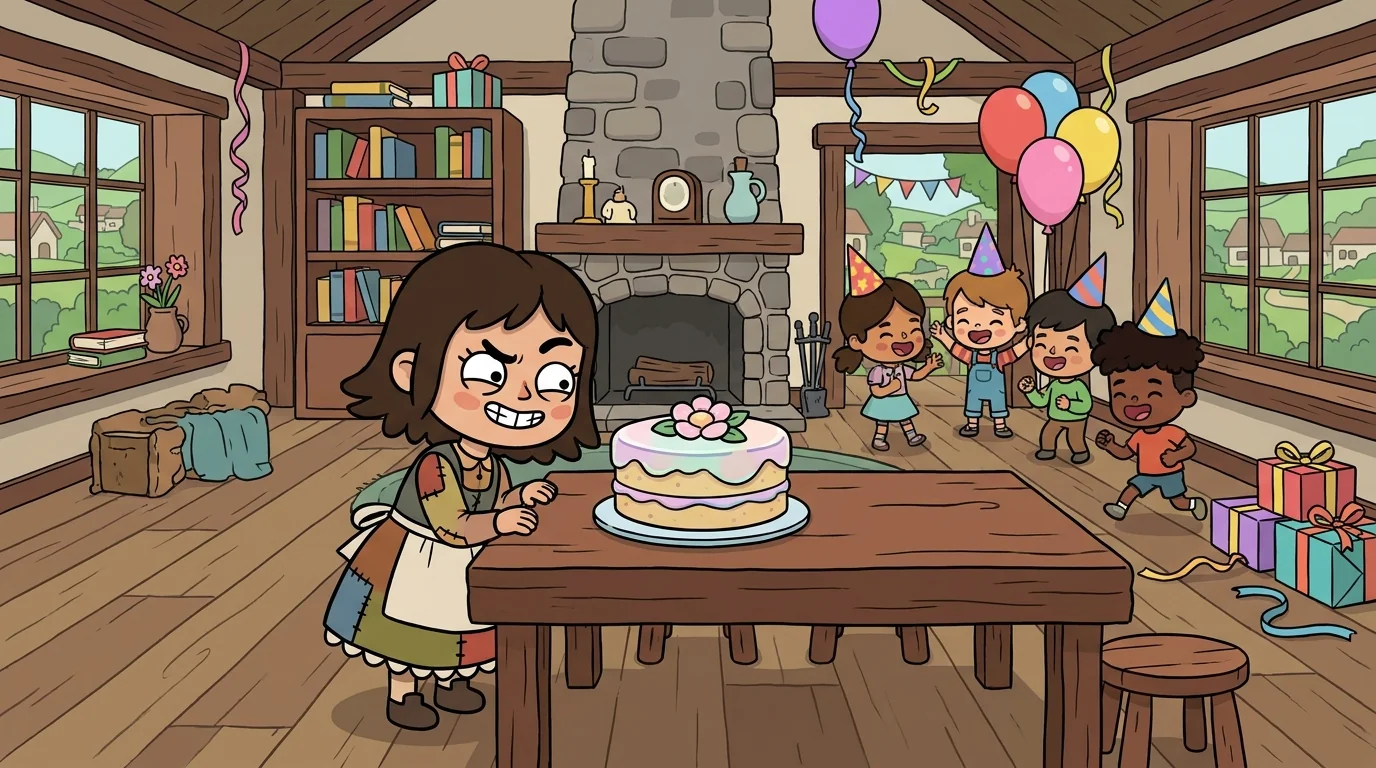
Halver the teacher was famous for being fair. But when she was a kid, she was famous for something else. She was terrible at sharing. Absolutely awful.
She tells her students this story on the first day of school. "My secret power," she says with a wink, "is that I used to be really greedy." The kids always giggle. But Halver is serious. "You have to understand a problem from the inside to really solve it."
Her real name was Posy, back then. The trouble started at her little brother's fourth birthday party. He was turning four. There were six kids crammed into their tiny cottage — her brother, three of his loud friends, Posy, and her know-it-all older cousin.
And in the center of the table sat one perfect cake.
Their village was called Fairshare, a place famous for two things: amazing bakers, and people who were good at solving arguments. The villagers said the two were connected. Posy's mom's cake was proof. Perfectly round. A secret layer of raspberry jam inside. A single sugar flower on top. It wasn't just nice. It was a masterpiece.
Posy stared at the masterpiece. She saw a huge problem. That perfect cake had to be cut up. It had to be divided.
Six hungry kids. One cake.
A fair piece was not what Posy wanted. Not at all. She wanted a giant piece. The biggest piece. She had been dreaming of this cake for two weeks. Of course, she didn't say this. She was seven, not a monster. You couldn't say you wanted the biggest slice at your own brother's party. But she thought it so loudly she was surprised the windows didn't rattle.
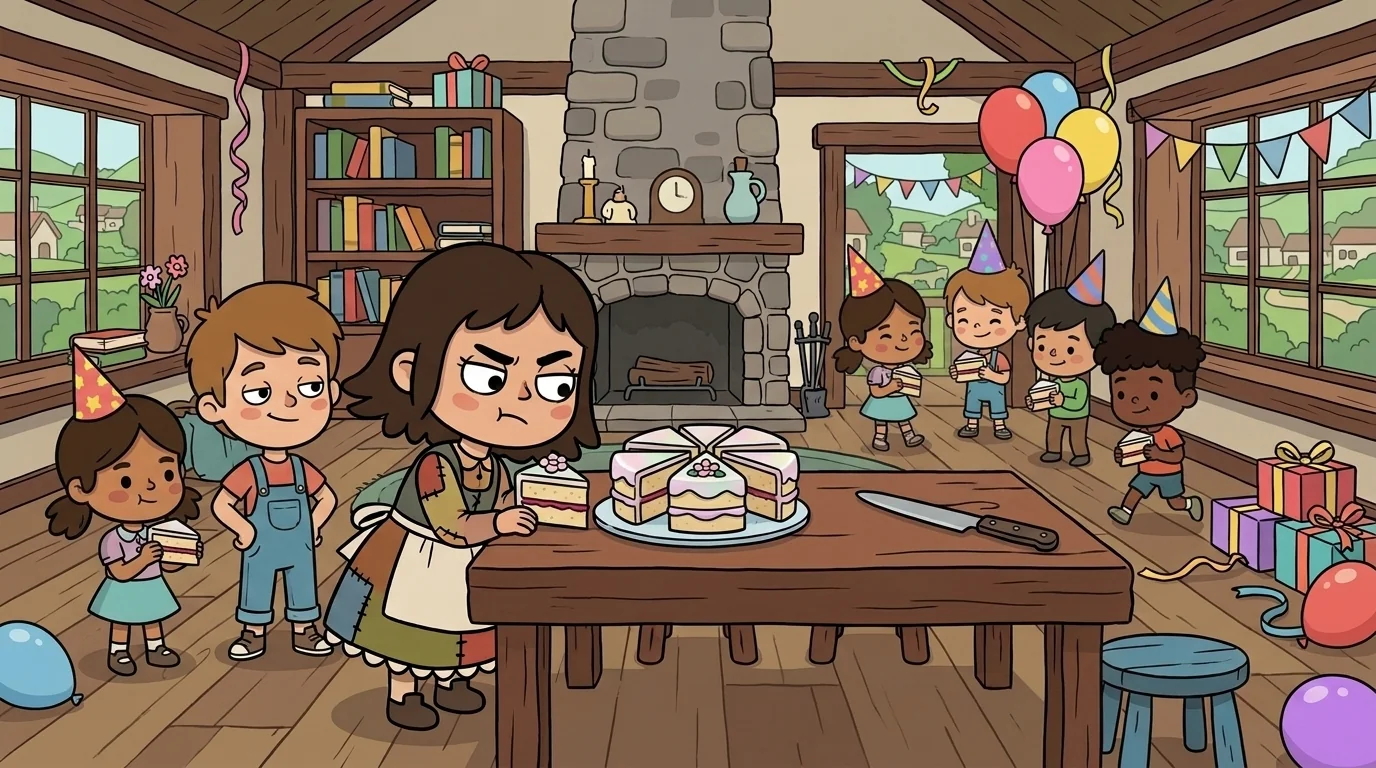
Her mother picked up the long cake knife. "Alright," she said, looking at the kids. "Six children. One cake. How should we cut it?"
Posy's cousin, who was eleven and knew everything, puffed out his chest. "Easy," he announced. "Cut it in half. Then cut each half into three smaller pieces. That makes six equal slices."
Her mother smiled. "Exactly right. Each piece will be one-sixth of the whole cake."
She traced a line down the middle with the back of the knife. Two halves. Then, in each half, two more lines. Suddenly, six perfect wedges appeared — like a star drawn inside a circle.
Her mom carefully cut along the lines. Six identical pieces of cake sat on the platter. Every single piece was the exact same size. Each wedge was one-sixth of the whole.
Posy got her slice. She examined it from all angles. It was, she had to admit, totally fair. Every other kid had a slice that looked just like hers. No one could complain. No one got cheated.
It was annoyingly perfect.
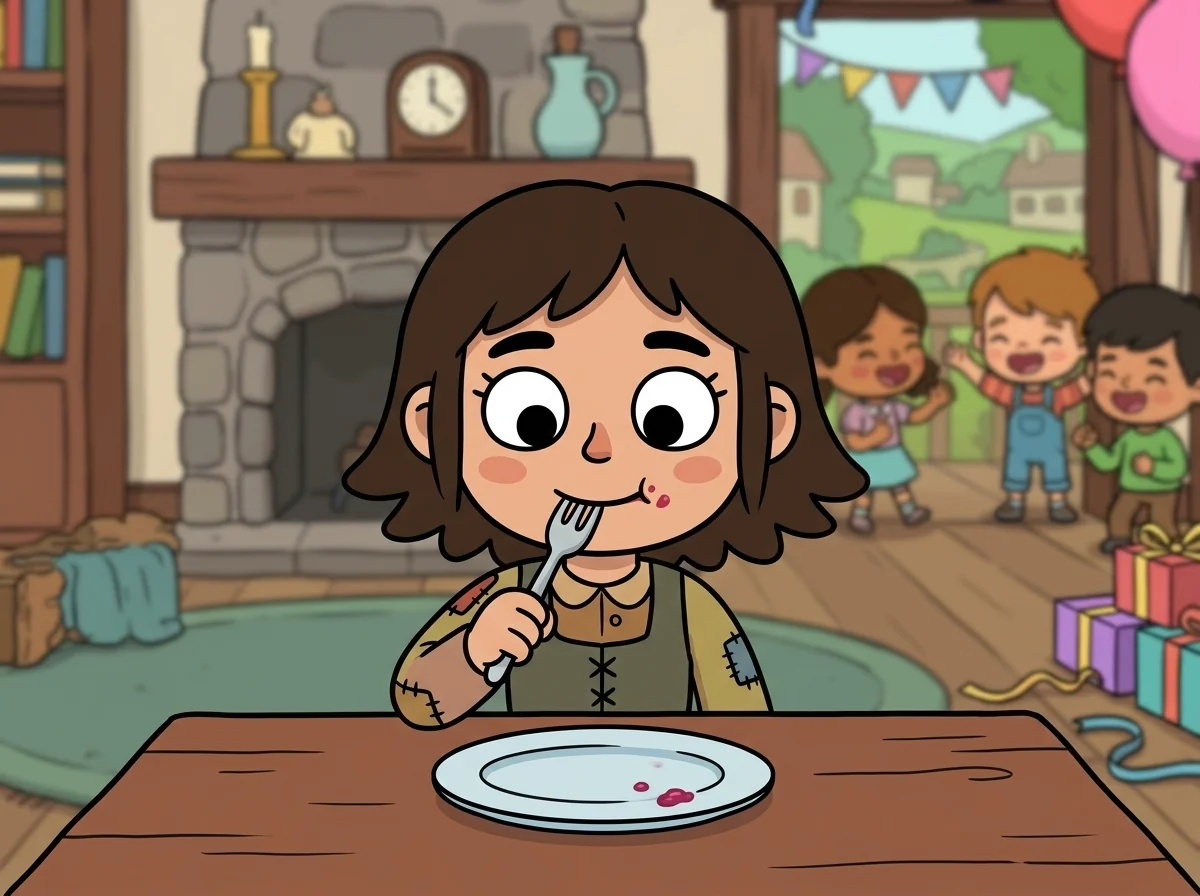
She ate her piece. The jam was sweet and tangy. It was, she calculated, exactly one-sixth as good as eating the entire cake herself.
But it was still pretty good.
She licked her fork clean and watched the empty plate go back to the kitchen. The other kids were already running outside to play. Nobody was arguing. Nobody was sad. The cake was gone, and somehow — somehow — everybody had ended up with the same thing.
Posy sat at the table for an extra minute, just thinking. She didn't have a word for what she was feeling yet. But it was warm, and it was quiet, and it was something like settled.
The idea of those six equal slices stuck in her head for years.
The memory of that cake kept popping up. She started to realize something. Fairness was a kind of math. To share something fairly, you had to partition it — a fancy word for cutting it into equal parts. The number of parts gave each piece its name. Cut something in two parts? Halves. Three parts? Thirds. Six parts? Sixths.
This was the big secret of fractions. *The denominator — the bottom number — is just a count of how many equal pieces you cut the whole thing into.*
The idea finally clicked into place when she was twelve. Her cousin had left his slate on the table, and on it was written: 1/4. Underneath, scribbled: "one-quarter — one of four equal parts."
Posy stared at the chalk marks. She thought of her brother's birthday cake. Six pieces. Each kid got one-sixth. One of six equal parts. The fraction 1/6 wasn't some scary math code. It was just the name for a slice of cake.
Fractions were just the language of sharing. The bottom number counts the total slices. The top number counts how many slices you have. Simple.
Right then, she decided what she wanted to do. She was going to teach this to everyone.
Her cousin had started calling her "Halver" as a joke. The name stuck. She liked it better than Posy anyway.
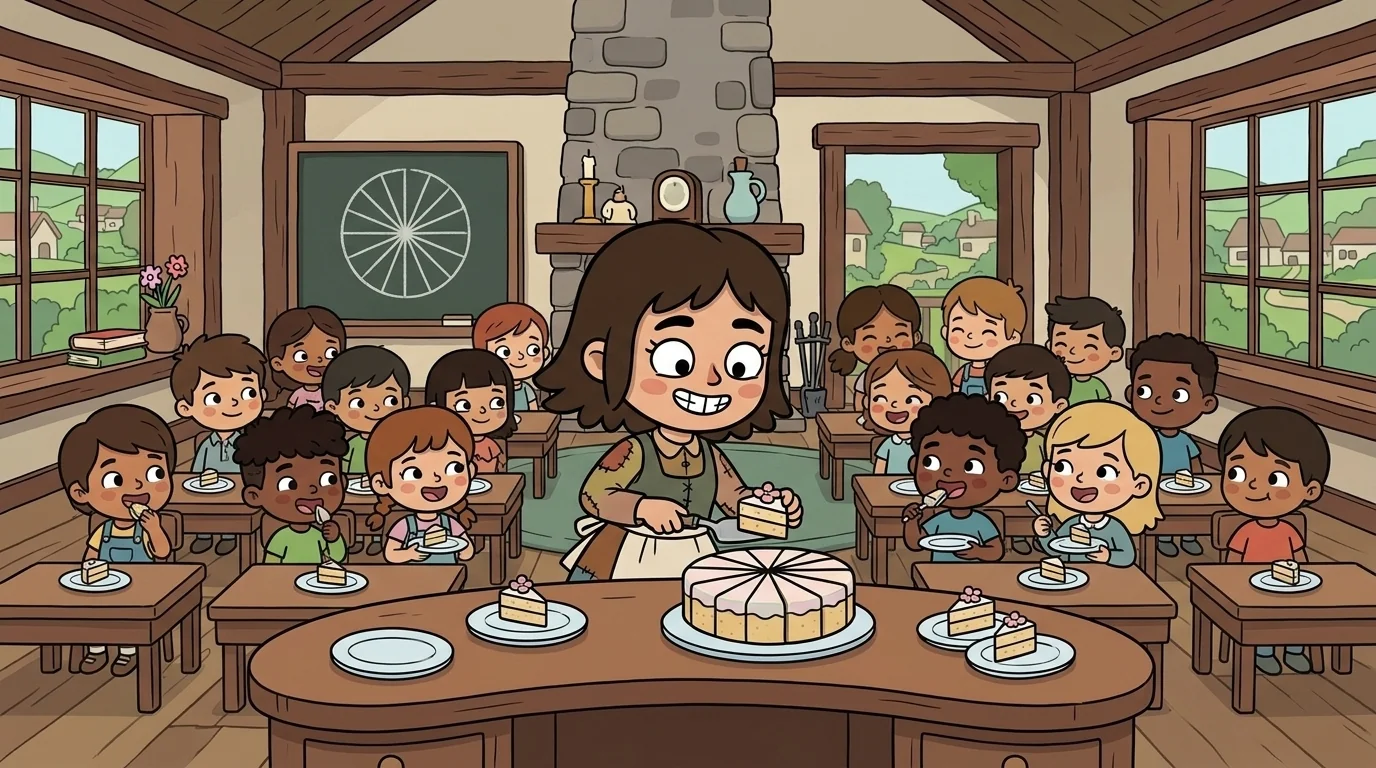
Now, every year on the first day of school, she does the same thing. She brings in a small, plain cake from the village bakery — her little brother runs it now. She places the cake on her desk. "Alright," she says to her new students. "There are twenty of you. How do we share this one cake fairly?"
And every year, the kids shout the same answer. "Cut it into twenty pieces!"
Halver nods. She cuts the cake into twenty tiny, perfect wedges. Each student gets one. Each of them has eaten one-twentieth of the cake.
"This is partitioning," Halver tells them as they eat. "The whole cake was cut into twenty equal parts. So each piece is called one-twentieth. The 20 on the bottom just tells us how many pieces we made. The 1 on top tells us you each got one. Fractions are just the language of sharing."
Whenever a student asks if fractions are hard, Halver gives the same answer.
"They aren't hard. They're just fair. Cut something into equal parts. Count how many parts. That number is the denominator. That's the whole secret."
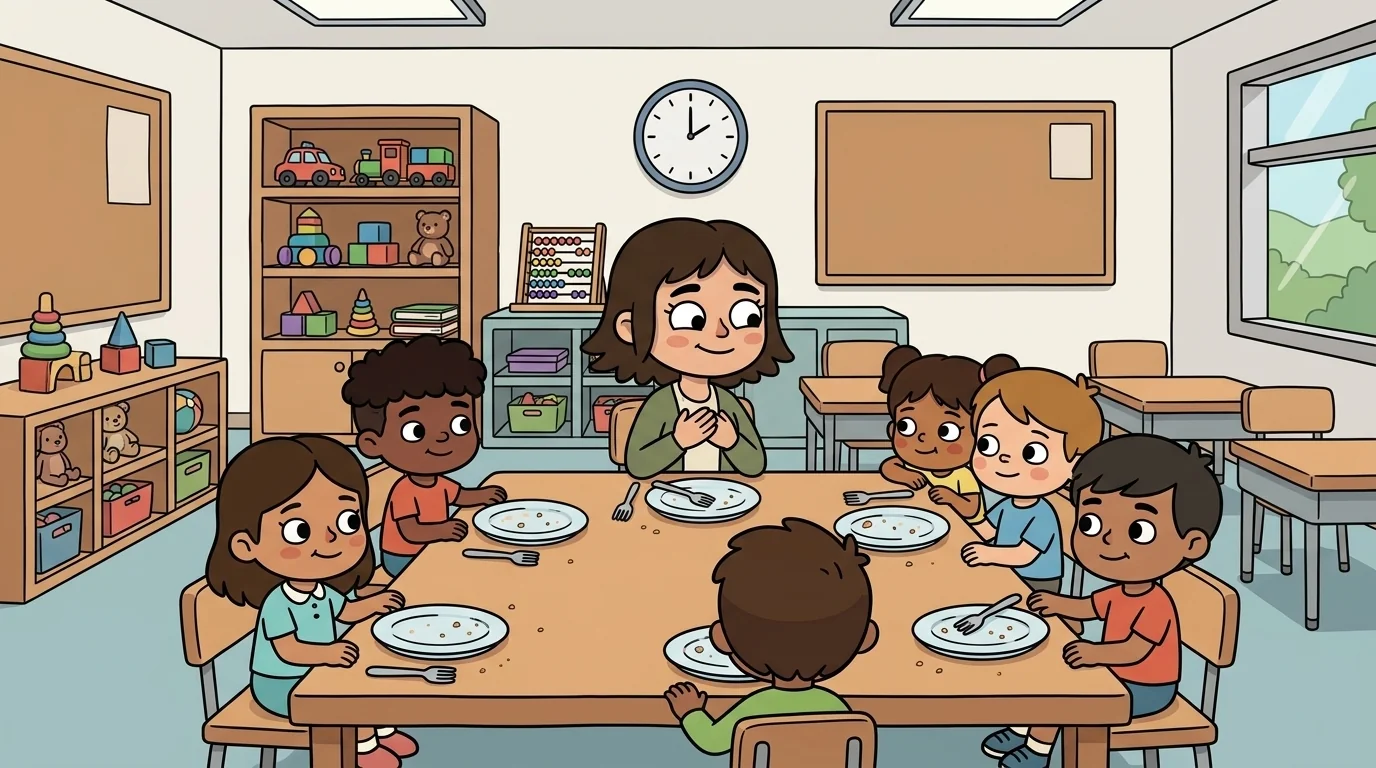
She still brings that cake every year. The children always eat it all. Halver never takes a piece. She just watches them.
And every year, when the last fork is set down and the room gets quiet for a second, she feels it again — that warm, settled feeling she felt at seven years old, sitting at the table after her brother's party. The feeling that said something just got handled the right way.
She thinks she finally has a word for it now. Fairness.
Not the kind of fairness you draw on a chalkboard. Not 1 over 20. The kind you can feel in your chest, when you look around and see that everyone got an equal slice and nobody had to fight for it.
That's the real secret she keeps coming back for. The denominator is a count. But fairness — fairness is something you feel.
That's what the math is really for.
The FractionForge ensemble
Halver is part of FractionForge's distributed-narrative cast. Each character embodies a different curricular primitive; together they teach the full subject.
-
Pie
Wholes and parts — mixed numbers, improper fractions, whole-as-pie anchor
-

Equi
Equivalent fractions — different forms, same value (×n/×n scaling)
-

Stretch
Common denominators — scaling to a common base for comparison + addition
-

Dot
The decimal point and fraction-decimal-percent equivalence
-

Liner
Number-line placement — every fraction has an exact spot between the whole numbers
-

Gather
Adding and subtracting fractions — you can only combine pieces that are the same size
-

Times
Multiplying fractions — a fraction OF a fraction, shown as the overlap of two strips
-
Tenth
Decimal place value — each column right of the point is ten times smaller
-
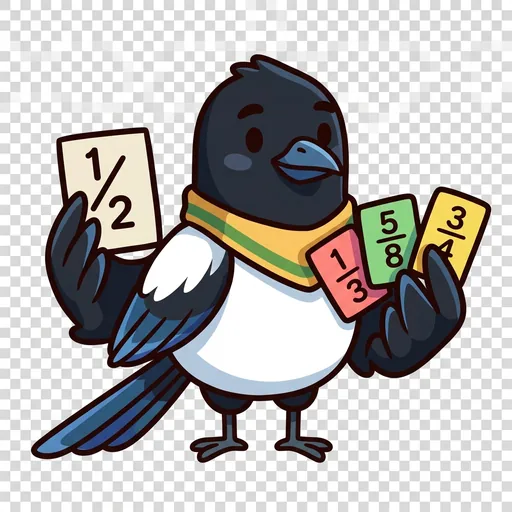
Rank
Comparing and ordering fractions using benchmarks and reasoning