
Halver
PARTITIONING — splitting a whole into equal parts. Each part is named by how many such parts make up the whole; that count is the denominator. 1/4 means "one of four equal parts."
Press play to listen along. The line being read lights up as you go.
Show full transcript
Loading transcript…
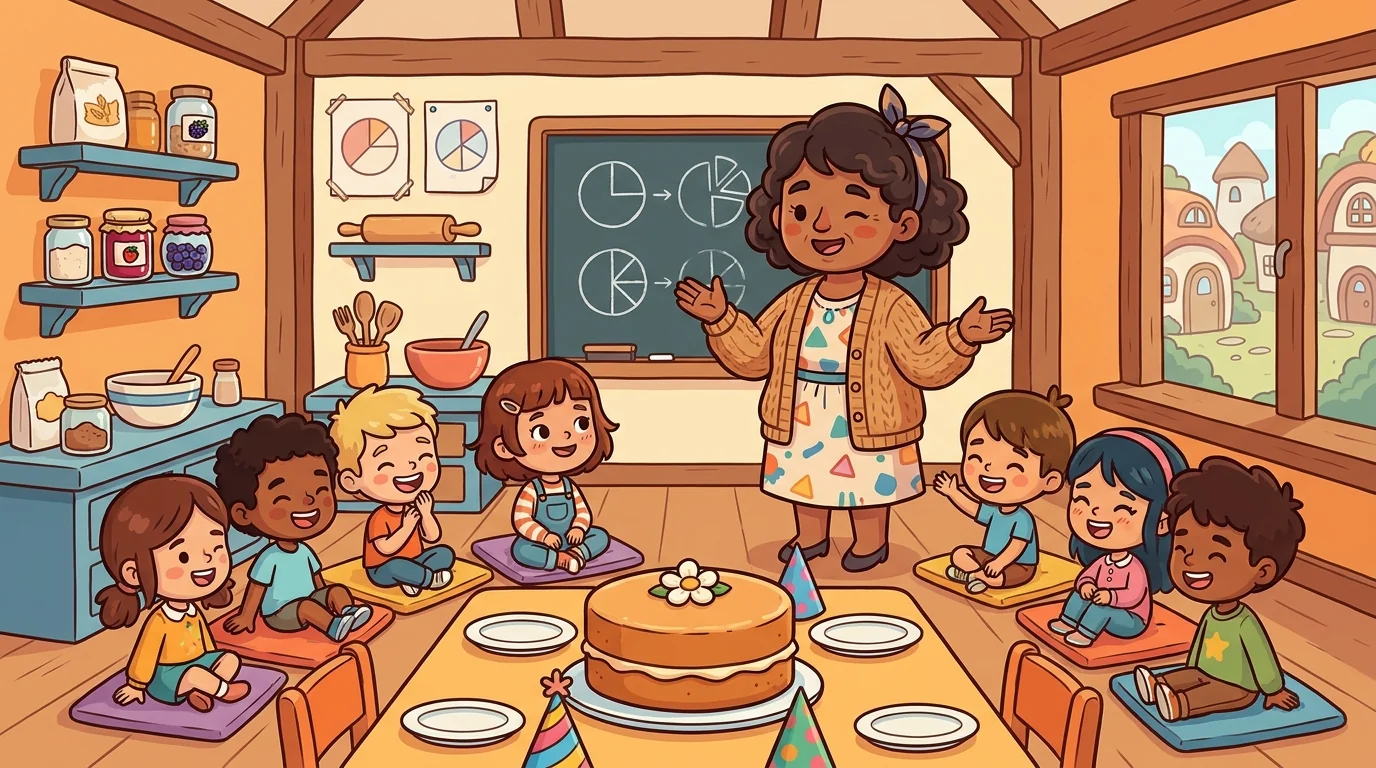
Halver, a woman whose name had not always been Halver, possessed a particular childhood trait: when she was small, she was terrible at sharing.
She often shares this detail with the children in her classroom now. She believes this early struggle with division was precisely why she eventually became a teacher of *fractions. Children, she has observed, frequently begin with a similar reluctance to share. They, she understands, comprehend the problem from the inside.*
When Halver—then known by her given name, Posy, a name she shed for Halver at the age of eleven—was seven, her younger brother celebrated his fourth birthday. Six children attended the party: the birthday boy, his three small friends, Posy herself, and Posy’s older cousin.
There was one cake.
Posy’s mother had baked the cake in the cozy kitchen of their cottage, nestled in the village of Fairshare. Fairshare, a real place within the kingdom, was renowned for two distinct qualities: its exceptional bakers and its long-standing tradition of mediation. Locals often claimed the two were deeply connected, though the precise nature of that connection rarely received a full explanation. The cake itself was perfectly round, featuring a sweet layer of jam in its middle and a delicate frosting flower perched on top. By the modest standards of village birthday cakes, it was quite lovely.
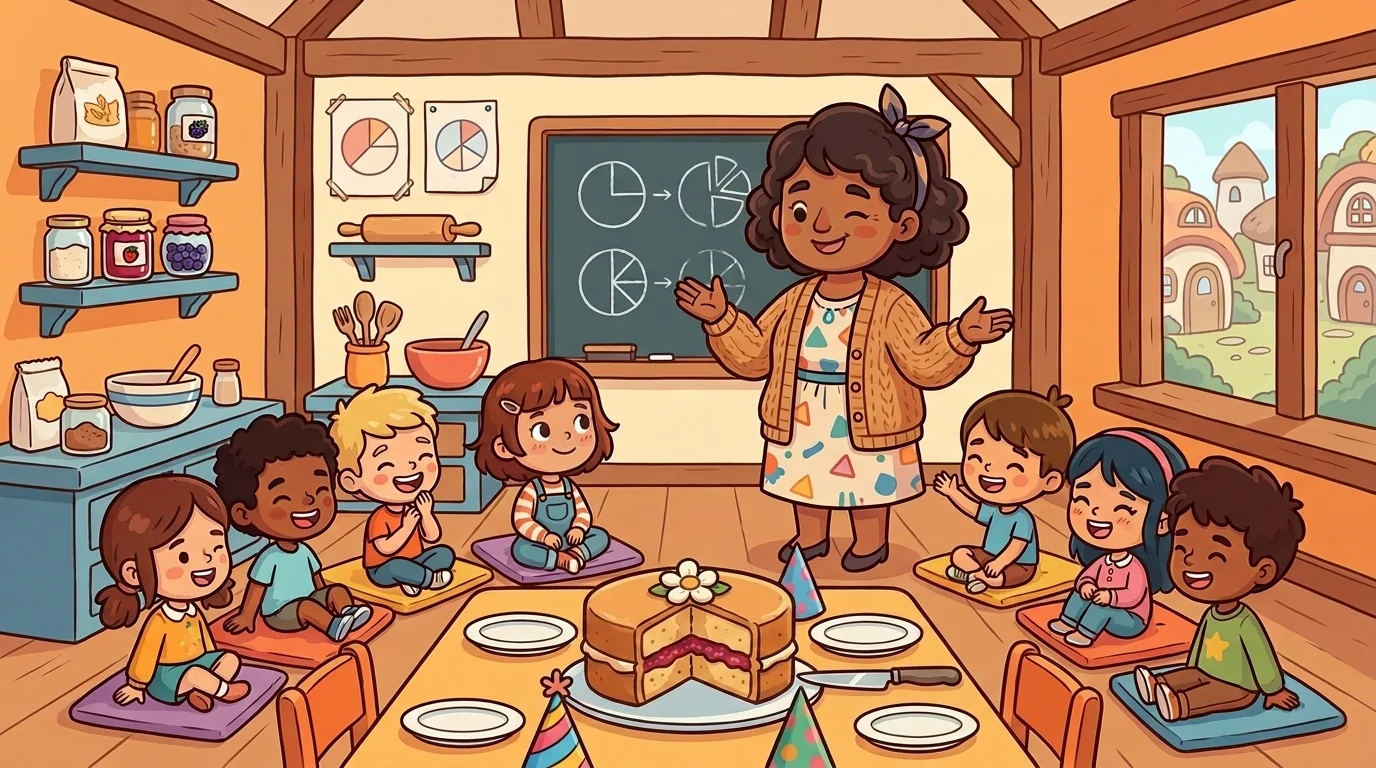
As her mother carefully placed the cake on the table, Posy immediately grasped the impending challenge: the cake had to be divided.
Six children. One cake. The task was clear: the cake required cutting so that each child received a fair piece.
Posy, however, harbored no desire for a mere fair piece. She wanted a large piece. For two weeks, ever since her mother had first mentioned the baking project, Posy had dreamt of this cake. She knew, even at seven, that voicing a demand for a large slice at someone else’s birthday celebration was strictly forbidden. Yet, the thought echoed loudly within her mind, a persistent, silent clamor for more.
Her mother, a woman of calm demeanor and steady hands, picked up the polished cake-knife. Her gaze swept over the eager faces gathered around the table. "Six children," she announced, her voice even. "One cake. How, exactly, do we cut it?"
Posy’s older cousin, who was eleven and already attending the village school, offered a solution with the confidence of a scholar. "You cut it in half first," he suggested, his tone slightly formal. "Then, you cut each of those halves into three. That way, everyone gets six equal pieces."
Her mother nodded slowly, a small smile gracing her lips. "That is precisely correct," she affirmed. "Each piece will represent one-sixth of the entire cake."
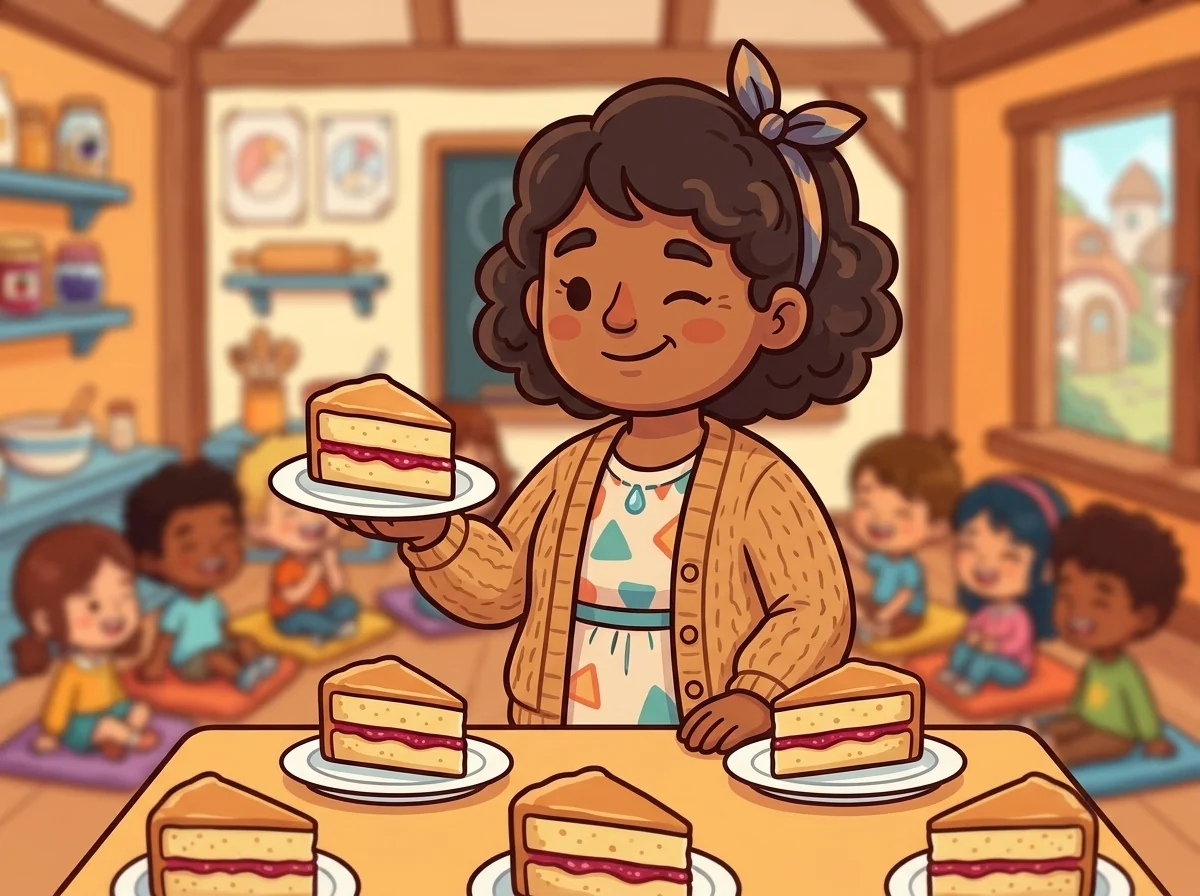
With the dull back of the knife, she traced a clean, vertical line across the cake’s frosted surface, dividing it into two symmetrical halves. Then, with practiced precision, she drew two more lines across each half, creating three segments within each section. Six pieces now defined the cake’s circumference. The lines, once completed, formed a pattern resembling a six-pointed star delicately etched into the circular dessert.
Her mother then began to cut, following the marked lines with unwavering care. Six distinct pieces emerged, each a perfect wedge. Posy watched, fascinated, as the knife sliced through the jam layer, revealing its vibrant ruby hue. Each piece, she observed, was exactly the same size. Each was a perfect, identical wedge, representing one-sixth of the whole cake.
When her turn came, Posy received her piece. She had to concede, albeit reluctantly, that the slice was undeniably fair. Every other child, from the tiny birthday boy to her older, more knowledgeable cousin, received an identical portion. There was no room for complaint, no justification for feeling cheated.
Posy ate her piece. It was delicious, a perfect blend of sweet jam and soft cake. (She noted, with a careful, almost mathematical precision, that it was one-sixth as good as the whole cake would have been if she had been the only child at the party. Still, it was good enough.) She savored every bite, finishing it slowly. She watched the other children, their faces smeared with frosting, devour their own slices. Finally, her mother set the empty plate back on the table, a testament to the cake’s swift disappearance.
Posy thought about that cake for the remainder of the day, and for many days that followed.
Over the subsequent years, slowly, in the way children gradually absorb the profound truths embedded in their everyday experiences, she began to understand. Fairness, she realized, was not just a feeling; it was a kind of arithmetic. To divide something fairly, you had to partition it. *Partitioning, she came to see, meant meticulously cutting a whole into equal parts. The number of parts you created became a specific name for the division’s fairness. Two parts? Each was a half. Three parts? Each became a third. Six parts, like the birthday cake? Each was a sixth*.
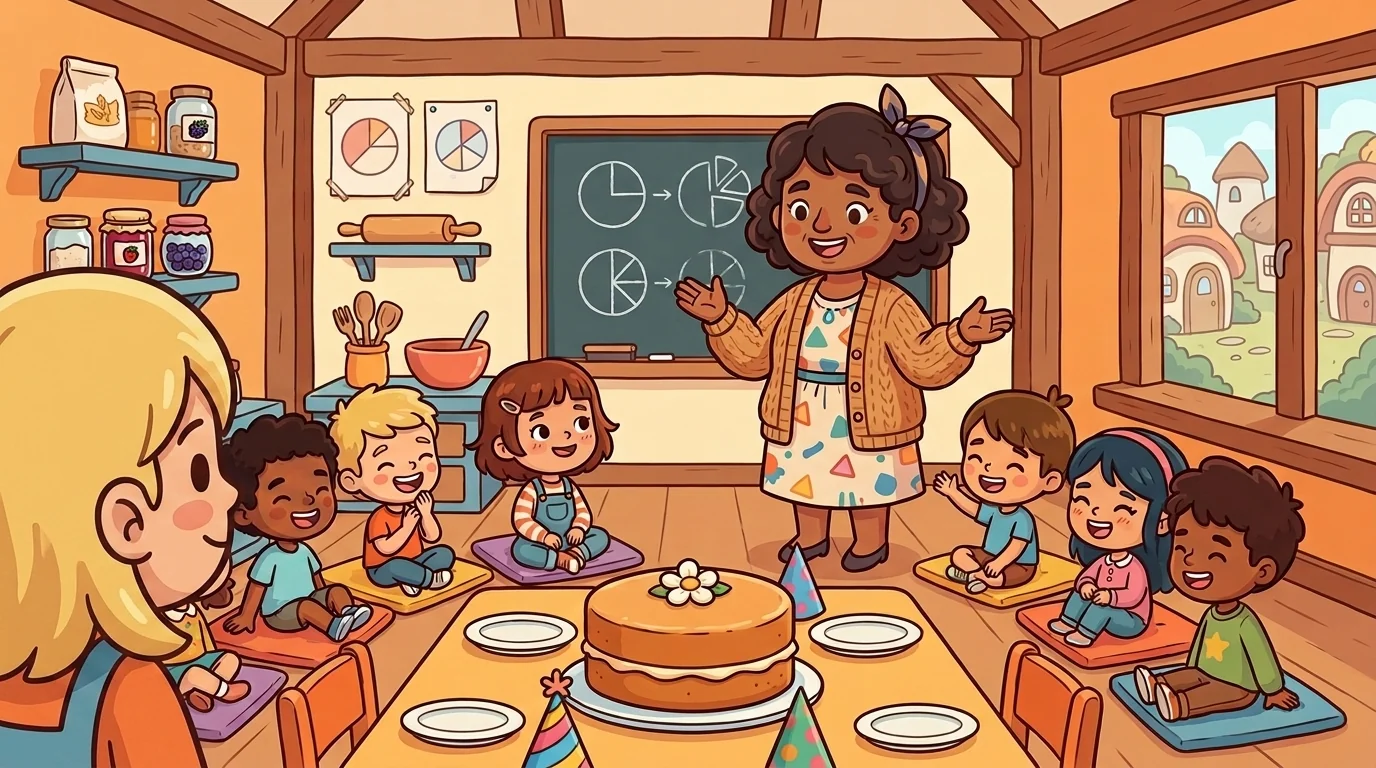
This fundamental principle, she later understood, formed the very bedrock of fractions. The *denominator* of a fraction, she learned, represented the exact count of equal parts into which the whole had been divided.
At the age of twelve, Posy encountered a moment that solidified this nascent understanding. Her older cousin, home for a holiday, had left his school slate lying on a table. Etched onto its surface was the notation: 1/4. Beneath it, her cousin had neatly written: "one-quarter — one of four equal parts."
Posy stared at the slate, a sudden jolt of recognition sparking through her. She immediately conjured the image of her brother’s birthday cake. The cake had been cut into six pieces. Each child had received one-sixth. One of six equal parts. The written notation, 1/6, was simply the name for the portion they had eaten. It was a label, a concise way to describe a fair share.
To Posy, this was an extraordinary revelation, a sudden opening of a door onto a new way of seeing the world. Fractions, she understood with a rush of excitement, were the precise language of *partitioning*. The number beneath the line, the denominator, counted the total number of equal parts. The number above, the numerator, counted how many of those parts you possessed.
That, Posy decided then and there, was exactly what she was going to teach.
She began calling herself Halver, a playful nickname her cousin had coined after the cake story spread through the family. The name stuck. From sixteen to nineteen, she rigorously studied at the esteemed FractionForge academy. At twenty, she joined its faculty. She has been teaching the principles of *partitioning* ever since.
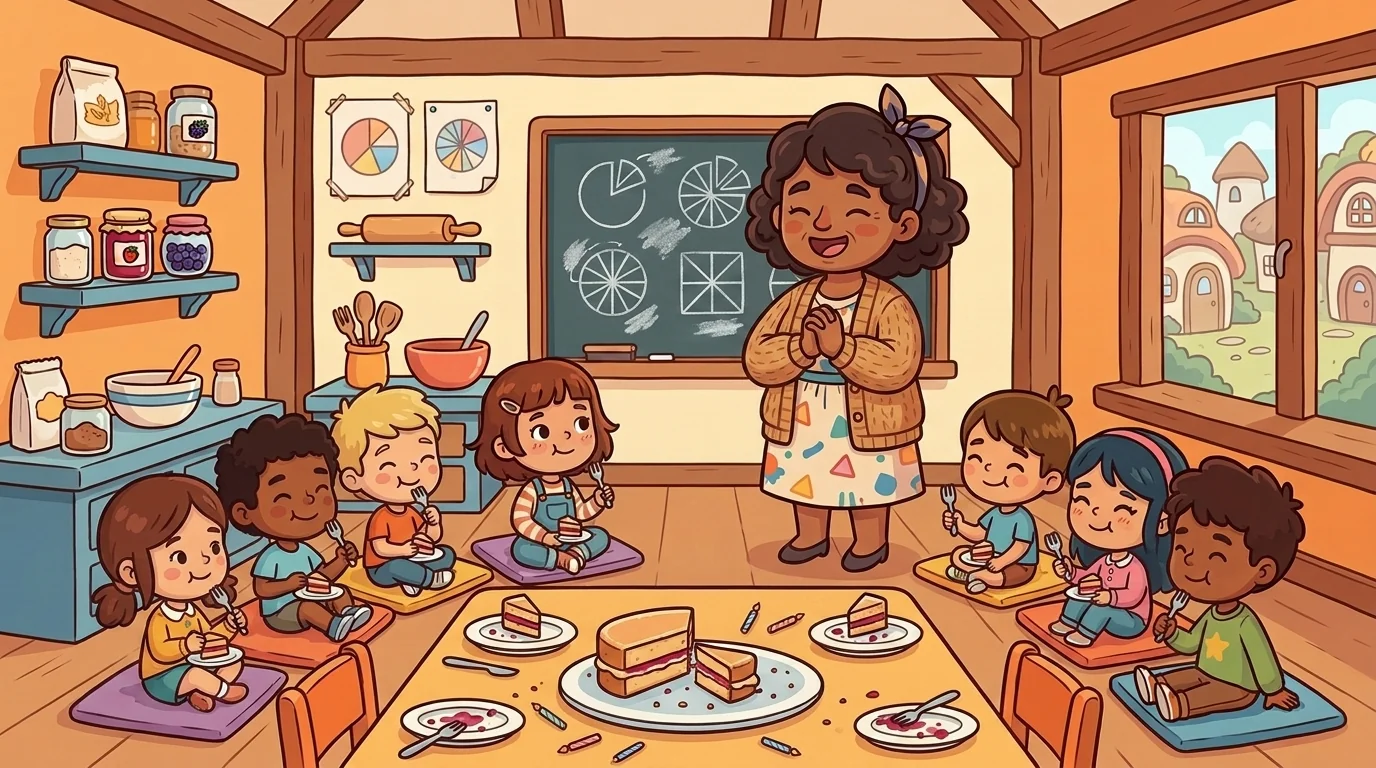
In her classroom, Halver commences every first-day lesson with the same ritual. She brings a small, perfectly round cake from the village bakery—which, incidentally, is her mother’s bakery, now managed by her younger brother, the very one whose fourth birthday had started everything. The cake is plain, unadorned, and clearly intended for cutting. She places it gently on her desk and addresses her new students. "There are twenty of you in this room," she states, her voice calm and clear. "How do we share this cake fairly?"
The children, without fail, respond in unison: "Cut it into twenty pieces!"
Halver nods, a knowing smile playing on her lips. She proceeds to cut the cake, dividing it into twenty small, precise pieces. Each child receives a slice. Each child, she explains, has eaten one-twentieth of the cake. "This," Halver declares, gesturing to the now-divided cake, "is *partitioning. The cake was the whole. We cut it into twenty equal parts. Each piece is one-twentieth. The 20 at the bottom of the fraction is the count of parts we cut the whole into. The 1 at the top is the number of parts* each of you got. Fractions are, quite simply, the language of fair-sharing."
When children inevitably ask if fractions are difficult, Halver always offers the same reassuring reply:
"They are not hard at all. They are partitions. You cut the whole into equal parts. You count those parts. That count becomes the denominator. The pieces you take are the numerator. Understanding that is everything you need to know about reading a fraction."
She continues to bake a small cake at the beginning of every academic year. The children eagerly consume it. Halver, however, never takes a piece for herself. She watches them, twenty years later, with the same patient, observant look her mother once gave her.
The FractionForge ensemble
Halver is part of FractionForge's distributed-narrative cast. Each character embodies a different curricular primitive; together they teach the full subject.
-
Pie
Wholes and parts — mixed numbers, improper fractions, whole-as-pie anchor
-

Equi
Equivalent fractions — different forms, same value (×n/×n scaling)
-

Stretch
Common denominators — scaling to a common base for comparison + addition
-

Dot
The decimal point and fraction-decimal-percent equivalence
-

Liner
Number-line placement — every fraction has an exact spot between the whole numbers
-

Gather
Adding and subtracting fractions — you can only combine pieces that are the same size
-

Times
Multiplying fractions — a fraction OF a fraction, shown as the overlap of two strips
-

Tenth
Decimal place value — each column right of the point is ten times smaller
-
Rank
Comparing and ordering fractions using benchmarks and reasoning