
Equi
EQUIVALENT FRACTIONS — different forms, same value. Multiply (or divide) numerator and denominator by the same number; the fraction is equivalent. 2/3 = 4/6 = 6/9 = 8/12.
Press play to listen along. The line being read lights up as you go.
Show full transcript
Loading transcript…
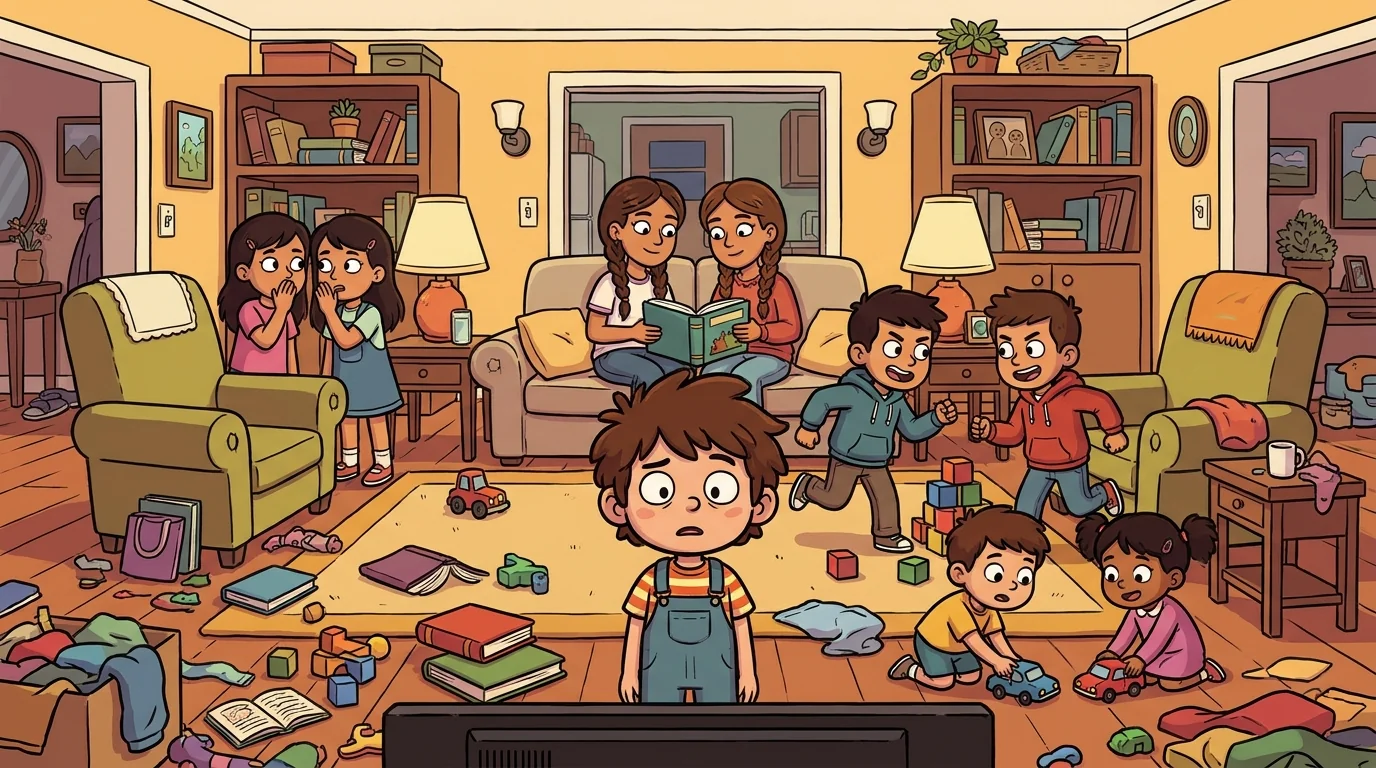
Growing up, my house was a mirror maze. But the mirrors weren't made of glass. They were made of people. Everywhere I looked, I saw a copy of someone else. That's because I lived with three sets of identical twin sisters. And I was a twin, too. That made four pairs of us, all under one roof.
My parents definitely didn't plan it. It just… happened. Then it happened again. And again. Our family doctor would shrug and grin. He called us "a statistical anomaly we will simply enjoy." My dad had a different name for it. He called us his "buy-one-get-one-free deal, times four."
Life at home was loud and unbelievably crowded. Getting a turn in the bathroom was like winning the lottery. But the weirdest part was that everyone always had a partner.
Mom had a naming system. She wanted each pair to sound like a team. The names had to be similar, but not the same.
First came Forta and Forga, the oldest. They were eight years ahead of me. Then came Vena and Verra, who were six years older and always whispering secrets. After them, Posi and Poso, four years older and masters of pranks.
Finally, there was us. Equa and me, Equi. I was born ninety seconds after her, which she never let me forget. We were the youngest. The fourth and final set.
My twin, Equa, was my living, breathing mirror. We had the same messy brown hair that refused to lie flat. Same crooked smile, especially when we were about to cause trouble. We practiced signing our names until they looked identical. But we weren't exactly the same person.
If you put a plate of fruit between us, she'd snatch the apple. I'd always go for the pear.
We were one pair of twins. But we were two different people. Same value. Different names.
I didn't know that idea had a name yet. Not until I was nine years old.

One rainy Tuesday, my teacher, Mrs. Gable, turned to the chalkboard. The chalk screeched with every number. She wrote a long line that made my brain hurt.
1/2 = 2/4 = 3/6 = 4/8
"These four fractions look different," she said, tapping the board. "But they are all the same value. They are *equivalent*."
A confused silence fell over the room. I could see kids squinting and tilting their heads like puppies. My friend Leo was counting on his fingers. It didn't make any sense. How could 1/2 be the same thing as 4/8? They were built from totally different numbers.
But I wasn't looking at the numbers on the board. I was picturing my sisters.
Forta and Forga. Vena and Verra. Posi and Poso. Equa and me.
Suddenly, it clicked. My hand shot into the air.
Mrs. Gable looked surprised. My hand didn't usually shoot up during math. "Yes, Equi?"
"They're like my sisters," I blurted out.
She blinked. "Like your sisters?"
The whole class swiveled around to stare at me. I took a deep breath. "I have four sets of twins in my family," I explained. "Each pair has two different names, right? But the twin-pair itself is the same. They're… *equivalent." I pointed at the board. "Fractions are just like that. The numbers on top and bottom change, like the names change. But the real amount* you have is still the same."
Mrs. Gable stared at me for a long moment. She had taught math for fifteen years. She had never heard anyone explain it that way before.
Then she nodded slowly. A huge smile spread across her face. "That is exactly right," she said. "*Equivalent fractions* are the same value. They just have different names. Just like your twins."
That night at dinner, I told everyone what happened. The table exploded.
"So we're a math problem now?" Forta asked. She was seventeen and way too cool for everything. She nudged her twin, Forga. "I guess that makes us 1/2."
"We're 2/4!" shouted Vena, who was fifteen.
"And we're 3/6!" yelled Posi, who was thirteen.
Equa and I looked at each other and grinned. "We're 4/8!" we shouted together.
Mom turned from the stove, holding a wooden spoon. "You are children," she said, pointing the spoon at the eight of us. "You are not fractions. Now please set the table."
But the joke stuck. From that day on, we were the Fraction Family.
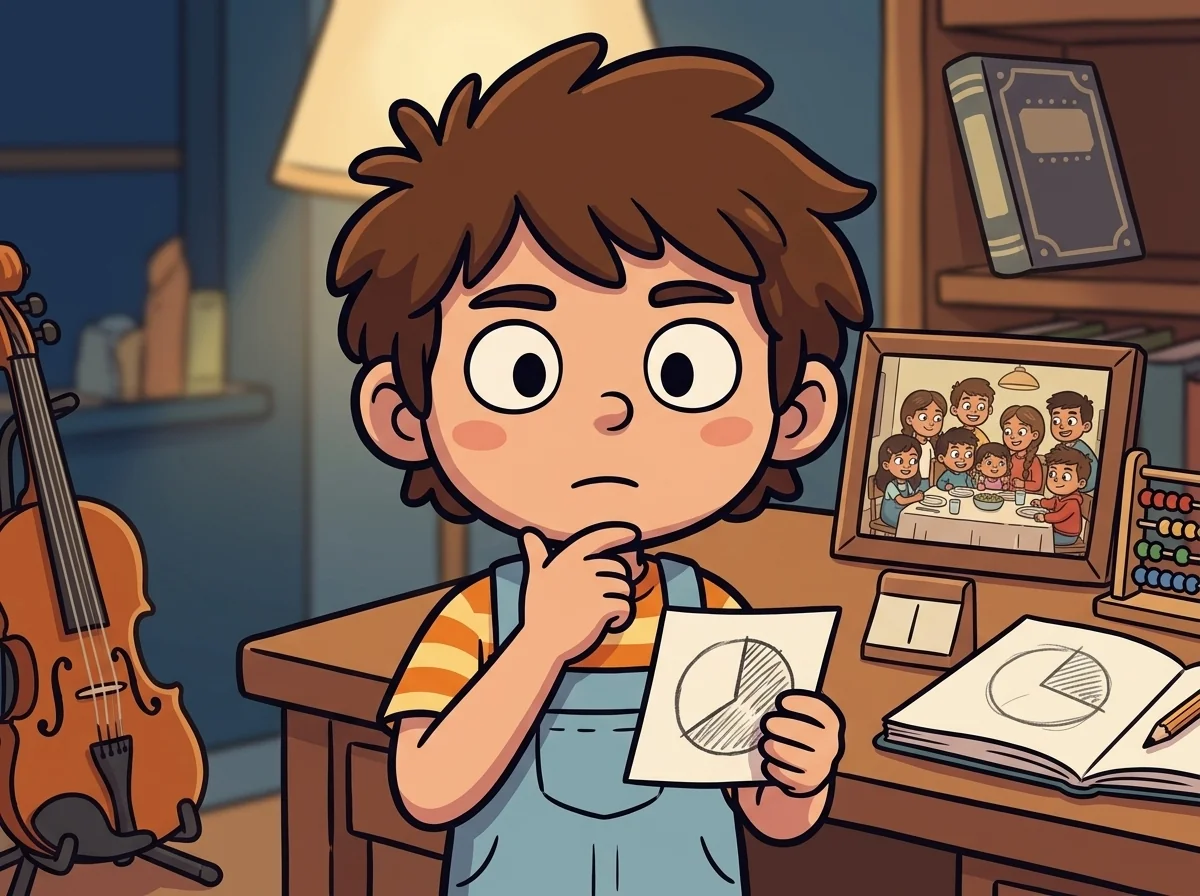
Years later, I went to the FractionForge academy to become a teacher. My sister Equa went to a different school to study music. We were still a matched pair — still equivalent — but following our own paths. She'd practice her violin late into the night. I'd be at my desk drawing pie-slice diagrams. The fractions were different now. The amount underneath was still the same.
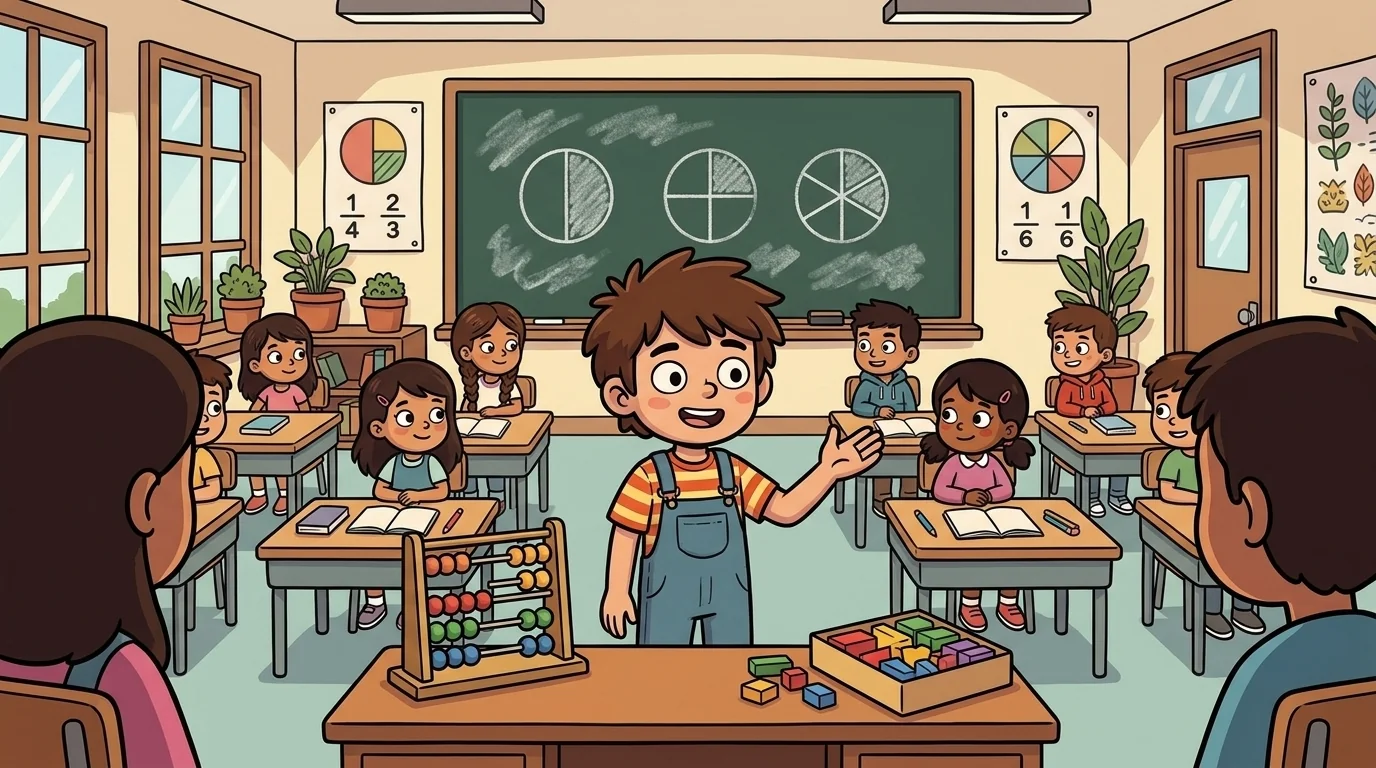
Now, I'm the teacher. I stand at the front of the room. I write the same thing on the board that Mrs. Gable did.
1/2 = 2/4 = 3/6 = 4/8 = 5/10
"These all look different," I tell my class. "But they're all the same amount. How can that be?"
I see them squinting, just like my class did. Then I tell them about my family. I tell them about the house with four sets of twins.
"Fractions can be like that," I say. "They can have different names, like 2/4 or 4/8. But underneath, they are really the same amount. They are *equivalent*."
Sooner or later, a hand goes up. "So how do you make one?" a student will ask.
"Easy," I say. "You give it a new name. Pick a number. Any number except zero. Now multiply the top and the bottom of your fraction by that same number. Your fraction looks different. But it's still the same amount underneath. It's *equivalent*."
I see them scribbling. They multiply 2/3 by 2/2 and get 4/6. Then they reach for their calculators to check. A little gasp goes through the room. The decimals are exactly the same. It really works.
The gasp is my favourite part. It's the same sound I made, at nine years old, sitting in Mrs. Gable's classroom while I thought about my sisters.
The best day of the year is when my sisters visit my class. All seven of them troop into the room. The kids' jaws practically hit their desks. They see Forta and Forga, who look like grown-up versions of each other. They see Vena and Verra, who still finish each other's sentences. They see Posi and Poso, who immediately start a thumb war in the back. And they see Equa, standing right beside me, with her crooked smile that's just like mine.
That's when they really get it. Not the definition — the feeling. The recognition. They look at the four pairs in front of them and something settles in their faces. Two different names. Same person inside. Two different fractions. Same amount underneath.
I love that look. It's the look I felt on my own face when I was nine.
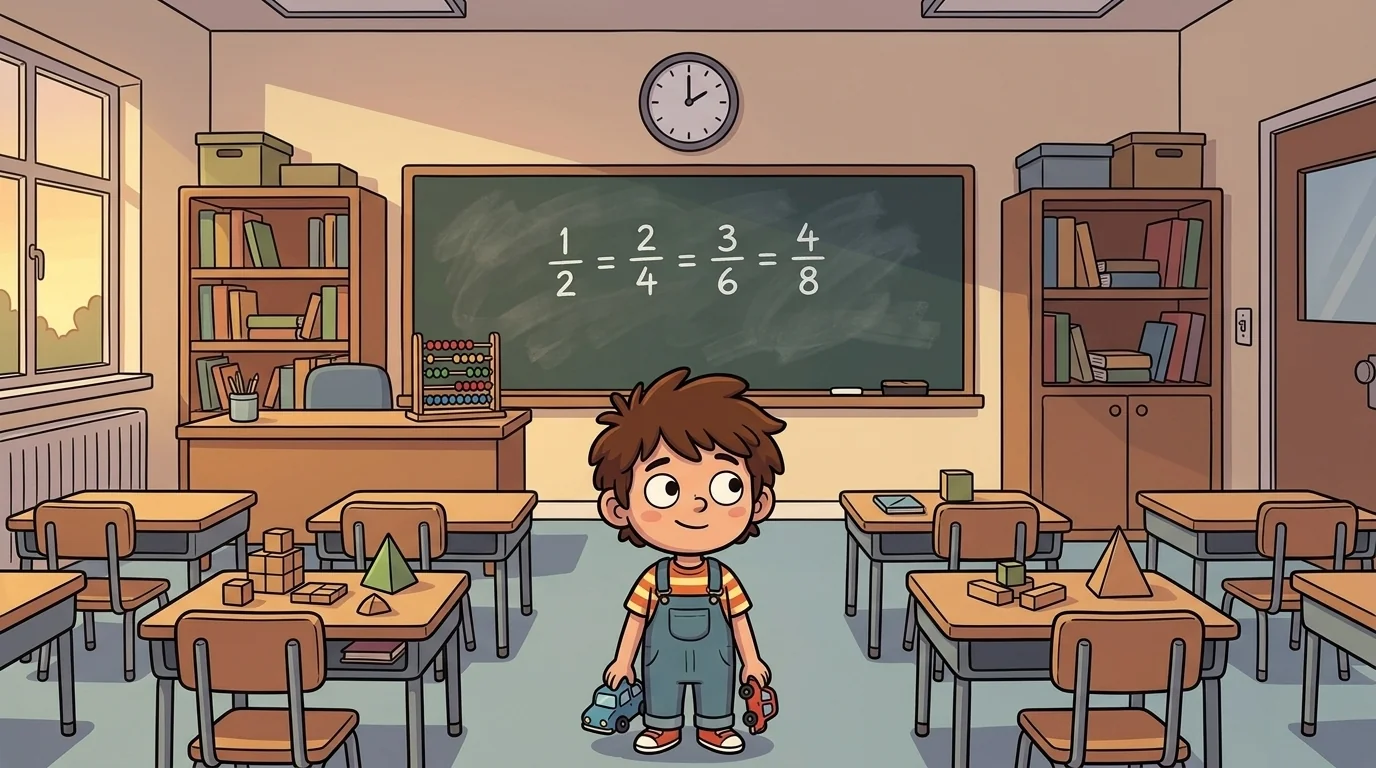
After the lesson, when my sisters have left and the kids have gone home, I stay behind for a minute. I look at the four-pair line still on the board. 1/2 = 2/4 = 3/6 = 4/8. Equa's already texting me from the train — did they like us? did you cry? — you cry every year, you know.
I read her message and smile.
Equivalence, I think, is not really about numbers. It's about that warm, quiet feeling you get when something looks completely different on the outside and yet you know, with your whole self, that it is the same thing underneath. You can teach the rule. You can show the math. But the rule lands when the recognition lands — when a kid looks at two different-looking things and finally feels, in the soft place behind the ribs, those are the same.
That feeling is the lesson. The numbers are just how I learned to point at it.
I close my notebook. I turn off the lights. And I head home to text my twin back.
The FractionForge ensemble
Equi is part of FractionForge's distributed-narrative cast. Each character embodies a different curricular primitive; together they teach the full subject.
-

Halver
Partitioning — splitting a whole into equal parts (denominator construction)
-

Pie
Wholes and parts — mixed numbers, improper fractions, whole-as-pie anchor
-

Stretch
Common denominators — scaling to a common base for comparison + addition
-

Dot
The decimal point and fraction-decimal-percent equivalence
-
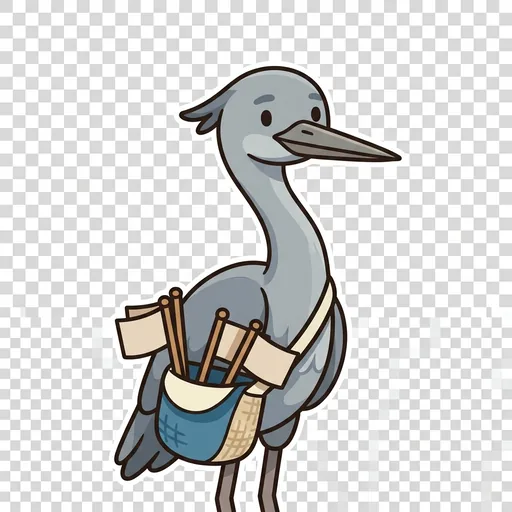
Liner
Number-line placement — every fraction has an exact spot between the whole numbers
-

Gather
Adding and subtracting fractions — you can only combine pieces that are the same size
-

Times
Multiplying fractions — a fraction OF a fraction, shown as the overlap of two strips
-

Tenth
Decimal place value — each column right of the point is ten times smaller
-
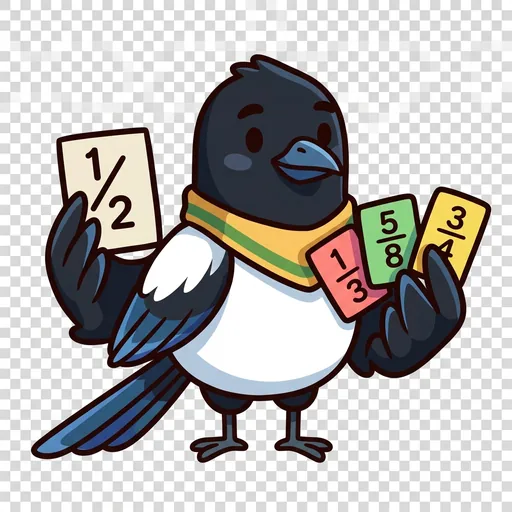
Rank
Comparing and ordering fractions using benchmarks and reasoning