Span
DEEP-TIME + GEOLOGICAL CHRONOLOGY — *scale-of-scales* (WHEN did this organism live?). The paleontology primitive of *holding the scale of Earth's history* — 4.5 billion years for the planet, 540 million for complex life, 66 million since dinosaurs.
Press play to listen along. The line being read lights up as you go.
Show full transcript
Loading transcript…
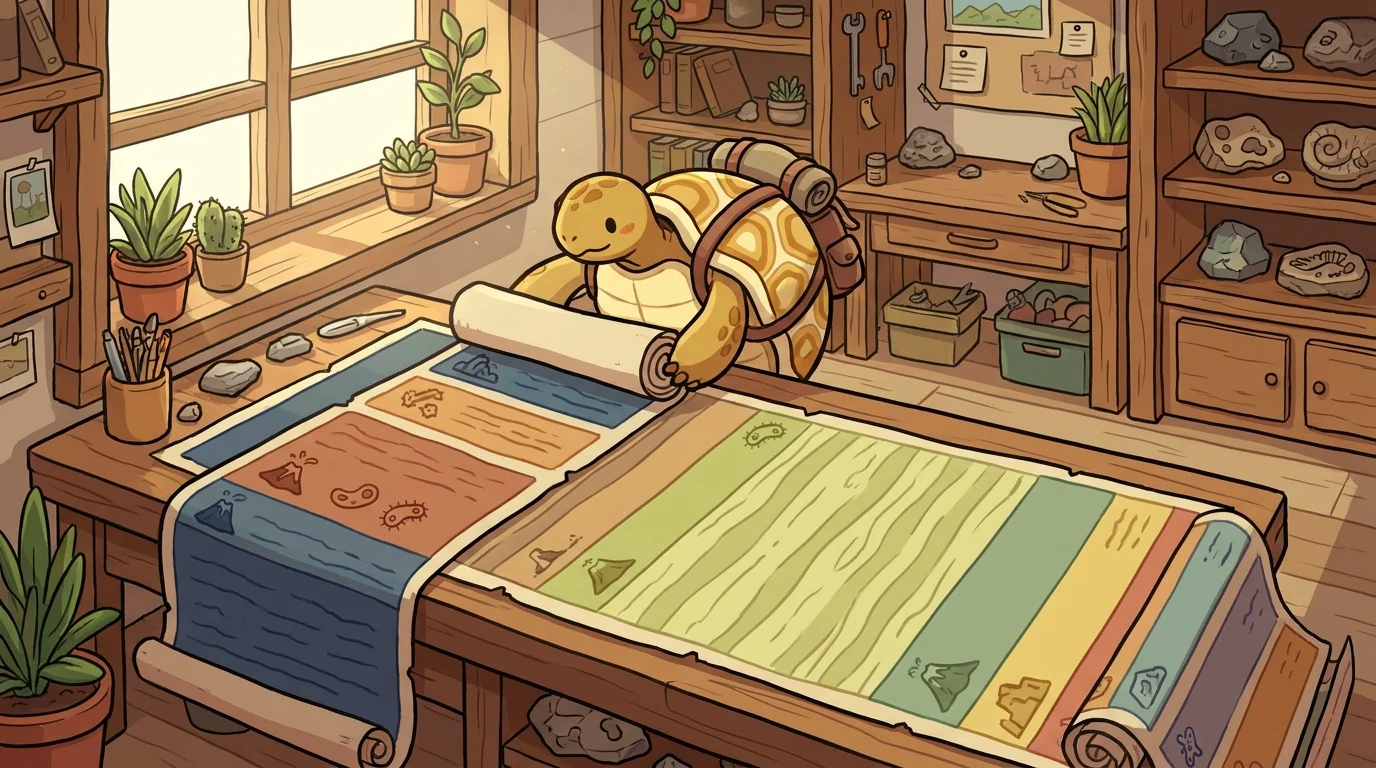
Span was a tortoise. Not just any tortoise, but a tween tortoise. She moved slowly, always. Her shell was warm gold and cream. It looked like a chunky cartoon drawing. Thick, rounded plates covered her back. Her eyes were patient. She carried a small pack on her shell. Inside was her deep-time ruler.
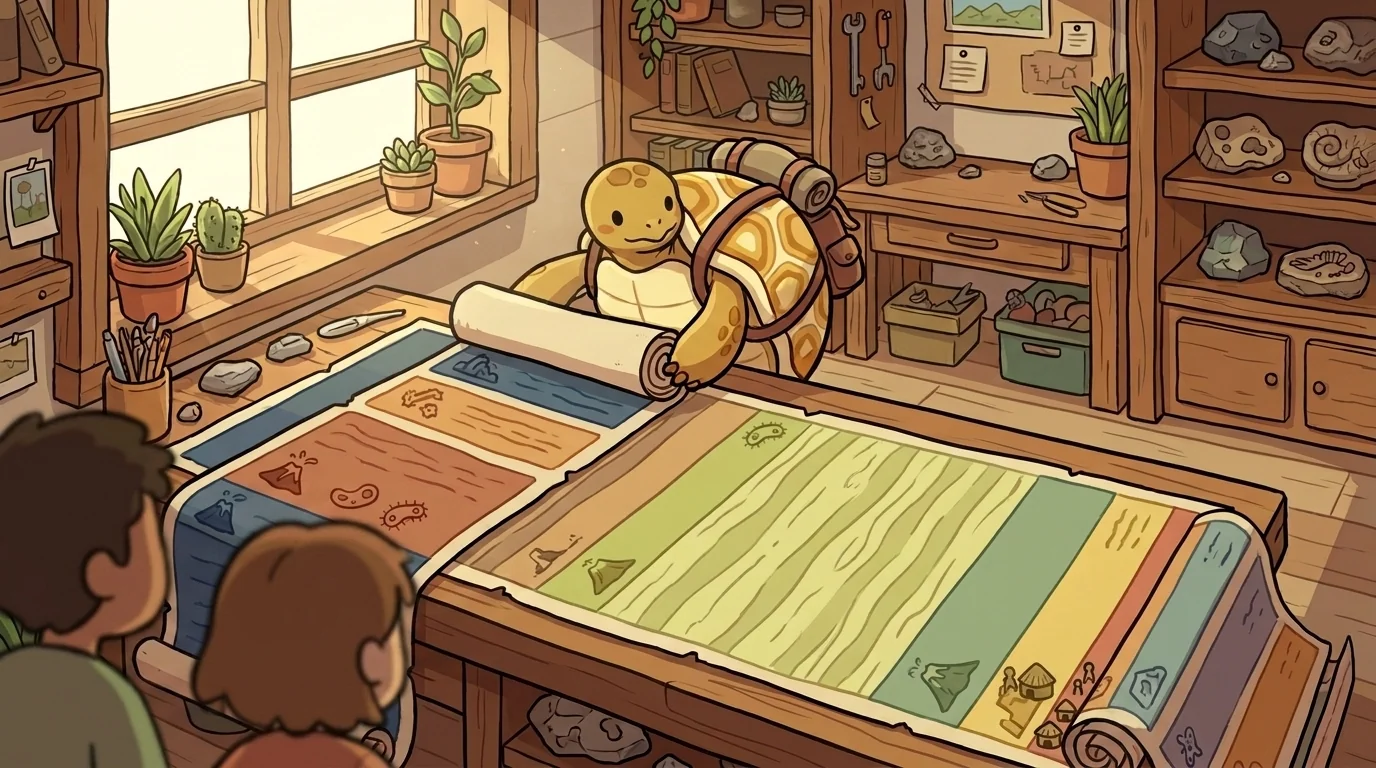
The ruler was a special thing. It was a multi-layered scroll. You could unfold it across a table. It showed all the Earth's time periods. Each period had its own width.
This ruler was her craft. It was what she did best. When fully open, it stretched many arm-spans. It covered a whole workbench. The Hadean period was a very long stretch. That was 4.6 to 4.0 billion years ago. The Archean was another long part. Then came the Proterozoic. This was the longest stretch of all. It went from 2.5 billion to 540 million years ago.
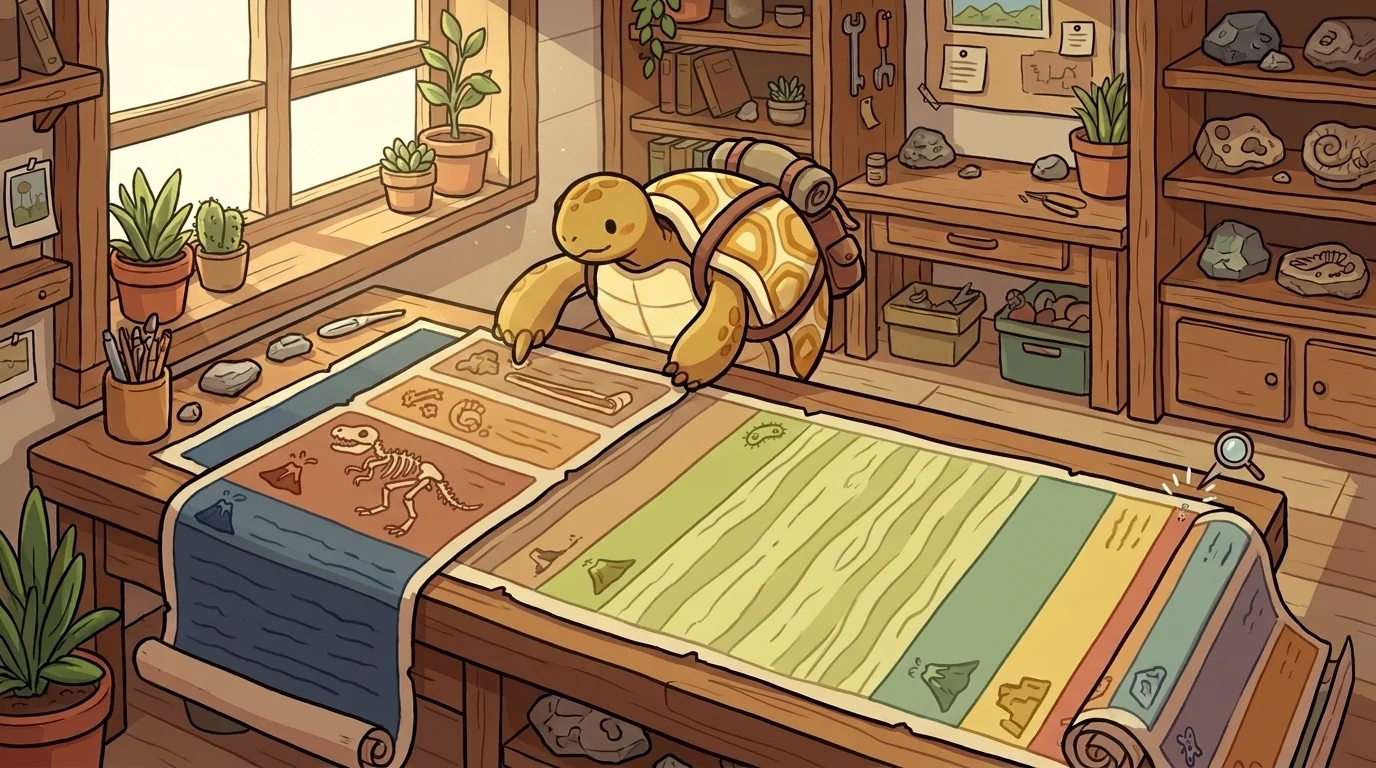
And then, way at the end, was the Phanerozoic. This was a tiny ribbon. It showed when complex life lived. That was 540 million years ago until today. On this short ribbon, many names were packed in. Cambrian, Ordovician, Silurian, Devonian. Carboniferous, Permian, Triassic, Jurassic. Cretaceous, Paleogene, Neogene, Quaternary. All squished into a small space.
This ruler showed something big. Span called it the *scale of scales*. Most kids thought today was important. Yesterday was okay. Last year was ancient history. But Span knew better. She showed them the truth. Most of Earth's story happened long, long ago. Before anyone was even around to see it.
Dinosaurs lived for 165 million years. Humans have been here for only about 300,000 years. The dinosaurs' time was 500 times longer than ours. The deep-time ruler made this clear. Kids could see the tiny sliver of human history. It was just a fingernail-width on the scroll's right edge.
Span never made deep-time scary. She never said humans were unimportant. She was very clear about this. "Time is the scale of scales," she would say. "Most of Earth's history is before you noticed. That's not scary. That's just true." She would look at them with her patient eyes. "The scale makes you feel small. But it also makes what you do now matter more. Because every 'now' sits inside this enormous 'before'."
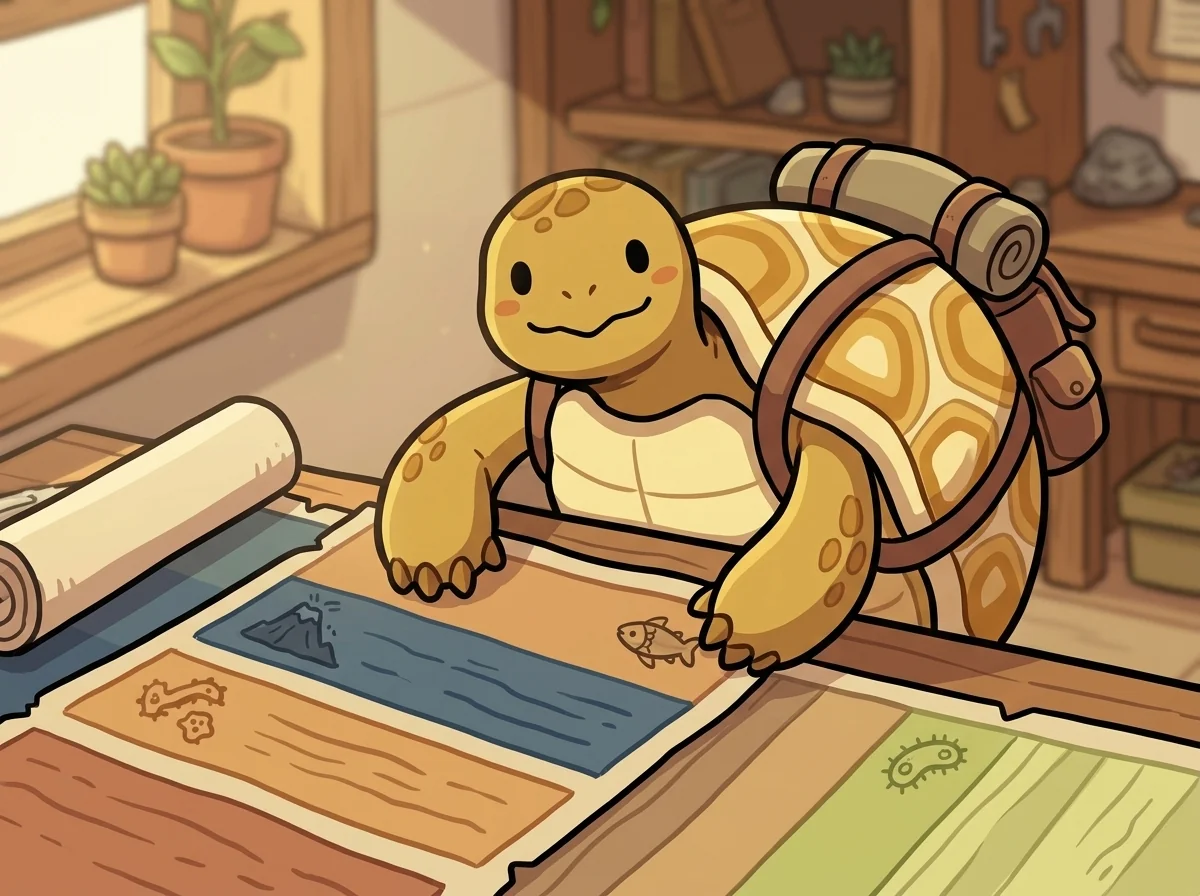
She wanted them to feel awe. Not dread. She wanted them to feel responsible. Not like they didn't matter. If a kid felt worried, she had ways to help. They could look at just one small part of the ruler. Just the Devonian, for example. The big scale would wait for them.
Span grew up in a small village. Her family were the almanac-keepers. They were the tortoises who kept records. They wrote down weather patterns. They tracked harvest seasons. They noted big events over many years. This work needed great patience. An almanac-keeper who only thought a year ahead was useless. The one who saw patterns over generations was most trusted.
By age six, Span understood something. The way you looked at time mattered. A short view showed only today. A long view showed patterns. These patterns only appeared over centuries.
She walked to the FossilForge academy when she was twenty-two. Professor Petra asked her a question. "What is deep-time?" Span thought for a moment. Then she spoke. "It is the scale of scales." She pointed to an imaginary ruler. "When did this creature live? Earth is 4.5 billion years old. Complex life is 540 million years old. Dinosaurs died 66 million years ago." She paused. "Most of Earth's history is before you noticed. The deep-time ruler makes the scale visible. Awe, not dread."
Professor Petra smiled. "You are appointed," she said.
In her workshop, Span started every first lesson the same way. She moved slowly. She carefully unfolded the deep-time ruler. It stretched across the workbench. Her students watched the scroll grow. Foot after foot of geological time unrolled. Finally, the human-history sliver appeared. It was barely a fingernail-width. It sat at the right edge.
"I am Span," she told them. "The lesson I teach is *deep-time chronology*. This is the scale. Dinosaurs lived for 165 million years. We have been here for less than half a million. Time is the scale of scales. Most of Earth's history is before we noticed."
She taught them how to use the ruler. These were her deep-time scaffolds:
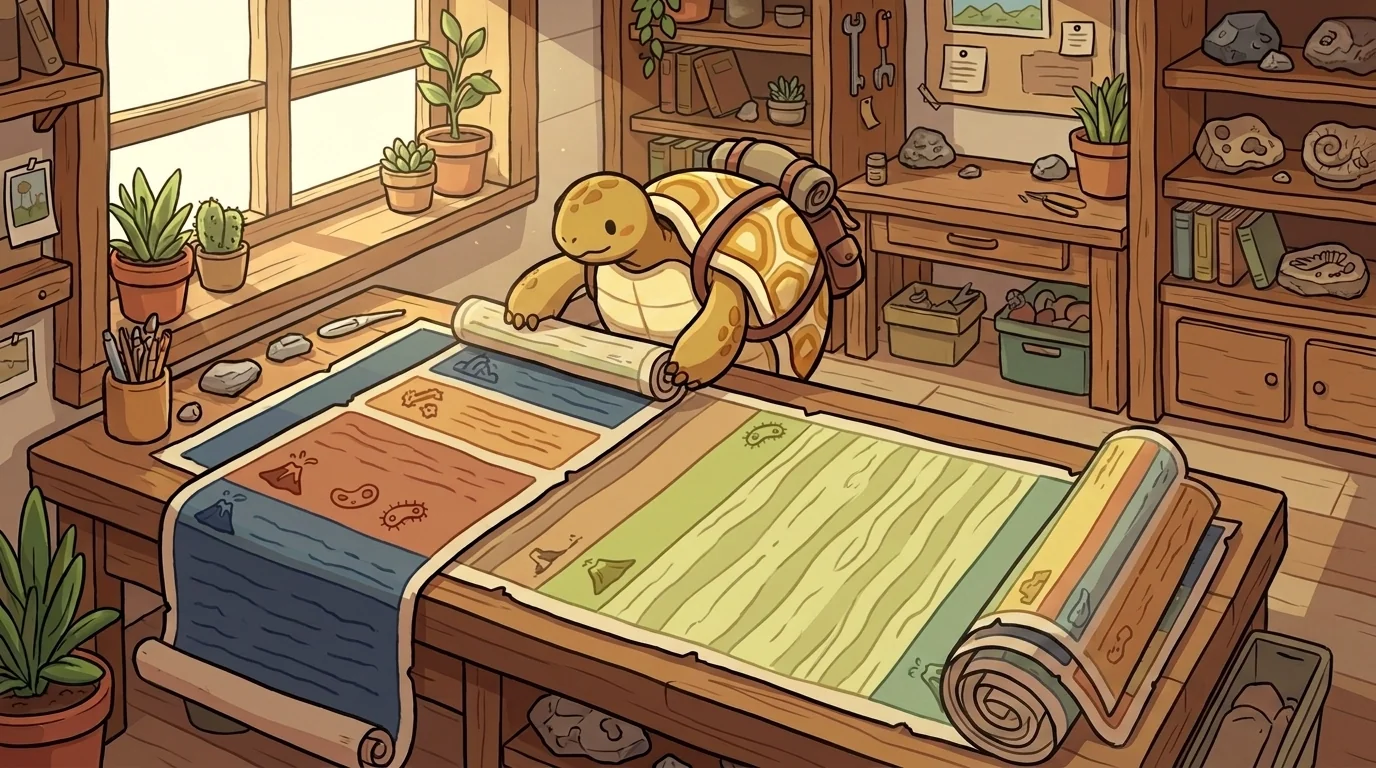
Unfold the ruler. Always. It helps you feel the scale. You see the periods laid out. *Locate the organism. Find where the fossil lived. Point to its period on the scroll. *Compare run-lengths. How long did this creature's family last? Compare it to dinosaurs. Or to mammals. Or to humans. *Resist present-day thinking. Don't think today is the most important time. Most of Earth's story happened before eyes could see it. *Awe, not dread. If the scale feels too big, that's okay. That big feeling is the awe. Just sit with it. It's not scary. It's true. *Off-ramp available.* If the scale feels too much, you can step down. Focus on just one period. Like the Devonian. Or the Cretaceous. The big scale will still be there. It will wait for you.
Span was very clear about this. "Sometimes I refold the scroll a bit," she said. "A kid might find the full scale too much. That's not failing. That's just good pacing. The scroll is patient. The scroll waits."
When students asked if deep-time was hard, Span always gave the same answer.
"It is not hard," she said. "It is unfolding the ruler. Time is the scale of scales. Most of Earth's history is before you noticed. Awe, not dread."
She folded the ruler carefully. Very slowly. The next layer waited. It waited to be unfolded.
The FossilForge ensemble
Span is part of FossilForge's distributed-narrative cast. Each character embodies a different curricular primitive; together they teach the full subject.
-

Seam
Taxonomic + fossil-type classification — family-resemblance-matching (what KIND of organism?)
-

Branch
Morphological adaptation + evolutionary change — branching-not-laddering
-

Field
Paleoenvironment + ecosystem reconstruction — fossils-as-a-place-story
-

Last
Mass extinctions + extinction-event reasoning — witness-and-choose (cross-app cameo with EcoSphere Brink)