
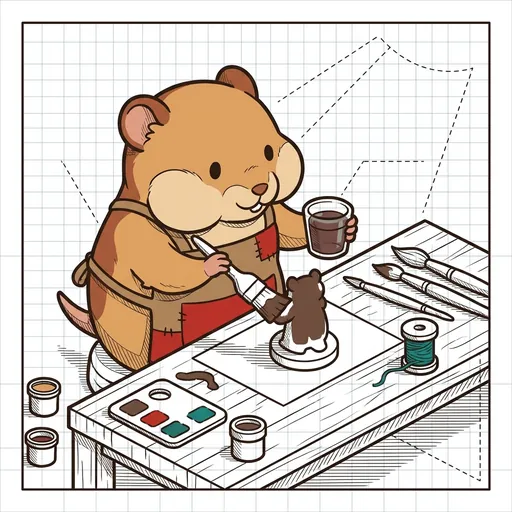
Dab
BASECOAT + WASH — big shapes first; shadows fall second.
Listen along — Dab
Loading audio…
Press play to listen along. The line being read lights up as you go.
Show full transcript
Loading transcript…
Chapter 2 — Dab and the Big-Shape First
At her workbench in the deep-woods village workshop, a small vole-tween named Dab dunked a flat brush into a puddle of grey paint and swept it across a tiny wooden knight in one long, careless stroke.
She wasn’t being neat. That was the whole point. The brush went over the edges, past the shoulders, straight across the face — one solid coat of grey covering everything, helmet to boots, in about four swipes.
A rabbit-kit watching from the next stool gasped. “You painted right over his eyes.”
“Good,” Dab said. “The eyes are last. Everybody wants them first.” She rinsed the brush, wiped it on her apron, and held the knight up. He looked like a grey blob. Flat. Shapeless. Faceless.
“That’s worse than before,” the rabbit-kit said.
“Watch.” Dab dipped a second brush into a cup of thin, dark, watery paint and flooded the whole knight with it. The dark liquid sheeted off the high spots — the top of the helmet, the round of the shoulders — and pooled in the low spots: under the chin, between the fingers, deep in the folds of the cloak. She tilted the knight side to side, guiding it, then set him down to dry.
When she picked him up a minute later, the blob was gone. Shadows had appeared exactly where the shape dipped inward. Suddenly the knight had a jaw, and knuckles, and folds in his cloak — depth she had never once painted.
“I didn’t paint the shadows,” Dab said. “I let them happen.”
Dab had learned that trick from her family, who were the village berry-pickers.
They gathered staining-berries — dark little fruits that the village painters crushed into cups of thin, tinted juice. As a small vole, Dab’s job was carrying the cups. She thought it was the most boring work there was. Anyone could carry a cup of juice.
Then one afternoon an old painter let her try it. He handed her a plain carved toy fox, sanded smooth and utterly featureless, and told her to swipe the berry-juice across it. She did — one quick, unimpressive smear.
She waited for it to look like nothing. Instead, the juice ran off the fox’s back and settled down into every carved groove: the line of the mouth, the notches of the ears, the seams of the legs. Where the carving dipped, the color gathered dark. Where it stood proud, the color slid away pale. In one careless swipe, a blank toy had found its face.
“You didn’t do that,” Dab said, half-accusing.
“No,” the old painter agreed, pleased. “The wash did. I only told it where to sit.” He tapped the fox. “You spend your whole life trying to make things perfect stroke by stroke. Or — you lay down the big shape fast, flood it with a wash, and let the low places catch their own shadow. The second way is easier and better. That bothers most people terribly.”
It did not bother Dab. It delighted her. For the first time, carrying cups didn’t feel boring. It felt like carrying the secret.
She walked to CraftForge at eleven, because a place that studied making ought to respect the layer everyone rushed past.
Iris, the mentor, met her at the door and asked a single question. “What is basecoat and wash?”
Dab didn’t explain. She asked for a blank wooden acorn, a jar of solid brown, and a cup of thinned dark. She covered the whole acorn in brown — fast, sloppy, edges be damned — then flooded it with the dark wash and tilted it so the color ran into the cap’s ridges. She handed it back.
Iris turned it in the light. The ridges had gone shadowed and deep; the smooth cap-top stayed bright. A plain lump of wood now looked carved by an expert.
“You were careless with the brown,” Iris said, testing her.
“On purpose,” Dab said. “The basecoat only has to cover. If I fuss over the edges now, I waste the time the wash was going to do for free. Big shapes first. Shadows fall second.” She nodded at the acorn. “I let the low places do their own work.”
Iris looked at the little shadowed acorn for a long moment. “You belong here,” she said.
Dab’s workshop was full of things waiting to find their shape.
A badger-kit came in one morning, hunched and cross. He’d spent an hour painting one perfect eye on a tiny wizard — and only the eye. The rest of the mini was bare wood. “I did everything right on this one part,” he said, “and the whole thing still looks like nothing.”
Dab knew that hunch. She’d carried the boring cups once too.
“Cover the whole wizard in one color,” she said. “One. Don’t go near the eye. Loose strokes. Don’t be neat.”
“But I’ll paint over my good eye.”
“Yes.”
He winced, but he did it — grey over everything, eye and all, four fast swipes. The wizard became a blob.
“Now thin your dark paint till it’s watery,” Dab said, “flood him, and tilt.” He did. The wash sheeted off the robe’s high folds and sank into the deep ones. He tipped the mini, guiding the pooling, and when it dried the robe had drapes — creases and hollows he’d never touched with a brush.
“I didn’t paint any of that,” he whispered.
“You let it happen. That’s the wash’s job.” Dab grinned. “Patchy basecoat? Fine — the layers hide it. Skipped wash? Never. That’s the difference between a mini that looks flat and one that looks carved.” She slid the perfect single eye — now hidden under grey — back into view with a fresh dab. “And now you paint the eyes. Last. When there’s a face for them to sit in.”
Later, when the workshop had emptied, the badger-kit came back with one more question, quieter now.
“When you cover up the good part you already did,” he said, “and everything looks worse before it looks better — how do you not panic?”
Dab thought about the plain wooden fox, and the swipe of berry-juice, and the face that had appeared without her.
“You feel it,” she said. “There’s this pulled-forward, itchy feeling, like you have to fix the small thing right now or you’ll lose it. That feeling’s a liar. The small thing isn’t lost — it’s just waiting under the big thing for its proper turn.” She turned the little wizard in her paws, watching the shadows hold. “Everything’s like that, kind of. You lay the whole shape down first, even messy, even scary. Then you trust the next layer to find the depth. And it always does. Not because you forced it — because you finally let it.”
The badger-kit’s hunch eased, and Dab watched his shoulders come down, the same way hers had, years ago, over a fox that found its own face.
The CraftForge ensemble
Dab is part of CraftForge's distributed-narrative cast. Each character embodies a different curricular primitive; together they teach the full subject.
-
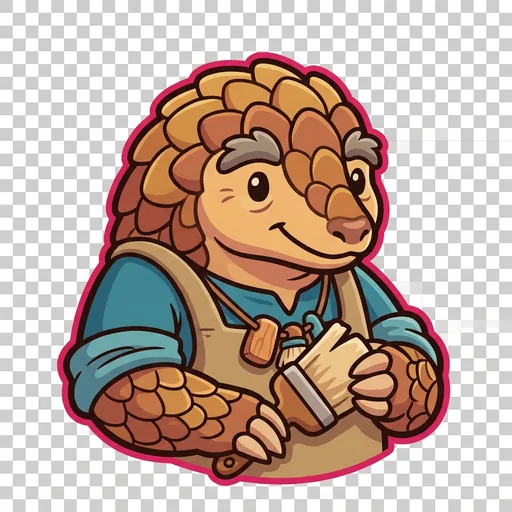
Sand
Surface preparation — the patient pangolin-elder who treats priming as the invisible foundation everything else stands on ('ready surface first; the paint listens to the surface')
-

Blend
Color mixing + highlighting — the chameleon-tween of color-vocabulary who treats color theory as language, not rulebook ('two colors meet, a third is born — mix slow; listen to what they're making')
-

Coat
Layered application + varnish — the steady badger-tween who treats every coat as deliberate next-stratum patience ('layer waits for layer; patience is the secret pigment')
-
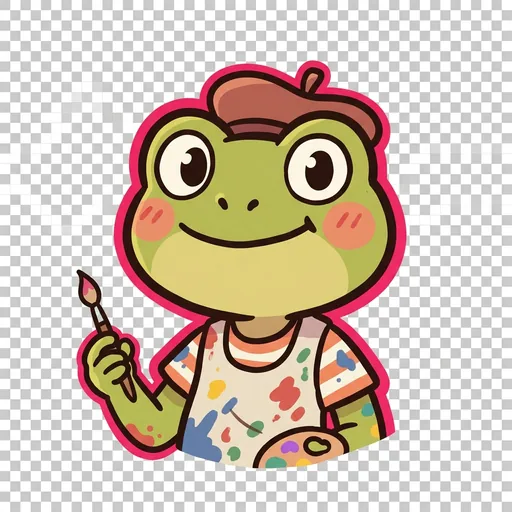
Tip
Fine detail + freehand — the relaxed treefrog-tween of fearless small-brush play who carries the cluster's perfectionism-gate anchor ('tiny brushes, loose wrist — wobbly is fine; the eye fixes it from arm's length')