
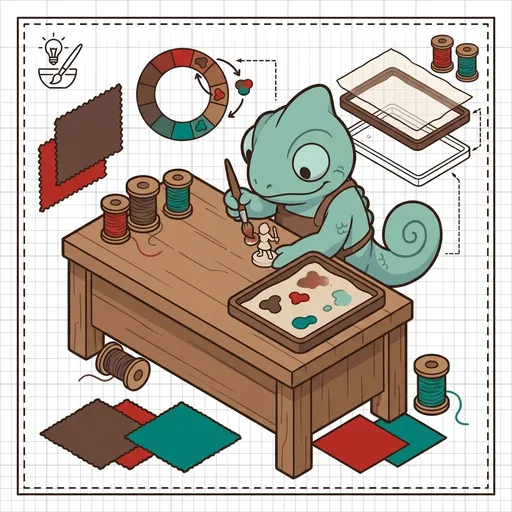
Blend
COLOR MIXING + HIGHLIGHTING — two colors meet, a third is born. mix slow.
Listen along — Blend
Loading audio…
Press play to listen along. The line being read lights up as you go.
Show full transcript
Loading transcript…
Chapter 3 — Blend and the Patient Mix
At the color-mixing bench in CraftForge, a chameleon-tween named Blend held a tiny grey miniature knight in one hand and did not paint him.
She had a wet-palette in front of her — a tray of damp parchment that kept paint soft for hours — and two little puddles of color sitting side by side. One was the knight’s base blue, straight from the pot. The other was a pale, almost-white blue she’d been building up drop by drop. She dipped her round-brush into the base, then just barely touched the pale one, and stirred, slow, letting the two puddles reach toward each other on the parchment.
“Are you going to paint him or just… stare at the paint?” asked a boy at the next stool.
“I’m mixing,” Blend said. Her scales had gone soft-teal, the color she turned when she was concentrating. “Watch what shows up.”
She laid the new, lighter blue onto the very top of the knight’s helmet — just a thin sweep, right where the sun would hit if the sun were straight above. Then she cleaned her brush, mixed the base with a whisper of darker blue, and laid that into the low folds of his cloak, where light wouldn’t reach.
She set him down. The boy leaned in and made a small noise. A minute ago the knight had been a flat grey-blue lump. Now he looked lit — like he was standing in real light, catching it on his helmet and hiding it in his cloak.
“Same knight,” Blend said. “Same one color. I just mixed it lighter, and mixed it darker, and put each where the light told me to.”
Blend had learned the slow part the hard way, back in the village.
Her family were the pigment-mixers — the chameleons who could look at a wet, muddy-looking wash and know what color it would dry into. When Blend was small, she’d wanted to be fast about it. She’d grab two pots, slap them together, and expect a beautiful new color to leap out.
It never did. It came out muddy. Grey. Nothing.
She remembered sitting at the mixing-hut one evening, close to crying, a ruined scroll in front of her. “I mixed them,” she said. “I did everything. Why is it ugly?”
Her grandmother — an ancient chameleon whose scales had gone slow and pale gold — didn’t tell her she’d used the wrong colors. She reached over, took two fresh drops, and stirred them together so slowly Blend wanted to scream.
“You’re rushing them,” her grandmother said gently. “Colors don’t fight to become a new one. They find each other. If you drag the brush fast, you tear them apart before they’ve met. Slow down, and watch — there’s a moment, right in the middle, where the two of them turn into something neither of them was.”
Blend watched. And there it was — a soft third color rising up out of the two, clean and glowing, not muddy at all.
Her chest, which had been tight and frustrated, loosened all at once. The color wasn’t the magic. The waiting was the magic. And somehow that made the whole thing feel possible instead of impossible.
She walked to CraftForge at twelve, because a place that studied making ought to understand the kind of making that can’t be hurried.
Iris, the mentor who ran the workshops, met her at the gate. She didn’t ask Blend to prove she was gifted. She asked one question. “What is color mixing and highlighting?”
Blend didn’t answer with a speech. She pulled out her wet-palette, set down a drop of green, touched a drop of pale yellow beside it, and stirred — slow, patient, her scales shifting warm-pink with the small thrill of it. A soft, lit-looking green rose out of the two. She swept it onto the ridge of Iris’s own painted mini, sitting on the gatepost, right where the light would land.
The little figure seemed to sit up in the sun.
“Two colors meet,” Blend said, “and a third is born. But only if you don’t rush them. Then you put the light where light goes.”
Iris looked at her mini catching the afternoon for a long moment. “You belong here,” she said.
Blend’s workshop smelled of damp parchment and patience.
The boy came back one afternoon, slumped and grumpy, a flat orange mini in his fist. “I painted him the right color,” he said. “The exact right orange. And he still looks like a blob. It’s not fair.”
Blend knew that slump. She’d felt it at the mixing-hut.
“Show me your orange,” she said. He did. “Good orange. Now — where does the light come from?”
He blinked. ”…Up?”
“Then lift some of that orange lighter. A drop of orange, a tiny drop of pale yellow. Stir slow — don’t drag it, let them meet.” He tried, too fast, and got a streak. “Slower,” she said, not unkind. “You’re pulling them apart.” He stirred again, slower, and the soft lighter orange bloomed in the puddle.
“Now — just the top of his head. Where the sun hits. Thin.”
He laid it on, one careful sweep. Then, following her nod, he mixed the orange darker with a whisper of brown and tucked it into the deep folds of the mini’s cloak.
He held the figure up. His mouth fell open. “He’s got a shape now.”
“He always had a shape,” Blend said. “You just showed the light where to land on it. Highlights and shadows — that’s the secret — are the same color you started with. One lifted lighter. One pushed darker. The eye does the rest. It sees the light and believes the whole thing.” She grinned. “Thin layers, though. Many thin ones. Never one thick splotch. Let each one dry before the next finds it.”
Later, when the workshop had emptied, the boy came back with one more question. He was quieter now, the mini cradled in both hands.
“When I’m stirring,” he said, “and it just looks like two blobs and nothing’s happening yet — how do you know the new color’s coming?”
Blend thought about the mixing-hut. About the tight chest, the ruined scroll, her grandmother’s slow gold hands.
“You feel it,” she said. “That’s the honest answer. There’s a moment where you want to hurry, where your hands itch to be done — and the whole trick is to stay in that moment instead of rushing out of it. The good color lives right there, in the part that feels like waiting.” Her scales settled to a soft, pleased gold. “Everything worth making has that middle. The song before it’s a song. The drawing that’s still just lines. It’s not nothing. It’s the two things finding each other, right before they turn into the third.”
The boy nodded slowly, and Blend watched the grumpy slump lift off his shoulders — the same way, years ago, hers had lifted at the hut.
She didn’t say the rest out loud, but she thought it, warm and certain: the slow, stuck, not-yet part is never the boring part. That’s where the new color is being born. You just have to be patient enough to catch it.
The CraftForge ensemble
Blend is part of CraftForge's distributed-narrative cast. Each character embodies a different curricular primitive; together they teach the full subject.
-
Sand
Surface preparation — the patient pangolin-elder who treats priming as the invisible foundation everything else stands on ('ready surface first; the paint listens to the surface')
-
Dab
Basecoat + wash — the confident vole-tween of broad strokes who treats basecoats as the loud first hello and washes as the quiet shadow-finder ('big shapes first, shadows fall second')
-

Coat
Layered application + varnish — the steady badger-tween who treats every coat as deliberate next-stratum patience ('layer waits for layer; patience is the secret pigment')
-
Tip
Fine detail + freehand — the relaxed treefrog-tween of fearless small-brush play who carries the cluster's perfectionism-gate anchor ('tiny brushes, loose wrist — wobbly is fine; the eye fixes it from arm's length')