

Coat
LAYERED APPLICATION + VARNISH — layer waits for layer. patience is the secret pigment.
Listen along — Coat
Loading audio…
Press play to listen along. The line being read lights up as you go.
Show full transcript
Loading transcript…
Chapter 4 — Coat and the Layer That Waits
At his workbench in the deep-burrow, a badger-tween named Coat painted one thin stripe of grey onto a tiny knight — and then, deliberately, put the knight down and did nothing to it at all.
He picked up a different knight instead, sitting in a row of four, and painted one thin stripe on that one too. Then that one went down as well. His brush was cheap and synthetic, easy to clean, and his little jar of varnish sat capped and waiting at his elbow. The paint on his palette was watered thin — so thin it looked more like tinted milk than paint.
A fox kit peered over the bench, watching him move down the row, then back up it, laying one whisper-thin coat on each mini in turn.
“You’re barely putting any paint on,” she said. “You could just… paint the whole thing at once. Get it done.”
“I could,” Coat agreed, not looking up. “And it’d dry chalky and hide every scratch of detail I’m trying to show.” He touched the first knight — bone-dry now — and laid a second thin coat of grey over the first. The colour deepened, smooth and even, without a single glob. “One thick coat lies flat and dead. Three thin coats build up like real steel. Same paint. Different patience.” He set the knight down again. “Layer waits for layer.”
Coat had learned that in the burrow, long before CraftForge.
His family were the village’s wood-finishers — the badgers who brushed protective coatings onto the carved wooden tools, season after slow season. When Coat was small, he’d hated it. The work never seemed to do anything. You brushed on a coat, and it looked wet and finished-ish, and then you had to wait — hours, sometimes a whole day — before the next one. He remembered standing over a half-finished rake handle, aching to be done, and slapping on the next coat while the first was still tacky.
It bubbled. It streaked. It peeled off in a rubbery sheet a week later, and the handle went grey and rough again.
His mother hadn’t scolded him. She’d just picked up the ruined handle and turned it in her paws. “You feel it, don’t you? That itch to finish. Like waiting is wasted time.” Coat had nodded, cheeks hot. “It isn’t wasted,” she’d said. “The waiting is the work. The coat has to become part of the wood before the next one can hold. Rush it, and none of it holds.” She’d handed him a fresh handle. “Slow is what makes it last a lifetime instead of a season.”
Coat had painted that handle one patient coat at a time, drying fully between each. It was still in the burrow, years later, smooth and whole. He’d stopped feeling like the waiting was empty after that. It had a shape now: layer, dry, layer, dry. Somehow that made the itch easier to sit with.
He walked to CraftForge at thirteen, because a place that studied making ought to understand the kind of making that mostly looks like waiting.
Iris, who ran the workshops, met him at the gate. She didn’t ask him to paint anything fast. She asked one question. “What is layered application, and varnish?”
Coat didn’t answer with a speech. He set a chipped, unvarnished mini on the bench — one someone had rushed — and rubbed his thumb across it. Grey paint smeared off onto his skin. Then he set down one of his own, finished long ago, and rubbed it just as hard. Nothing moved. The paint stayed exactly where he’d put it, sealed under a soft matte shell.
“That one was painted thick and left bare,” Coat said, nodding at the smeared one. “This one was thin coats, fully dried, then varnished twice.” He held his up to the light. “The colours aren’t better. They just don’t leave.”
Iris looked at the smear on his thumb, then at the mini that had shrugged him off. “You belong here,” she said.
Coat’s workshop always had minis drying in it — a whole quiet row of them, waiting their turn.
A rabbit kit came in one afternoon, slumped and cross, holding a mini gone chalky and pale. “I picked good colours,” she said. “I know I did. But it looks fuzzy. Like chalk. It’s ruined.”
Coat knew that slump. He’d felt it over a bubbled rake handle.
“Show me how you painted it,” he said. She mimed loading her brush straight from the pot and swiping it on, thick and fast. Coat nodded. “There. Not your colours. Your coats. Paint from the pot is too thick — it dries in a rough crust and buries all your detail under fuzz.” He dipped her brush, touched a single drop of water into the paint, and stirred until it flowed like tinted milk. “Thin it. It’ll look too weak at first — like it’s barely doing anything. Trust it. Lay one thin coat. Then walk away.”
“Walk away? For how long?”
“Ten, twenty minutes. Touch-dry isn’t dry — dry is dry.” He grinned and slid a second, half-painted mini toward her. “So paint this one while the first dries. Always have one drying, always have one painting. Two going makes the waiting disappear.” He laid a second thin coat over her first. The chalky fuzz vanished; the colour came up clean and deep. “Two thin coats beat one thick coat. Every single time. And when it’s all done and dry —” he tapped the little jar ”— you brush on varnish. Thin. Twice. That’s the shell that stops it smearing on someone’s thumb ten years from now.”
The rabbit painted the rest one patient coat at a time, a second mini always drying at her side. It came out clean.
Later, when the workshop had emptied, the rabbit came back with one more question, quieter now.
“When it’s just sitting there drying,” she said, “and nothing’s happening you can see… how do you know it’s still working?”
Coat thought about the burrow. About the itch to finish, and the bubbled handle, and his mother turning it slowly in her paws.
“You feel it,” he said. “That’s the honest answer. There’s this itchy, not-done-yet, almost-there feeling while you wait — like standing outside a door that isn’t open yet. That feeling isn’t nothing going wrong. That’s the layer becoming part of the mini, quiet and sure, so the next one has something to hold onto.” He looked down the row of drying minis, each one a little further along than the last. “Everything that lasts is made this way. The wood-finish on an old tool. The seal on a boat. A mini that’s still bright after ten years of handling. It’s all just somebody who let one layer wait for the next.”
The rabbit nodded slowly, and Coat watched the cross, chalky-mini frustration lift off her shoulders — the same way, years ago, his own had.
He didn’t say the rest out loud, but he thought it, warm and certain: the waiting was never the empty part. The waiting was where it held.
The CraftForge ensemble
Coat is part of CraftForge's distributed-narrative cast. Each character embodies a different curricular primitive; together they teach the full subject.
-

Sand
Surface preparation — the patient pangolin-elder who treats priming as the invisible foundation everything else stands on ('ready surface first; the paint listens to the surface')
-

Dab
Basecoat + wash — the confident vole-tween of broad strokes who treats basecoats as the loud first hello and washes as the quiet shadow-finder ('big shapes first, shadows fall second')
-

Blend
Color mixing + highlighting — the chameleon-tween of color-vocabulary who treats color theory as language, not rulebook ('two colors meet, a third is born — mix slow; listen to what they're making')
-
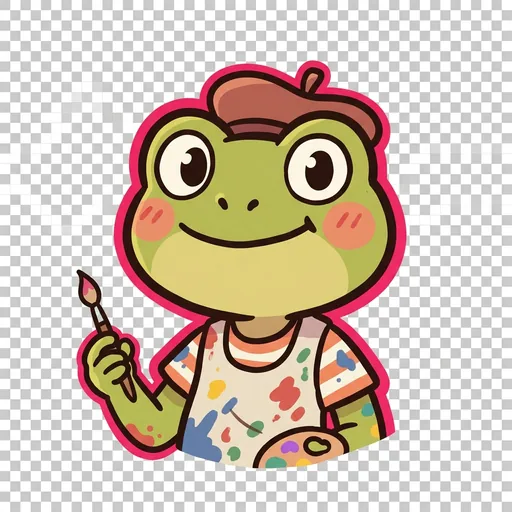
Tip
Fine detail + freehand — the relaxed treefrog-tween of fearless small-brush play who carries the cluster's perfectionism-gate anchor ('tiny brushes, loose wrist — wobbly is fine; the eye fixes it from arm's length')