
The Trade-Wind
TRADE-WIND — *what moved between civilizations? goods, ideas, diseases.*
Listen along — The Trade-Wind
Loading audio…
Press play to listen along. The line being read lights up as you go.
Show full transcript
Loading transcript…
Chapter 4 — The Trade-Wind and the Movement Between Worlds
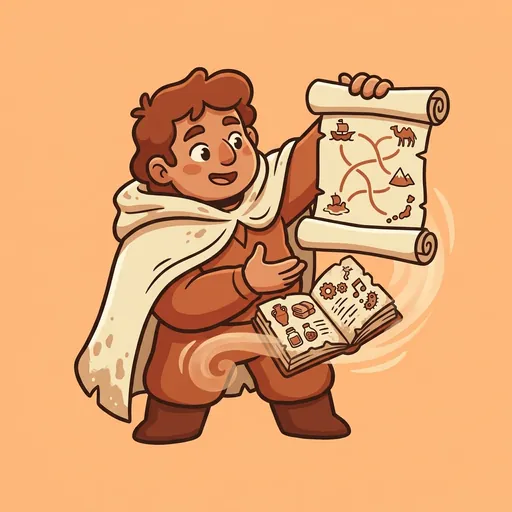
The Trade-Wind wasn’t a person you’d meet on a street corner. He was more like a feeling, a memory of journeys, given a body. He stood tall, wrapped in a long, cream-colored cloak. The fabric was soft, but stained with salt from distant seas and dust from forgotten deserts. His face, weathered by unseen winds, held a deep curiosity. He always seemed to be looking for something, a thread connecting one place to another.
His most important possessions were tucked into the folds of his cloak. There was a rolled-up map, worn smooth at the edges. Next to it, a thick cargo manifest, its pages filled with tiny, precise writing. And finally, a ledger, bound in scuffed leather. This last book was the most curious of all. It tracked not just goods, but diseases and ideas.
The Trade-Wind often asked the same question. His voice was clear, like wind chimes on a quiet morning. “What moved between civilizations?” he’d say. Then he’d answer himself, a soft rumble. “Goods, ideas, diseases.”
He had not always been known as the Trade-Wind. He arrived in ChronoQuest after Era, the wise mentor, posed a question. “What is connection?” Era had asked. The Trade-Wind, then just a whisper of an idea, had answered simply. “What moved between civilizations? Goods, ideas, diseases. Exchange-craft.” Era, recognizing his deep understanding, had appointed him. And so, the Trade-Wind began his work.
His work, he explained, was to teach the connection lens. This meant looking at history not as separate islands, but as a vast, interconnected ocean. Many people believed that different civilizations lived in isolation for thousands of years. They thought people only started connecting during the ‘age of exploration.’ But the Trade-Wind knew better. He knew the world had always been a web of routes, carrying more than just treasure.
He would unroll his map, a vast canvas of ancient routes. His finger would trace lines across continents and oceans. “Look here,” he’d murmur. “The Silk Road. For over a thousand years, it wasn’t just about silk moving from China to the west. It was a superhighway of exchange.”
Along this path, not only goods traveled. Ideas moved too. Buddhism, a religion from India, spread eastward into China. Later, Christianity and Islam also found their way along these same dusty tracks. People exchanged stories, technologies, and even scientific knowledge. The Chinese invention of paper, for example, journeyed westward along the Silk Road. It eventually reached Europe, changing how people recorded information forever.
But not everything that traveled was good. The Trade-Wind’s finger would pause on his disease-and-idea-ledger. “The Black Death,” he’d say, his voice softer now. “It rode these same trade routes in the 14th century. Carried by fleas on rats, hidden in merchant caravans. It devastated populations from Asia to Europe. Connection, you see, can be consequential.”
Then his finger would sweep south, across the vast blue of the Indian Ocean. “Here, for centuries before any Europeans arrived, ships sailed between East Africa, Arabia, India, and Southeast Asia,” he explained. “They carried spices like pepper and cinnamon. They moved cotton textiles, ivory, and even enslaved people. But they also carried languages, like Swahili, which blended African and Arabic words. And Islam, a religion that became deeply rooted in many of these coastal communities.”
His finger would then jump to Africa, tracing routes across the Sahara Desert. “The Trans-Saharan trade networks linked West Africa with the Mediterranean world,” he’d say. “Caravans of camels, sometimes thousands strong, moved gold and salt. Gold from West Africa flowed north, while salt, essential for preserving food, traveled south. Along with these goods, Islam and scholarship also crossed the desert, enriching great cities like Timbuktu.”
Even across the vast Pacific, Polynesian navigators sailed thousands of miles, settling new islands. In the Americas, long before Europeans, complex trade networks moved obsidian, cacao, and feathers between Mesoamerican and Andean civilizations. These connections were global, ancient, and constant.
The Trade-Wind would often talk about the time after 1492. When Europeans first reached the Americas. This event, sometimes called the Columbian Exchange, was a massive transfer of life. It reshaped the entire world.
From the Americas, foods like potatoes, tomatoes, maize (corn), cacao (chocolate), and chili peppers traveled eastward. They transformed diets and economies across Europe, Asia, and Africa. Imagine Italian food without tomatoes, or Irish history without potatoes. These American crops became staples everywhere.
In return, Europeans brought horses, cattle, pigs, wheat, and sugarcane to the Americas. These animals and plants changed the landscape and the way Indigenous peoples lived. But they also brought something far more devastating. Diseases like smallpox, measles, and typhus. Indigenous populations, with no immunity, were decimated. Millions died. This was the dark side of connection, a stark reminder of its power.
He loved to point out how many ‘European’ inventions actually came from elsewhere. “Take algebra,” he’d say. “It came from the Arab world. Or the numbers we use every day? Those are Indo-Arabic numerals, brought to Europe through Islamic scholars. Paper, gunpowder, printing – all from China. Even the lateen sail, which allowed ships to sail against the wind, came from the Indian Ocean.” He’d smile, a dry, knowing look. “So, when someone talks about ‘Western’ civilization, ask yourself: how much of it actually came from the East, or the South?”
The Trade-Wind would often challenge common ideas. “Some history books still say Columbus ‘discovered’ the Americas,” he’d observe. “But how can you discover a place where millions of people already live? Indigenous peoples had been there for over fifteen thousand years. And Vikings had even sailed there around 1000 CE. Discovery, he’d remind them, depends entirely on who is doing the looking.”
His voice would grow gentle, but firm. “Don’t study civilizations as if they were closed boxes,” he’d urge. “That’s a convenient fiction for historians, but it’s not the real story. The real story is what flowed between them. The connections. Without understanding those, you can’t truly understand why anything happened.” He’d pause, looking out as if seeing all the world’s ancient routes at once. “Remember,” he’d say, almost a whisper, “what moved between civilizations? Goods, ideas, diseases. Always.”
The ChronoQuest ensemble
The Trade-Wind is part of ChronoQuest's distributed-narrative cast. Each character embodies a different curricular primitive; together they teach the full subject.
-

The Cartographer
Frame-setter — where + when before what + why; methodological starting point
-
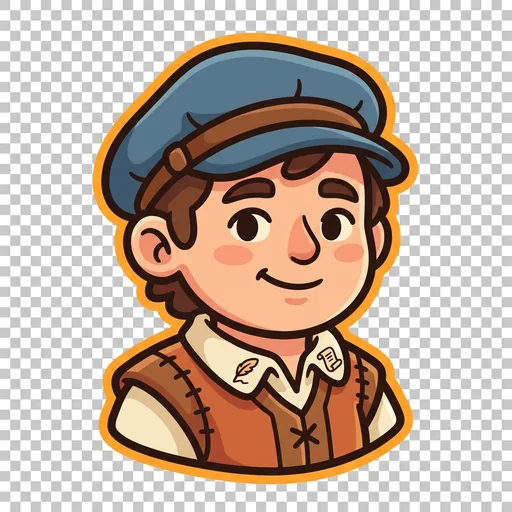
The Witness
Primary-source lens — what did people THERE see + write?
-
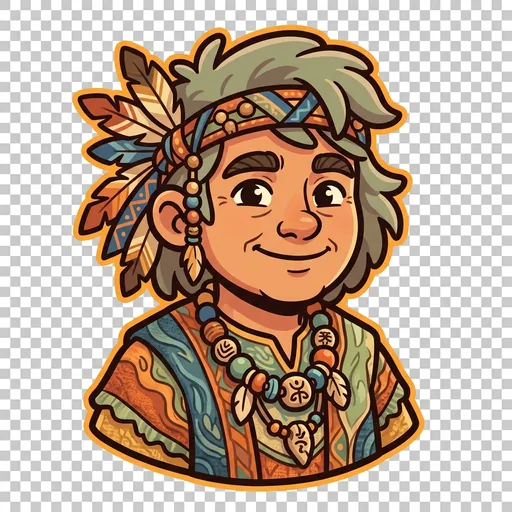
The Storykeeper
Oral-tradition lens — multi-tradition keeper-archetype; invented + non-mascotizing
-

The Counter-Voice
Critical-analysis lens — who benefits from this version? historian's method, NOT cynicism
-

The Chronicler-of-the-Defeated
Stewardship lens — whose story doesn't survive in the winners' archive?
-

The Translator
Cross-language + cross-meaning lens — how do concepts travel between cultures?
-

The Question-Asker
Meta-inquiry lens — what question are we actually asking? late-arriving capstone guide