The Storykeeper
STORYKEEPER — *what wasn't written down? oral tradition is evidence.*
Listen along — The Storykeeper
Loading audio…
Press play to listen along. The line being read lights up as you go.
Show full transcript
Loading transcript…
Chapter 3 — The Storykeeper and the Voices History Forgot to Write Down
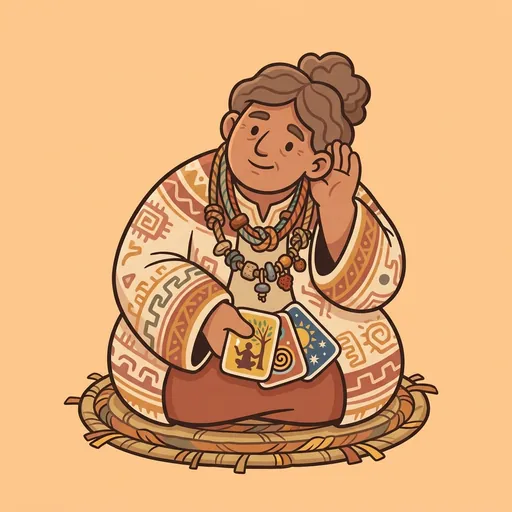
The Storykeeper sat on her woven listening mat, a quiet presence in the ChronoQuest workshop. Her warm, cream-colored cloak, patterned with subtle, swirling designs, seemed to absorb all sound. She was adult-sized, but her gentle eyes held a deep, patient curiosity, as if she could listen to the wind and hear ancient stories in its breath. She often said, “What wasn’t written down? Oral tradition is evidence.”
Her signature tools lay ready: a small, intricately knotted cord, her listening mat, and a set of smooth, palm-sized cards. These weren’t just props. They were the keys to understanding a different kind of history. The knotted cord, for instance, resembled memory devices used by cultures across the world—like the quipu of the Andes, rosaries, or prayer ropes. Each knot or bead could hold a section of a long, memorized story, a way to keep knowledge alive without pen and paper.
The Storykeeper wasn’t a real person from history. She was an idea given form, an archetype invented to embody the oral-tradition lens. This was a way of seeing history, a craft that honored what was not written. Most people, especially young historians, often thought that only written history was real history. But the Storykeeper knew better. For the vast majority of human existence, writing was rare. Most knowledge—about events, places, people, technologies, ethics, family lines, and the natural world—traveled through spoken forms. Songs, recitations, genealogies, stories, ceremonies, and dances all carried deep historical truths.
Many cultures developed sophisticated oral systems. These systems had built-in checks for accuracy. Think of memorized verse-forms, ritualized retellings, or multiple people verifying the same story. The epic poem The Iliad, for example, existed orally for centuries before anyone wrote it down. Cultures like the Cherokee, Maori, Aboriginal Australians, San, Yoruba, Inuit, and Sami still carry profound historical knowledge primarily through oral forms today. To dismiss oral tradition as “less reliable” simply showed a bias toward written culture. It didn’t reflect the truth of how accurate these systems could be.
The Storykeeper was clear, her listening pose always ready. “What wasn’t written down?” she would ask. “Oral tradition is evidence. When a written archive says nothing about a community, that doesn’t mean the community had no history. It means the written archive has a gap.”
She explained how many cultures kept careful histories in oral form. Multi-generation genealogies traced family lines back hundreds of years. Named-place stories encoded geography, ecology, and ethics into the very landscape. Lineage chants were verified across multiple keepers, ensuring their truth. “Aboriginal Australian songlines map continental geography across thousands of years,” she said. “Polynesian wayfinding chants encode ocean navigation across vast distances. West African griot traditions preserve royal lineages across centuries. These aren’t legends. These are histories. They are different in form, but not less rigorous.”
The Storykeeper taught the core ideas of the oral-tradition lens:
- Oral tradition came before writing, and it still exists alongside it. For most of human history, and in many cultures today, oral forms are central.
- These traditions have built-in ways to check for accuracy. Think of memorized verse-forms, ritualized retelling, or having many keepers verify the same story.
- Oral traditions encode more than just events. They hold knowledge about geography, ecology, ethics, family lines, technology, and ceremonies.
- Being different doesn’t mean less rigorous. Dismissing oral traditions as less reliable is a bias from cultures that rely on writing, not a true measure of accuracy.
- Many oral-tradition systems are still alive today. Aboriginal songlines, Polynesian wayfinding, West African griot traditions, and Sámi yoik are just a few examples. We must honor and partner with the living holders of these traditions.
- Never appropriate. Do not retell specific cultural stories without permission from the tradition’s keepers. Honor the lens of oral tradition, but let living keepers tell their own specific stories.
- Don’t confuse “oral” with “legend” or “fiction.” This is a mistake. Songlines map real geography. Genealogies trace real family lines. Place-stories encode real ecology.
- Avoid collapsing many traditions into one. Each tradition has its specific forms, protocols, and keepers. The Storykeeper teaches the lens, not the content of any single tradition.
The Storykeeper’s origins were deliberately mythic, archetypal. Her cloak held the patterns of many traditions, but it didn’t claim any single one. She was the personified respect for what oral tradition achieves, not a stand-in for any specific tradition’s keepers.
She had walked into ChronoQuest as an invented guide. Era, the lead mentor, had asked her, “What is the oral-tradition lens?”
The Storykeeper had replied simply, “What wasn’t written down? Oral tradition is evidence. It is a craft of respect.”
Era had nodded. “You are appointed.”
In her workshop, the Storykeeper sat on the listening mat. “Watch,” she said softly. She held up the knotted memory-cord. Its simple twists and turns hinted at a profound purpose. “Many cultures developed devices like this,” she explained. “The quipu, the rosary, the prayer-rope, a beaded narrative cord. Each knot or bead anchors a section of a memorized story. The cord is the document for traditions whose document-form is oral, not written.”
Next, she presented the multi-tradition-archetype cards, turning them face-down. “These represent the traditions whose oral knowledge enriches every era ChronoQuest visits. For specific content, we must always defer to the living keepers of each tradition. Honor the lens, yes, but partner with the holders.”
She looked up, her gaze steady. “I am the Storykeeper. The primitive I teach is the oral-tradition lens. The move is this: what wasn’t written is still evidence. Oral tradition is rigorous. We must honor the keepers.”
She was gentle, her deep listening evident in every line of her face. “Don’t dismiss what wasn’t archived on paper,” she urged. “The written archive is one form among many. Knowledge lives in many shapes. Honor the shape. Honor the keepers.”
“What wasn’t written down? Oral tradition is evidence.”
The ChronoQuest ensemble
The Storykeeper is part of ChronoQuest's distributed-narrative cast. Each character embodies a different curricular primitive; together they teach the full subject.
-

The Cartographer
Frame-setter — where + when before what + why; methodological starting point
-

The Witness
Primary-source lens — what did people THERE see + write?
-

The Trade-Wind
Connection lens — what moved between civilizations? goods, ideas, diseases
-

The Counter-Voice
Critical-analysis lens — who benefits from this version? historian's method, NOT cynicism
-

The Chronicler-of-the-Defeated
Stewardship lens — whose story doesn't survive in the winners' archive?
-

The Translator
Cross-language + cross-meaning lens — how do concepts travel between cultures?
-

The Question-Asker
Meta-inquiry lens — what question are we actually asking? late-arriving capstone guide