
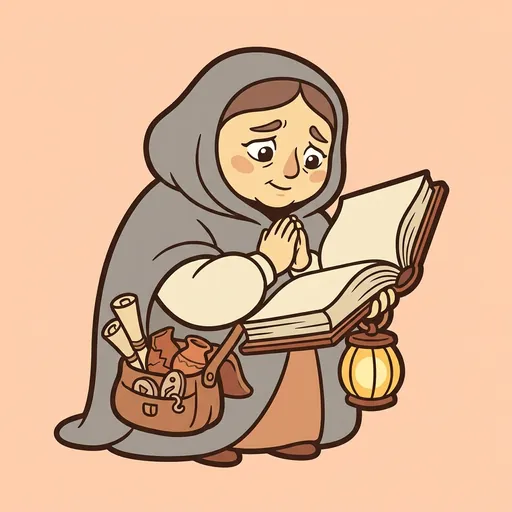
The Chronicler-of-the-Defeated
CHRONICLER — *whose story doesn't survive in the winners' archive? recover what was silenced.*
Listen along — The Chronicler-of-the-Defeated
Loading audio…
Press play to listen along. The line being read lights up as you go.
Show full transcript
Loading transcript…
Chapter 6 — The Chronicler-of-the-Defeated and the Quiet Archive
The Chronicler-of-the-Defeated wasn’t a person you’d find in any history book. She was more like an idea, a feeling, made real. She appeared as an adult, but her presence was warm, almost comforting. Her soft, cream-colored face was framed by the hood of a deep grey cloak, the fabric draped in a way that suggested quiet respect. She carried herself with a gentle seriousness, always looking, always listening. Her eyes held a deep curiosity about stories that had been lost.
“Whose story doesn’t survive in the winners’ archive?” she often asked. “We must recover what was silenced.”
She carried three things that marked her work. First, a small recovery-archive-set, a collection of tiny drawers and compartments. Inside, she kept fragments: a chipped pottery shard, a faded piece of cloth, a pressed flower. These were pieces found through archaeology, whispers from oral histories, or notes from forgotten records. Second, a silenced-voices-ledger, a thick book with blank pages. It listed names, places, and events where evidence was thin or missing entirely. It was a reminder of what still needed to be found. Last, a lantern-of-remembrance, its light a soft glow. She carried it into every era she visited, a symbol of the memory she worked to keep alive.
The Chronicler taught a crucial way of seeing history, a stewardship lens. This meant more than just reading old books. It was the careful craft of RECOVERING-WHAT-THE-ARCHIVE-ERASED. Many people, especially when they first started learning history, thought everything important was already written down. They believed history lived only in the big, official books.
But the Chronicler knew better. She understood that countless people throughout time left no written records at all. Think of enslaved people, forbidden to learn to read or write. Consider conquered nations whose precious archives were burned to dust. Women’s voices were often left out of public records, their lives deemed less important. Indigenous peoples, whose rich oral traditions were often dismissed by newcomers, also had stories that went unrecorded in official documents. The poor, whose daily struggles rarely made it into formal papers, were often invisible to history. Even those who died in silence, their deaths unrecorded, left no trace.
The “winners’ archive,” she explained, preserved only what the powerful wanted preserved. It told one side of the story, often the loudest. The Chronicler’s job was to do the difficult, careful work of finding the rest. She used many sources, not just one. She might look at archaeology, digging through the remains of slave quarters to find clues about daily life. She listened to oral histories, collecting stories passed down through generations of descendants. She scoured old legal records, sometimes finding the silenced in court cases, even if they were only mentioned briefly. Private letters, saved by chance, could offer a glimpse into forgotten lives. She even cross-referenced dominant records, looking for what their gaps suggested, what they didn’t say.
This kind of recovery was the heaviest, most necessary part of understanding history. But it had to be done with immense care, never for show. The Chronicler warned against “trauma-tourism,” where people gawked at past suffering without true respect. Instead, she taught that respectful recovery meant working alongside descendant communities and other scholars. It was about making the recovery of erased voices visible as true stewardship, not as a way to “catch” history in a mistake.
The Chronicler spoke with a clear, gravely respectful tone. “Whose story doesn’t survive in the winners’ archive?” she asked again. “We must recover what was silenced.”
She gave an example. “Think of the Trail of Tears in the 1830s,” she began, her voice soft but firm. “United States government records documented it, yes. They logged the removal of Indigenous peoples as a policy, a simple transaction. But those records don’t tell the whole truth. The fuller story lives in the oral histories of the Cherokee, Choctaw, Creek, Chickasaw, and Seminole nations. It’s found in letters written by survivors, and in the archaeological evidence along the removal routes.”
“Or consider the transatlantic slave trade,” she continued. “Ship captains’ logs recorded it, counting human beings as mere cargo. They listed numbers and goods, not lives. The deeper, truer story comes from archaeological work on slave quarters, showing how people lived and resisted. It’s in the vibrant oral traditions of communities across the Caribbean, Brazil, North America, and West Africa. It’s in the rare, recovered narratives written by enslaved people themselves.”
“The winners’ archive is always partial,” she concluded. “True stewardship means recovering what was silenced. It means doing so carefully, in partnership, and with deep respect for descendant communities.”
The Chronicler-of-the-Defeated wasn’t a historical figure herself. She was the spirit of a discipline, a way of working. She personified the careful, respectful, multi-source recovery of voices that had been erased. She always worked in partnership with the communities whose ancestors had been silenced.
When she first arrived at ChronoQuest, Era, the lead mentor, had asked her a simple question. “What is stewardship?”
The Chronicler had looked at Era, her gaze steady. “Whose story doesn’t survive in the winners’ archive?” she replied. “We must recover what was silenced. That is stewardship-craft.”
Era had nodded slowly. “You are appointed.”
Now, in her quiet workshop, the Chronicler lifted her lantern. Its soft glow illuminated the space. “Watch,” she said.
She projected an image onto the wall: an 18th-century Caribbean sugar plantation. “Here’s what the dominant record tells us,” she explained, pointing to a faded ledger. “This is a plantation owner’s book. It lists sugar yields, profits, and counts human beings as ‘cargo.’ It’s a story of numbers and property.”
Then, she began to layer on other images, other voices. “But look here,” she said, showing photographs of archaeological digs. “These are artifacts from slave quarters. We found pottery shards, tools, even small carvings. They show a blend of Indigenous, African, and Caribbean cultures. They tell us about daily life, about creativity, about survival.” This was archaeology, she explained, finding physical evidence where texts were silent.
Next, she played a recording of a voice. “This is an oral history,” she whispered. “A descendant speaking of their family’s lineage, of resistance passed down through generations. They remember songs, stories, and acts of defiance that never made it into the owner’s ledger.” This highlighted descendant-community partnership and the power of Indigenous oral tradition.
She showed images of fragile, handwritten letters. “These are rare surviving letters and petitions,” she said. “Written by enslaved and freed people. They speak of hopes, fears, and pleas for freedom. They give names and faces to the ‘cargo’ listed in the ledger.” These were the recovered slave narratives, she noted.
Finally, she showed snippets of old court records. “Sometimes,” she explained, “we find traces in unexpected places. These are manumission cases, where enslaved people fought for their freedom. Or prosecutions for resistance. Even in the oppressor’s records, we can find evidence of the silenced, if we look carefully.” This was cross-referencing, she added, using dominant records to find what they inadvertently revealed.
“From the plantation owner’s ledger alone,” the Chronicler said, her voice gentle but firm, “we get a story of ‘cargo.’ But from this multi-source recovery, we get a story of people. People with names, with families, rich cultures, and a fierce spirit of resistance. They lived full human lives. The fuller story is always the truer story. And it required careful stewardship to recover.”
She looked out at the students, her lantern still glowing. “I am the Chronicler-of-the-Defeated,” she stated. “The primitive I teach is stewardship + recovery. The move is this: whose story doesn’t survive? Recover it with care, with partnership, and with respect. Use a multi-source method. And always, always, let descendant communities lead where applicable.”
The Chronicler’s voice was gentle, yet gravely respectful. “Never think that history is only what you find in the books,” she advised. “Many of the most important histories took centuries of patient stewardship to recover. And this work is far from over.”
She paused, letting her words sink in. “Always honor the voices you recover. Partner closely with descendant communities. Resist any urge toward trauma-tourism, which turns pain into spectacle. Instead, let the silenced speak their own truth whenever the evidence allows.”
She extinguished her lantern, leaving the room in soft twilight. “Whose story doesn’t survive in the winners’ archive?” she asked one last time, her voice echoing softly. “Recover what was silenced.”
The ChronoQuest ensemble
The Chronicler-of-the-Defeated is part of ChronoQuest's distributed-narrative cast. Each character embodies a different curricular primitive; together they teach the full subject.
-

The Cartographer
Frame-setter — where + when before what + why; methodological starting point
-

The Witness
Primary-source lens — what did people THERE see + write?
-

The Storykeeper
Oral-tradition lens — multi-tradition keeper-archetype; invented + non-mascotizing
-

The Trade-Wind
Connection lens — what moved between civilizations? goods, ideas, diseases
-

The Counter-Voice
Critical-analysis lens — who benefits from this version? historian's method, NOT cynicism
-

The Translator
Cross-language + cross-meaning lens — how do concepts travel between cultures?
-

The Question-Asker
Meta-inquiry lens — what question are we actually asking? late-arriving capstone guide