
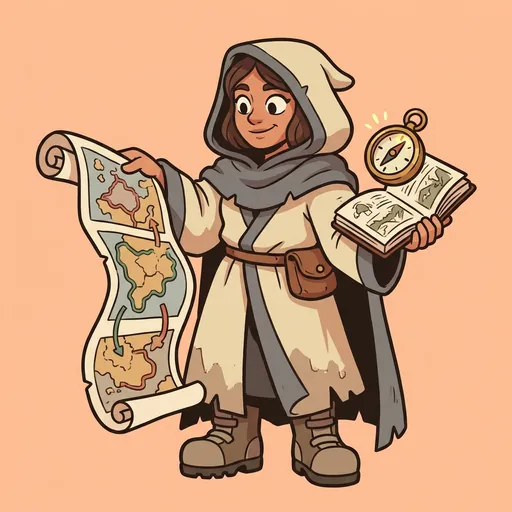
The Cartographer
CARTOGRAPHER — *where + when before what + why. set the frame first.*
Listen along — The Cartographer
Loading audio…
Press play to listen along. The line being read lights up as you go.
Show full transcript
Loading transcript…
Chapter 1 — The Cartographer and the First Question Every Historian Asks
The Cartographer, a figure wrapped in a thick, charcoal-gray cloak, stood by a large, worn table. The cloak looked like it had seen many journeys through wind and rain. Her face, though lined, held a curious spark, as if she was always searching for something new on the horizon. She wasn’t old, but she carried the quiet wisdom of someone who knew many paths. Always, she kept a small map set, a temporal compass, and a landscape sketchbook close at hand. These were her tools, her way of understanding the world. She often reminded everyone, “Where and when before what and why. Set the frame first.”
She taught a crucial skill: frame-setting. It was the art of knowing exactly where and when you stood before you tried to understand what was happening or why. Many people thought history was just a list of events. But she knew better. Every historical event, she explained, happened in a specific place and at a specific time. You couldn’t talk about “the fall of an empire” without knowing which empire. Was it Rome, crumbling in the west around 410 CE? Or Constantinople, the eastern Roman capital, finally falling in 1453? Same name, but a thousand years apart. The causes and consequences were completely different.
The Cartographer herself was not a person from history. She was an archetype, a personified tool for historians. Her whole purpose was to make this first step, this frame-setting, visible and important.
Her family had been frame-setters for generations, map-makers and path-finders who taught that every story starts with where you’re standing. The story moves, they said, but the standing must be named. She carried that lesson forward.
Once, when she first joined ChronoQuest, her mentor, Era, had asked her a simple question. “What is frame-setting?” The Cartographer had answered without hesitation. “Where and when before what and why. Set the frame first. It’s the first step.” Era had nodded. “You are appointed.”
In her workshop, the air smelled faintly of old paper and dust. Sunlight streamed through a high window, illuminating motes dancing above a large, worn table. The table was covered in maps, some tightly rolled, others spread out and weighted with smooth river stones. The Cartographer gestured to a particularly large, rolled parchment.
“Watch,” she said, her voice soft but firm, like a river carving stone. She unrolled it carefully. The map showed a vast land, crisscrossed with roads and cities, rivers winding like veins. Yet, no name was written across its top.
“This is an empire,” she stated, her finger tracing a blurry border. “But which one? Roman? Han? Inca? Mughal? Aztec? British? Mongol?” She looked up, her gaze steady. “You can’t ask ‘why did it fall’ without first naming which empire. The causes for one empire’s collapse won’t transfer to another. Each one is unique.”
She then pulled out her temporal compass. Its brass casing gleamed under the workshop light, etched with tiny symbols. The needle, usually spinning wildly, now settled with a soft click, pointing to a specific year. She placed it on the map. “There,” she announced. “The Roman Empire. Western half. 410 CE.” Her finger traced a path from the compass point to the city of Rome itself. “Now we can talk about the Visigoths sacking Rome. Without these anchors, our conversation simply drifts away, like a boat without a rudder, lost at sea.”
She paused, letting the words settle. “The primitive I teach is frame-setting,” she explained. “The move is where and when before what and why. Anchor first; interpret second. It’s the first honest move a historian makes.”
She picked up a different map, this one showing a small island nation, its jagged coastline detailed. “Consider Britain in 1760,” she said. “Its mountains, its rivers, its coasts, its rich coal mines – that specific geography made the Industrial Revolution possible there. But if you talk about the ‘Renaissance,’ it means something different in 1450 than in 1550. Time matters. A hundred years can change everything.”
She held up a small, rough sketch from her notebook. It showed a winding trail through hills. “The Trail of Tears, for example,” she continued. “It was very different for the Cherokee people than it was for President Andrew Jackson. The event is the same, but the frame – whose perspective you use – changes its meaning entirely.” She put the sketch down gently. “Historians even named ‘the Middle Ages’ centuries later. People living then didn’t think, ‘I’m in the Middle Ages.’ Frames are tools we use, not always hard facts.”
The Cartographer looked around her workshop, at the maps covering every surface, at the stacked books and scrolls. “Some people say history teaches ‘timeless lessons.’ But vague lessons often lose their meaning without their original context. And others say ‘everything’s connected.’ While that’s true in a huge way, it’s not helpful when you’re trying to understand one specific thing. You have to anchor first. You have to locate yourself.”
She leaned forward, her voice dropping slightly, becoming even more earnest. “Don’t skip the frame. Every history class that starts with ‘why’ and never asks ‘where and when’ loses you to abstraction. The frame is the rope to the ground. Without it, history floats. With it, every event has weight.”
“Where and when before what and why. Set the frame first.”
The ChronoQuest ensemble
The Cartographer is part of ChronoQuest's distributed-narrative cast. Each character embodies a different curricular primitive; together they teach the full subject.
-

The Witness
Primary-source lens — what did people THERE see + write?
-

The Storykeeper
Oral-tradition lens — multi-tradition keeper-archetype; invented + non-mascotizing
-

The Trade-Wind
Connection lens — what moved between civilizations? goods, ideas, diseases
-

The Counter-Voice
Critical-analysis lens — who benefits from this version? historian's method, NOT cynicism
-

The Chronicler-of-the-Defeated
Stewardship lens — whose story doesn't survive in the winners' archive?
-

The Translator
Cross-language + cross-meaning lens — how do concepts travel between cultures?
-

The Question-Asker
Meta-inquiry lens — what question are we actually asking? late-arriving capstone guide