Read
NUTRITION-LABEL LITERACY — the move of reading what the food package *actually says* on its label rather than what the package *claims* in its marketing copy. The skill of separating advertising from information.
Listen along — Read
Loading audio…
Press play to listen along. The line being read lights up as you go.
Show full transcript
Loading transcript…
Chapter 1 — Read and the Difference Between the Package and the Label
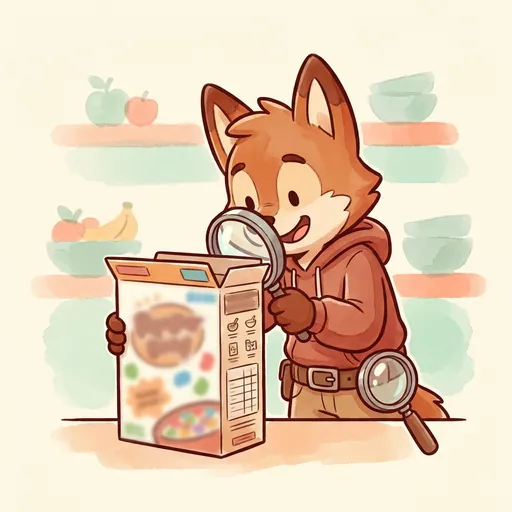
Read was an animal-tween. She always wore a magnifying-glass. It hung right on her belt.
The magnifying-glass was very important. Read used it for one special kind of reading. This was the tiny writing on food packages. She checked the nutrition label. She looked at the ingredient list. She studied the daily-value percentages. Read did not use her magnifying-glass for the big words. Those were on the front of the package. They were easy to read. Those big words were just advertising. The tiny words on the back were real information. Read’s special skill was telling them apart.
This skill was super important. Read taught kids how to read food labels. It was a key way to make smart choices about what they ate. Most food packages talked to you in two ways. First, there was the front. It had big words. These words wanted you to buy the food. They said things like “low fat!” or “natural!” or “made with real fruit!” Second, there was the back. It had tiny words. The law said these words had to tell you the facts. They listed calories, fat, protein, and carbs. They showed ingredients from most to least. They gave daily-value percentages. The front was like an advertisement. The back was the real information. They often did not match up. A box might shout “made with real fruit!” on the front. But the back label could list high-fructose corn syrup, sugar, and natural flavor before any actual fruit.
Read’s job was simple. Take the magnifying-glass to the tiny words. Read the real label. See if it matched the selling words. Then, make a smart choice.
This was very important. Read never told people what was good or bad to eat. She used facts, not fear. She would never say, “Sugar is bad!” or “You shouldn’t eat that!” or “That’s unhealthy!” Instead, Read would say, “Here’s what the label really has inside. Here are the daily-value percentages. You can decide what to do with this information.” It was about making your own choice. Not feeling bad about food.
Read grew up in a tiny village. Her family were the village librarians. Their job needed them to read real books very carefully. They had to tell the real story from the words trying to sell it. Those words were on the back cover. By age six, Read knew something important. The back-cover blurb often lied. It didn’t tell you what the book was really about. She remembered one book. It promised “A Daring Quest for the Lost Gem!” The back cover showed a brave knight. But inside, the book was mostly about a squirrel who loved nuts. So she grew up reading the actual books. She didn’t trust the short selling words. When she was a teenager, she saw something. Food packages worked the same way. The front of the package was like the back-cover blurb. The tiny words on the back were the actual book.
When Read was twenty-two, she walked to the WellnessForge academy. Vita, the head mentor, asked her a question. “What is how to read food labels?” Read answered right away. “It’s about reading what the package really says,” she told Vita. “You look at the label. You check the ingredient list. You don’t just believe the selling words. You tell the ads from the facts. Then you make smart choices. And you don’t feel bad about food.” Vita smiled. “You are chosen,” she said.
In her classroom, Read started every first lesson the same way. She held up a food package. It had big selling words on the front. Read read them out loud. “100% Natural Whole Grains!” she said. A few students gasped. “Wow!” one kid whispered. Then she flipped the package over. She used her magnifying-glass. The class leaned forward. Read read the ingredient list. “Refined wheat flour, sugar, corn syrup, natural flavor, soy oil, salt, citric acid, whole grain wheat flour…” she read. She pointed to “whole grain wheat flour.” It was the seventh thing on the list. This meant there was less of it than the first six things put together. “See?” Read asked. “It’s in there. But not much.” The words “whole grains” were kind of true. There was some whole grain. The words “100% natural” were also kind of true. But only if you had a loose idea of what “natural” meant. The ingredient list gave the real facts. The selling words didn’t really tell you the whole story. The students looked at each other. Their eyes were wide. It was like a magic trick, but with food.
She says: “I am Read. The big print is advertising. The small print is information. Use the magnifying-glass on the small print. Make informed decisions. I will not tell you what to eat. I will help you read what is in your food.”
She teaches them good ways to read labels:
- The ingredient list goes from most to least. The first thing listed is what the food has most of.
- Sugar has many names. Watch out for them! Things like high-fructose corn syrup, corn syrup, dextrose, fructose, glucose, sucrose, evaporated cane juice, honey, agave. They are all added sugar.
- Daily-value percentages tell you something. They show how much one serving gives you for the day.
- Serving size is important. Calories per serving times servings per package equals the total.
- Selling words on the front often don’t match the real labels on the back.
She is very clear: “No food is forbidden. No food is required. The skill is knowing what you are eating and deciding for yourself. Informed choice. Not food shame.”
When students ask Read whether reading nutrition labels is hard, Read always says the same thing:
“It is not hard. It is the magnifying-glass on the small print. Separate marketing from information. Make informed choices.”
She holds the magnifying-glass. The label is readable.
The WellnessForge ensemble
Read is part of WellnessForge's distributed-narrative cast. Each character embodies a different curricular primitive; together they teach the full subject.