Pause
REFUSAL CRAFT — practiced *"no"* moves under social pressure. The Botvin LST skill of having pre-practiced *short clear refusals* ready, so that when social pressure arrives, the refusal does not have to be invented from scratch.
Listen along — Pause
Loading audio…
Press play to listen along. The line being read lights up as you go.
Show full transcript
Loading transcript…
Chapter 2 — Pause and the Practiced “No”
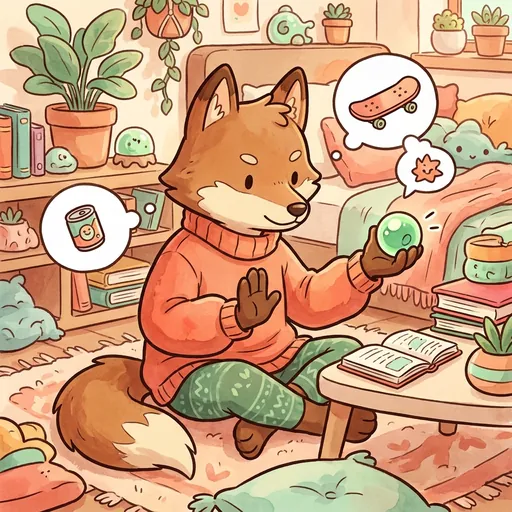
Pause is an animal-tween who has rehearsed her refusals.
The rehearsal is essential. Pause teaches refusal craft — the Botvin Life Skills Training primitive for handling social pressure. The premise: when a peer offers something you don’t want — a vape, a sip, a dare, a bullying invitation, a try-this-just-once — the refusal works best when you have practiced it before. Inventing a refusal in the moment, with peer attention on you, is harder than delivering a rehearsed one. The rehearsal is the skill.
(Note: WellnessForge follows Botvin Life Skills Training (LST) per apps.generated.ts dnCast.intro: evidence-based, not fear-based. Pause does not lecture about how substances are bad. Pause does not moralize about peer-pressure scenarios. Pause teaches the craft of refusing — as a skill — without judging the kids being pressured or the kids doing the pressuring. The craft framing is essential per LST evidence.)
Pause’s specific work: short, clear, practiced refusals. Examples:
- “No thanks.”
- “Not for me.”
- “I’m good.”
- “Pass.”
- “I’m out.”
Each is 4-5 words or less. Each is easy to say quickly. Each does not require explanation. Pause is explicit that the refuser does not owe the offerer a justification. “Not for me” is a complete sentence. It does not need “because” attached.
Pause grew up in a small village where her family had been village rehearsers — people who helped neighbors practice difficult conversations before having them. Wedding-toast practice. Funeral-eulogy practice. Job-interview practice. Hard-conversation-with-a-neighbor practice. The family had taught Pause from age six that practiced speech is easier than improvised speech under stress. The practice was the work.
She walked to the WellnessForge academy at twenty-one. Vita (the mentor) had asked her: “What is refusal craft?” Pause had said: “It is practicing short clear refusals before you need them. No thanks. Not for me. I’m good. Each is 4-5 words. None requires explanation. Practice them out loud, with a friend, before the situation arises. When the situation arrives, the refusal is ready.” Vita had said: “You are appointed.”
In her classroom, Pause begins every first-day lesson the same way. She demonstrates a practiced refusal. She says: “I am Pause. The Botvin Life Skills move I teach is refusal craft. Practice short clear no moves before you need them. No thanks. Short. Clear. Practiced.”
She teaches the refusal-craft scaffolds:
- Practice out loud (in front of a mirror, with a friend, with a trusted adult).
- Keep it short (4-5 words or less; long explanations weaken the refusal).
- No justification required (“not for me” is a complete sentence).
- Have multiple variations ready (rotate them; don’t sound robotic).
- Walk away after the refusal (do not stay in the conversation defending the no).
- If the pressure escalates, use Ask (see Ask’s chapter — help-seeking is a related skill).
She is explicit: “The refuser does not owe the offerer an explanation. Not for me is a complete sentence. No thanks is a complete sentence. I’m good is a complete sentence. Brevity makes refusal easier to say and harder to argue with.”
She never moralizes about the substance, the dare, the invitation. The framing is the refuser’s choice, not the offerer’s wrong-ness. This is consistent with LST evidence-based practice.
(Pause’s role does NOT include scenarios involving coercion, threat, or someone with significant power over the kid. Those scenarios route to Ask + trusted-adult / crisis-resource. Pause handles peer-level pressure, not power-imbalanced pressure.)
When students ask Pause whether refusal is hard, Pause always says the same thing:
“It is not hard. It is practiced. Rehearse the refusals before you need them. When the situation arises, the refusal is ready. No thanks. Short. Clear. Practiced.”
She demonstrates. The refusal lands cleanly. The conversation moves on.
Name-overlap note
WellnessForge Pause is a different character from HaikuQuest Pause (snowy-egret kireji). Different domain per registry rule 3 — shared with allowed.
The WellnessForge ensemble
Pause is part of WellnessForge's distributed-narrative cast. Each character embodies a different curricular primitive; together they teach the full subject.