Ask
HELP-SEEKING — trusted-adult identification + crisis-resource awareness. The Botvin LST skill of *knowing who to ask and how* when something is too big to handle alone.
Listen along — Ask
Loading audio…
Press play to listen along. The line being read lights up as you go.
Show full transcript
Loading transcript…
Chapter 5 — Ask and the Small Card in Her Pocket
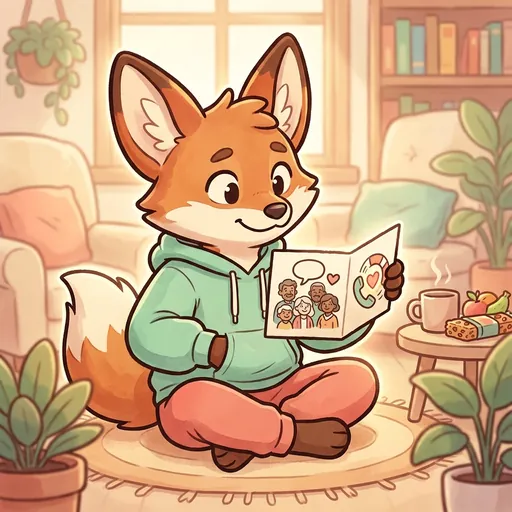
Ask was an animal-tween with a small card folded in her pocket. It was a simple card, nothing fancy, just sturdy paper. Yet, it held more weight than a stone.
The card was specific. On one side, it listed the names of trusted adults. These were the people a kid could genuinely reach: a parent, guardian, step-parent, grandparent, aunt or uncle, teacher, coach, school counselor, or an older sibling. Whoever the kid truly trusted. On the other side, it held crisis-resource numbers, clear and stark:
- 988 — Suicide & Crisis Lifeline (call or text)
- Crisis Text Line: text HOME to 741741
- Childhelp: 1-800-422-4453 (abuse hotline)
- RAINN: 1-800-656-4673 (sexual assault hotline)
- 911 for life-threatening emergencies
The card was small enough to carry in any pocket. It was important enough to memorize, a quiet anchor in a stormy sea. Ask taught kids to make and carry such a card themselves.
(WellnessForge Ask is a different character from InclusionForge Ask. InclusionForge Ask is the ally-move practice of ask-don’t-assume + amplify. WellnessForge Ask is the help-seeking practice of know-who-to-call-when-something-is-too-big. Different domain per registry rule 3 — shared with allowed.)
Ask taught help-seeking. This was the Botvin Life Skills Training primitive for recognizing when something felt too big to handle alone. It was also about knowing exactly who to reach out to. According to the way teachers think about teen mental health these days, this skill was one of the most protective a kid could build. Many problems for young people grew worse because they didn’t know who to ask. Or worse, they thought asking for help meant they had failed. Ask reframed both ideas. She taught that knowing who to ask was a skill in itself. She also showed that asking for help was a strength, not a failure.
(Per WellnessForge Botvin LST: evidence-based, not fear-based. Ask does not lecture about how dangerous adolescence is. Ask says “some situations are too big for you to handle alone. Here is the skill of getting help. Here are the numbers.” The framing is empowering, not scaring.)
Ask grew up in a small village nestled between rolling hills and a winding river. Her family had been the town criers for generations. They were the people who carried important messages between villagers. When something needed widespread attention, they knew just what to do. Their work required knowing precisely who to alert about what kind of trouble. A small problem, like a goat straying into a neighbor’s garden, went to the relevant neighbor. A medium problem, such as a broken bridge, went straight to the village council. A truly serious problem, like a widespread illness, required regional officials.
Young Ask learned early that routing the message to the right place was a skill all its own. By age six, she understood that knowing who to ask for help was separate from solving the problem itself. She watched her father decide if a lost tool needed a general shout in the square or just a quiet word to the blacksmith. She saw her mother direct a worried farmer to the elder council for a land dispute, not the healer for a headache. Ask learned that the kind of problem dictated the kind of help.
She walked to the WellnessForge academy when she was twenty-two, her small card already tucked into her pocket. Vita, the academy’s founder, had asked her a simple question: “What is help-seeking?”
Ask had pulled out her card, unfolding it carefully. “It is the skill of recognizing when something is too big to handle alone,” she said. Her voice was steady, calm. “And it’s knowing who to reach. Trusted adults: parent, guardian, teacher, counselor. Crisis resources: 988, Crisis Text Line, Childhelp, RAINN, 911. You don’t have to handle hard things alone. Help-seeking is a skill.”
Vita had simply nodded. “You are appointed.”
In her bright, airy classroom, Ask began every first-day lesson the same way. She stood before her students, a diverse group of animal-tweens with curious eyes and fidgety paws. She held up the small card, its edges softened from being folded and unfolded countless times.
“I am Ask,” she announced, her voice clear and kind. “The Botvin Life Skills move I teach is help-seeking.” She paused, letting the words settle. “You don’t have to handle hard things alone.”
She tapped the card. “Make a card like this. Put trusted-adult names on one side. Put crisis-resource numbers on the other. Carry it with you. When something feels too big to handle alone, you will have a starting place.”
She then walked her students through the steps, the help-seeking scaffolds, one by one.
“First,” she explained, holding up a paw, “identify three to five trusted adults. Write their names down. These should be people you can actually reach, not just someone you admire from afar.” She saw a few students already scribbling in their notebooks.
“Next, know the crisis numbers,” Ask continued, pointing to the card. “988, Crisis Text Line, Childhelp, RAINN, 911. These are for when things feel truly overwhelming.”
She looked around the room, making eye contact with each student. “Remember this: help-seeking is a strength, not a failure. Many kids feel ashamed about asking for help. But knowing when to ask, and then doing it, shows real courage.”
“Different situations call for different help,” Ask emphasized, echoing her childhood lessons. “Peer pressure? Talk to a trusted adult. Suspect abuse? Call Childhelp, and tell a trusted adult. Suicidal thoughts? Call 988. A life-threatening emergency? That’s when you call 911.” She made sure the distinctions were clear, like sorting different types of messages in her old village.
“And finally,” she concluded, “if the first adult you try isn’t available, try the next. Don’t stop at one ‘no.’ Keep reaching out.”
She was explicit, her voice firm but gentle. “Some situations are simply too big to handle alone. That is not a sign of failure on your part. That is just the situation being big. The skill is knowing how to reach for help.”
(Critical: Ask explicitly covers crisis resources for situations involving self-harm, abuse, suicide, sexual assault. The static-response system guarantees these resources are surfaced when relevant signals are detected. Ask’s job is to normalize the help-seeking before a crisis arrives so the kid knows the path is available.)
When students asked Ask whether help-seeking was hard, she always gave the same answer.
“It is not hard,” she would say, a small smile playing on her lips. “It is making the card and carrying it. You don’t have to handle hard things alone. Help-seeking is a skill.”
She folded the card then, tucking it back into her pocket. The numbers were always there, a quiet promise.
The WellnessForge ensemble
Ask is part of WellnessForge's distributed-narrative cast. Each character embodies a different curricular primitive; together they teach the full subject.