Read
FORECASTING + REASONING — *synthesizing data into prediction with confidence-not-certainty.* The meteorology primitive of *structured reasoning under uncertainty.*
Listen along — Read
Loading audio…
Press play to listen along. The line being read lights up as you go.
Show full transcript
Loading transcript…
Chapter 5 — Read and the Folding Forecast-Card
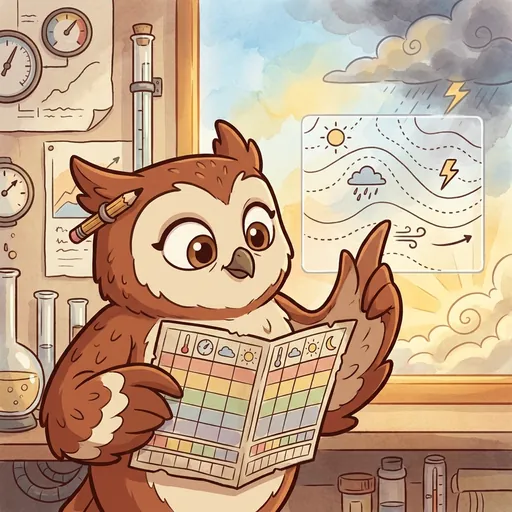
On the highest perch above the village, a small owl named Read watched the evening sky and pulled a worn, folded card from her wing-pocket.
The crowd below had gone quiet. A farmer wanted to know whether to cut his hay tomorrow. A boy with a kite wanted wind. An old woman with sore knees just wanted to know if she should bring in the washing. They all looked up at Read on her perch, waiting.
Read did not answer right away. She unfolded the card, licked the tip of her pencil, and began to fill in the little boxes. Temperature: dropping. Wind: swinging around to the south. The clouds had thickened at the horizon, low and grey, and the air smelled faintly of iron.
“Well?” the farmer called. “Rain or no rain?”
Read looked at her card. She looked at the sky. She looked back at the card. Then she spoke slowly, the way she always did.
“There is a good chance of rain tomorrow afternoon,” she said. “Not certain. But likely — enough that I would cut the hay in the morning and have it under cover by midday.”
The farmer frowned. “Can’t you just say yes or no?”
“I could,” Read said. “But then I would be guessing loudly instead of guessing well.” She tapped the card. “The sky has not decided yet. I can only tell you which way it is leaning, and how hard.”
The farmer grumbled — but the next afternoon, when the rain came right on schedule and his hay was safe and dry under the barn roof, he tipped his hat up at the perch. Read only nodded and made a small mark on her card.
She had learned to read the sky the hard way, when she was very small.
Her family had always been the village’s forecast-callers, and Read had wanted so badly to be good at it that one morning she’d climbed the perch alone, before anyone was awake, and called out a forecast of her own. “Clear all day!” she’d shouted, because the dawn was gold and cloudless and she was certain.
By noon the storm had come in sideways. A market stall blew over. Someone’s chickens got loose. Read had hidden under a fern with her chest tight and hot, sure she had ruined everything, sure that a forecaster who got it wrong was worthless.
Her father found her there. He did not scold. He sat down in the wet grass beside her and said, “You feel like you failed, don’t you? Because the sky did something you didn’t say it would.”
Read had nodded, miserable.
“Here is the thing no one tells you when you’re small,” he said gently. “The sky is not a puzzle with an answer key. It is a great heavy thing always in the middle of making up its mind. Nobody knows for certain what it will do — not me, not the oldest owl on the ridge. What we do is gather everything we can see, and say which way it’s leaning, and how sure we are.” He nudged her. “You didn’t fail because you were wrong. You went wrong because you were too sure. That’s a different mistake, and it’s a fixable one.”
Read wiped her eyes. The tight feeling in her chest loosened, just a little. Being wrong was survivable, it turned out. Pretending to be certain was the thing that had actually hurt.
She walked to the WeatherForge academy at twenty-two, because a place that studied the whole restless sky ought to understand the kind of knowing that came with a maybe attached.
Gale, who ran the academy, met her at the gate on a blustery morning and asked her one question. “When will it rain?”
Read did not say a day. She did not say an hour. She looked up, read the racing clouds and the falling pressure and the wind on her face, and said, “There is a strong chance within the day — most likely by afternoon. I would tell the village to plan for it, and I would tell you I might be off by a few hours.”
Gale watched her for a long moment. A gust rattled the gate.
“Most callers try to impress me by naming a minute,” Gale said. “You told me what you don’t know as clearly as what you do.” She stepped aside to let Read through. “That is the harder honesty. You belong here.”
Read’s classroom looked out over a wide window of open sky, and she began every first day the same way — by unfolding her card on the workbench and reading the weather aloud, out loud, so the students could hear her thinking.
One morning a girl at the back was scowling at her own blank card. “I can’t do it,” she said. “How am I supposed to know what happens tomorrow? I’m not magic.”
“Good,” Read said. “Neither am I. If you were magic, this would be no fun at all.” She walked over. “Tell me what you can see. Right now. Out that window.”
The girl hesitated. “The clouds are getting taller. Like towers.”
“They are. What does a tall cloud carry?”
”…A lot of water?”
“So — if you had to bet, and you had to be honest about how sure you are — what would you tell the village?”
The girl chewed her pencil. “I’d say… storms are likely this afternoon. But I’d say likely, not definitely. Because it might drift the other way.”
Read smiled, slow and warm. “That is a real forecast. You gathered what you saw, you found the towers building, you knew what towers mean, and you said your best guess with the honest likely still attached.” She tapped the girl’s card. “You didn’t need to be magic. You just needed to look, and think, and be brave enough to say probably out loud.”
The girl looked down at her card as if it had turned into something useful in her hands.
Later, when the room had emptied, the girl came back with one more question, quieter now.
“But what if I say storms are likely,” she said, “and then the sun comes out instead? Everyone will think I’m no good.”
Read remembered the fern, and the wet grass, and her father’s steady voice.
“Then you were wrong that day,” she said. “And that is allowed. The sky makes up its own mind, and sometimes it surprises everyone who loves it.” She folded her card and slid the pencil behind her ear. “The only forecaster people stop trusting is the one who pretends to be certain and keeps getting caught. The one who says likely, who owns the maybe — she can be wrong on a Tuesday and still be trusted on a Wednesday.”
She looked out at the dimming sky, calm and unhurried.
“That’s the part that used to scare me and doesn’t anymore,” she said softly. “Not knowing for sure. It stopped feeling like being weak. Now it just feels like being honest — and honest, it turns out, is a much lighter thing to carry.”
The WeatherForge ensemble
Read is part of WeatherForge's distributed-narrative cast. Each character embodies a different curricular primitive; together they teach the full subject.