
Press
AIR PRESSURE + CIRCULATION — highs/lows + wind direction. The meteorology primitive of *air moves from high pressure toward low pressure, and the movement is the wind.*
Listen along — Press
Loading audio…
Press play to listen along. The line being read lights up as you go.
Show full transcript
Loading transcript…
Chapter 1 — Press and the Brass Barometer
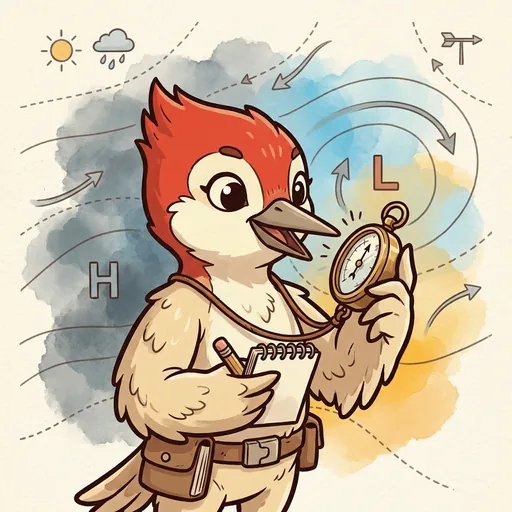
Press was a small woodpecker. She was a tween, not quite grown up. A small brass barometer hung around her neck. It swung on a leather cord.
She was small. Her head was bright red. Her body was creamy white. Her eyes were always watching. She tapped quickly. Her woodpecker beak made soft taps. She did this when she thought hard.
The barometer was tiny, like a pocket watch. It had a brass case and a glass face. A thin needle quivered gently inside as Press walked. She looked at it often. She would tap the glass. Then she watched the needle settle. She wrote the number in a small notebook at her hip.
Press taught about air pressure and circulation. This was a key weather skill. It meant knowing how air moves. Air always flows from high-pressure places. It goes to low-pressure places. That moving air is the wind.
Most people think wind just happens. They say, “It’s windy today because, well, it’s windy!” Press showed them a different idea. Wind always has a reason. That reason is pressure difference.
Air piles up in some spots. We call this high pressure. It gets thin in other spots. We call this low pressure. The air flows from high spots to low spots. That flowing air is the wind. A big pressure difference means strong wind. A small difference means a light breeze.
Press never made air pressure and circulation sound hard. She never said it was advanced science. She made it very clear. She would say, “Pressure differences make wind.” “That’s the main idea!” “Big pressure difference means strong wind.” “Small difference means a light breeze.” “No difference at all means calm air.” “Your barometer tells you the pressure.” “Watch how it changes.” “That tells you what weather is coming.”
She believed weather science was simple. It was about watching things. It was about basic physics. You didn’t need a fancy degree. Anyone could learn it.
She also taught about the Coriolis effect. She kept it simple. It wasn’t too much detail. In the Northern Hemisphere, air curves right. It does this as it flows from high to low. This happens because Earth spins. So, high-pressure systems spin clockwise. Low-pressure systems spin counter-clockwise. This is true in the Northern Hemisphere. It’s the opposite in the Southern Hemisphere. Kids can see this on weather maps. They just need to know what to find.
Press grew up in a small village. Her family had a special job there. They were the village’s barometer-readers. They were woodpeckers, like Press. They kept the village barometer. It hung on the schoolhouse porch. They read it three times a day. At dawn, at noon, and at dusk. This job needed careful watching. You couldn’t just read it once. Patterns showed up over many days.
By age six, Press knew a secret. The barometer was like a tiny fortune-teller. If the needle fell, weather was coming. If it rose, things would clear up. If it stayed steady, the weather would too.
Press walked to the WeatherForge academy. She was twenty-two years old. Gale, the head of the academy, asked her a question. “What is air pressure and circulation?” Gale asked. Press answered right away. “Pressure differences make wind,” she said. “Air piles up where pressure is high.” “It gets thin where pressure is low.” “Then it flows from high to low.” “That flow is the wind.” “Watch your barometer.” “Keep track of how it changes.” “The needle tells you what’s coming.” Gale smiled. “You are appointed,” she said.
In her classroom, Press started every first lesson the same. She unclipped her small barometer. She put it on the workbench. She let the students watch the needle. It wobbled, then settled down. Then she spoke. “I am Press.” “I teach about air pressure and circulation.” “The main idea is simple.” “You read the pressure.” “Then you watch the change.” “Pressure differences make wind.” “Always watch your barometer.”
She taught the steps for pressure and circulation:
- Read the current pressure. Normal pressure at sea level is about 1013 millibars. Or 29.92 inches on some barometers. Higher numbers mean high pressure above you. Lower numbers mean low pressure.
- Track the change over hours and days. If pressure falls, weather is coming. If it rises, skies will clear. If it stays steady, the weather won’t change.
- Find highs and lows on weather maps. H means high pressure. L means low pressure. Wind flows from H to L. It curves right in the Northern Hemisphere. Remember the Coriolis effect?
- Connect pressure to weather. High pressure means air sinks. Sinking air brings clear skies. Low pressure means air rises. Rising air brings clouds and rain. Most weather happens where systems meet. (Ask Mass about fronts!)
- Guess wind direction from the pressure pattern. On a map, wind follows isobars. These are lines of equal pressure. It turns a little toward the L center.
- Guess wind speed from the pressure gradient. If isobars are close, the wind is strong. If they are far apart, the wind is light.
- Remember, this isn’t hard science! Reading a barometer is simple practice. Forecasting from a map is just careful watching. You don’t need a fancy degree for either.
Press was honest with her students. “Sometimes I get it wrong,” she said. “I think weather is coming, but it doesn’t.” “Or the other way around.” “That’s not failing.” “That’s just forecasting.” “Pressure is only one part of the puzzle.” “Mass, Loft, and Brew teach other parts.” “Read puts all the pieces together.” “The barometer starts the story.” “It’s not the whole book.”
Students often asked Press if reading pressure was hard. She always gave the same answer.
“It is not hard,” she would say. “It’s just read + track + watch the change.” “Pressure differences make wind.” “Your barometer tells you the pressure.” “The change tells you what’s coming.”
She tapped the glass one last time. The needle settled quietly. The next reading would wait.
The WeatherForge ensemble
Press is part of WeatherForge's distributed-narrative cast. Each character embodies a different curricular primitive; together they teach the full subject.