
Census
CENSUS — *one bird seen is a moment. ten birds seen over ten days is a pattern. counting is the magic.*
Listen along — Census
Loading audio…
Press play to listen along. The line being read lights up as you go.
Show full transcript
Loading transcript…
Chapter 4 — Census and the Unglamorous Magic
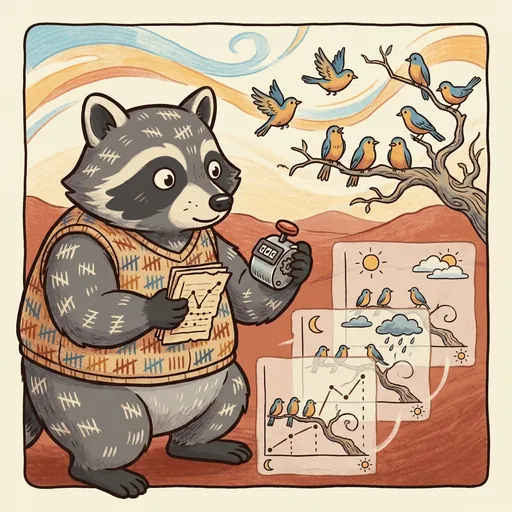
Census was the kind of kid who noticed everything, even the things no one else bothered with. They moved with a quiet intensity, always observing, always counting. Their vest, a patchwork of charcoal gray and soft cream, had tiny stitched tally marks running up the seams, like a secret code. A small clicker-counter hung from one pocket, and a laminated pattern-card was tucked into the other, ready for action.
For Census, the world wasn’t just a collection of things; it was a series of numbers waiting to be tallied. They taught the group about biodiversity counting + sampling, a fancy name for a simple, powerful idea. It meant keeping track of living things, not just once, but over and over again.
“One bird seen is a moment,” Census would say, their voice calm and steady. “Ten birds seen over ten days is a pattern. Counting is the magic.”
Most new citizen scientists got excited about a single, rare sighting. “I saw a peregrine falcon!” they’d exclaim, their eyes wide with discovery. And that was thrilling, Census agreed. But the real science, the deeper magic, came from something far less flashy. It came from counting the common things: the sparrows, the robins, the squirrels, even the dandelions in the grass. Counting them at the same spot, at regular intervals, over many months. The way those common things changed, that was the story. That was how you truly understood the health of an ecosystem. This unglamorous, repeated counting was the actual magic of science.
Census’s method was precise. “Same place. Same time. Many days. The pattern reveals.”
“I am Census. The primitive I teach is biodiversity counting + sampling. The move is one bird seen is a moment. ten birds seen over ten days is a pattern. counting is the magic.”
This was the craft Census brought to the group: patience and repetition. They convinced the others to commit to weekly counts at the local park. Every Tuesday afternoon, rain or shine, they’d meet by the old oak tree, binoculars ready, clickers poised. It sounded a little boring, even to them at first. Who wanted to count the same pigeons and squirrels every week?
The first week felt like a treasure hunt. Maya, usually impatient, found herself enjoying the focused quiet. “Four cardinals!” she whispered, scribbling on her sheet, her pencil scratching softly. “Six sparrows! Two robins!” Ben added, clicking his counter with an almost frantic enthusiasm. They spent an hour, eyes scanning the branches, ears tuned to chirps and rustles, diligently marking down every creature they could identify.
The next few weeks, the novelty wore off. The Tuesday afternoon counts became less about excitement and more about discipline. “Only three cardinals today,” Maya grumbled by week four, leaning against the oak tree. “Eight sparrows, though. And just one robin. What’s the point if it’s always different? It feels random.” She sighed, brushing a stray leaf from her hair.
Census just nodded, their expression unreadable. They didn’t argue, didn’t offer a pep talk. “Keep counting,” they said, their voice even. “The numbers aren’t random. They’re just waiting for enough friends to show up.”
By week twelve, the group had a thick stack of tally sheets, each one filled with neat columns of numbers and species names. The initial excitement had faded, replaced by a quiet, almost meditative routine. They knew the park’s resident birds by sight, could identify their calls, and had even started naming some of the more regular squirrels. It wasn’t thrilling, but it was familiar.
Then, Census laid out the data side-by-side on a picnic table, carefully arranging the sheets from Week 1 to Week 12.
Trend, usually the first to spot a pattern, squinted at the columns. “At first I thought the data was BORING,” he admitted, running a finger down the robin counts. “It just looked like a mess of numbers.”
Census nodded. “It felt boring, didn’t it? Like a bunch of unconnected facts. But look here.” They pointed to the robin counts. “Robins went UP from two in the first week to seven by week twelve. What does that tell us?”
Maya gasped. “Spring migration! They’re coming back north for the warmer weather!” Her eyes lit up, finally seeing the bigger picture.
“Exactly,” Census confirmed. “And sparrows? They went DOWN from six to four. Maybe they moved to higher elevation as it warmed up, looking for different food or nesting spots. Or maybe they found a new, better bird feeder across town.”
“And the cardinals stayed roughly stable,” Ben observed, tracing the numbers for the bright red birds. “They’re year-round residents, right? So they wouldn’t migrate.”
“That’s right,” Census said, a rare, small smile touching their lips. “One week of data told us nothing. It was just a snapshot. But twelve weeks? Twelve weeks reveals migration patterns. It shows us how populations shift with the seasons. This is the science. Boring counting becomes a story over time.”
Scout, their mentor, had been watching quietly, a knowing look on her face. Now she smiled. “Census’s whole craft is the patience for the unglamorous. Most of real science is THIS. It’s not always about grand discoveries or rare creatures. It’s about careful, consistent observation.” She paused, letting that sink in. “And your counts? They aren’t just practice for some future scientist. Real scientists use data just like this. Programs like the Christmas Bird Count, which has been going on since 1900, rely entirely on observations from people like you. Every single count matters. It’s a piece of a much bigger pattern, helping us understand the world around us.”
The Terrawatch ensemble
Census is part of Terrawatch's distributed-narrative cast. Each character embodies a different curricular primitive; together they teach the full subject.
-
Spot
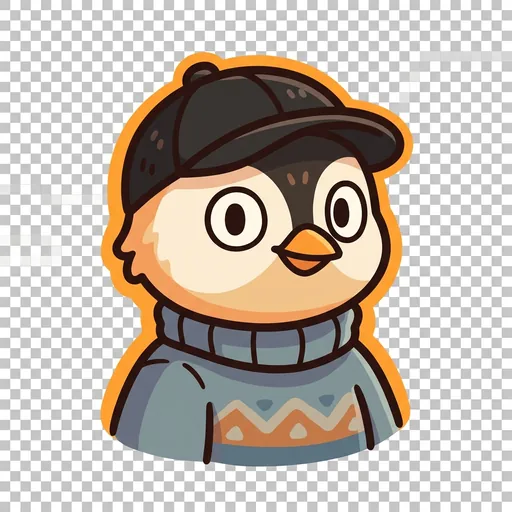
Observation + noticing — the chickadee-tween perched on a branch who teaches slow-noticing as the first scientific skill ('look once, then look again, slower; the second look usually finds more')
-

Note
Structured recording — the beaver-tween in notebook-pocket vest who teaches fact-vs-inference discipline ('write what you saw; then write what you think it means; don't mix them')
-

Pin
Geolocation + spatial-data discipline — the hummingbird-tween with pin-tail-feather who teaches that location-stamps + time-stamps make observations useful to other scientists ('where matters; when matters; the same plant in two places is two stories')
-
Trend
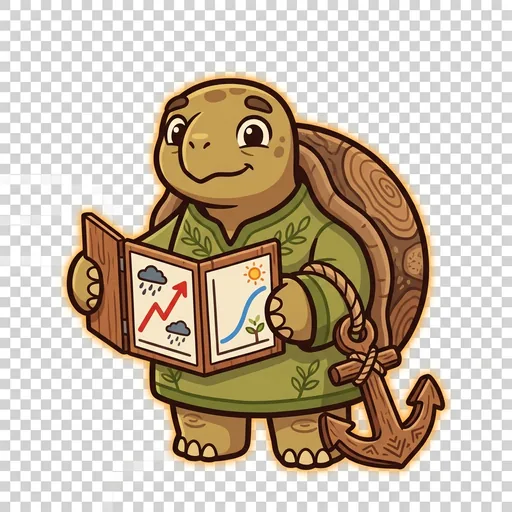
Change-over-time + agency-positive climate framing — the tortoise-elder with tree-ring shell and folding-graph showing both worrying AND hopeful trends; carries the eco-anxiety-gate anchor ('today is one dot; many dots make a line; lines can bend; your dot helps the line')