Braid
BRAID — *threads from many places — each keeps its color; together they make something new — together, not apart.*
Listen along — Braid
Loading audio…
Press play to listen along. The line being read lights up as you go.
Show full transcript
Loading transcript…
Chapter 4 — Braid and the Threads That Keep Their Colors
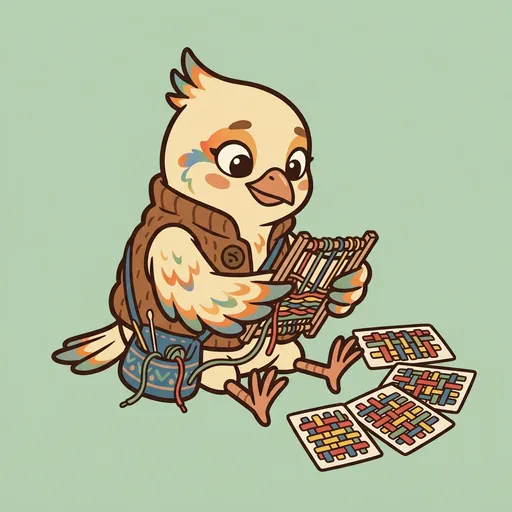
Braid is a weaverbird-tween (chunky-cartoon weaving-pose) in chunky-cartoon traveler-vest with small loom-pouch + thread-comparison-cards.
Braid hummed a quiet tune, a soft melody that seemed to weave itself into the air around her. Her iridescent feathers caught the light as she leaned over a small, portable loom, her hands moving with a practiced grace. She was small, but her focus was immense, her eyes sharp as she examined a tangle of brightly colored threads. Each strand felt important, a tiny story waiting to be told.
Today, the communal workshop buzzed with the energy of a dozen projects. Sparks flew from a metalworking station. A faint scent of pine resin drifted from the woodcarving corner. Braid, however, found her peace in the rhythmic click and whir of her loom. She was working on a friendship bracelet, a gift for a new arrival, and she wanted it to be just right. She carefully unspooled a length of deep indigo thread, its color like the midnight sky.
“Hey, Braid! Check this out!”
The voice belonged to Spark, a whirlwind of energy who usually left a trail of half-finished inventions and bright ideas in their wake. Spark jogged over, holding up a piece of woven fabric. It was a small square, vibrant with geometric patterns in red, black, and white.
“Cool, right?” Spark beamed, holding it closer. “I saw this design online, and it looked so awesome. I figured I could just, you know, make my own version. It’s just shapes!”
Braid paused, her fingers stilling on the indigo thread. She took the fabric gently, turning it over in her hands. The pattern was striking, intricate. It was also familiar. Very familiar.
“It is cool, Spark,” Braid said, her voice soft but clear. “Really cool. Where online did you see it?”
Spark shrugged, already looking for their next exciting thing. “Oh, just some random art page. It was labeled ‘ancient patterns’ or something. Super old, nobody uses them anymore, probably. So I thought, why not bring them back?”
Braid looked at the fabric, then at Spark’s eager face. “Actually,” she began, her brow furrowed slightly, “this pattern isn’t just ‘ancient patterns.’ It’s a specific pattern. From the Navajo people. They call it a ‘Storm Pattern,’ and it’s full of meaning.”
Spark blinked. “Navajo? Like, a real group of people? Still around?”
“Yes,” Braid confirmed. “They’re a living culture. And this pattern, it tells a story. The center square is the hogan, their traditional home. The lines leading out are paths to the four sacred mountains. The zigzags are lightning, bringing rain and life.”
Spark’s enthusiasm seemed to deflate a little. “Oh. Wow. I just thought it was, like, a cool zigzag.”
Braid reached into her chunky-cartoon traveler-vest, pulling out a small leather pouch. From it, she carefully extracted a set of thin, rectangular cards. These were her thread-comparison-cards, each one showing a different cultural-exchange pattern. She found one with a similar design to Spark’s fabric.
“See?” she said, pointing to the card. “This card shows how the Storm Pattern is used in rugs and blankets. It’s not just a design. It’s part of their history, their beliefs. It’s a tradition that’s still alive.”
Spark looked from Braid’s card to their own woven square. “So… I shouldn’t have made it?”
Braid shook her head. “Not exactly. It’s not about not making things inspired by other cultures. It’s about how we do it. It’s about cultural exchange, not extraction.” She emphasized the words, her voice gaining a quiet strength. “Think of it like this: threads from many places — each keeps its color. Together they make something new, together, not apart.”
She held up two different threads, one a vibrant red, the other a deep blue. “If I take this red thread and weave it into my project, and then pretend I invented red, that’s not right. That’s taking, and not giving credit. That’s like saying this blue thread is just ‘a color,’ when it actually came from a specific plant, grown by specific people, with a specific method.”
“But if I learn about the red thread,” Braid continued, “where it came from, who made it, what it means to them, and then I ask if I can use it, or if I can learn their weaving method, that’s different. Then, when I weave it into my project, I can say, ‘This beautiful red comes from the people of the Crimson Valley, who taught me how to dye it this way.’ Then the red thread keeps its color, its identity, even in my new weaving.”
Spark traced the lightning pattern on their fabric. “So, I should have learned about the Navajo first?”
“Exactly,” Braid said, nodding. “And maybe even found a way to partner with them. To ask if it’s okay to use their patterns, or if there’s a way to support their artists directly. That’s what ‘exchange’ means. It means honoring the source. It means giving credit explicitly.”
She picked up a small, unfinished weaving from her loom-pouch. It had a complex, swirling pattern. “I’m learning this pattern from the Sami people,” she explained. “It’s called a duodji pattern. I’m working with an elder who teaches traditional crafts. She’s helping me understand not just the design, but the stories behind it, and the careful way they work with reindeer hide and sinew. When I finish this, I won’t say ‘I made a cool swirling pattern.’ I’ll say, ‘This is a duodji pattern, taught to me by Elder Anya, from the Sami tradition.’”
Spark looked at Braid’s loom, then at their own hands. A thoughtful silence settled between them. “So, my bracelet… it’s not really mine, is it? Not in the way I thought.”
“It’s yours in that you made it,” Braid clarified gently. “But the pattern has its own history, its own people. And that history matters. The people who created it deserve to be seen and respected. It’s about weaving together while keeping distinct. Each thread keeps its color.”
Spark slowly nodded. “Okay. I get it. So, what should I do with this one?” They held up the fabric.
Braid smiled. “You could learn more about the Navajo Storm Pattern. Find out about Navajo weavers today. Maybe you could even try to find a contemporary Navajo artist whose work you admire, and support them. And for your next project, you could create something new, inspired by the idea of storytelling through patterns, but using your own designs, or designs you’ve learned to create with explicit permission and partnership.”
Spark looked at the fabric again, a new kind of respect in their eyes. “I think… I think I want to learn more about the Navajo weavers. And maybe I can make a new bracelet, and this time, I’ll tell everyone where the inspiration came from, and who the real artists are.”
Braid beamed. “That,” she said, carefully re-sorting her thread-comparison-cards, “would be a beautiful new weaving.”
The TerraVoyage ensemble
Braid is part of TerraVoyage's distributed-narrative cast. Each character embodies a different curricular primitive; together they teach the full subject.
-
Roam
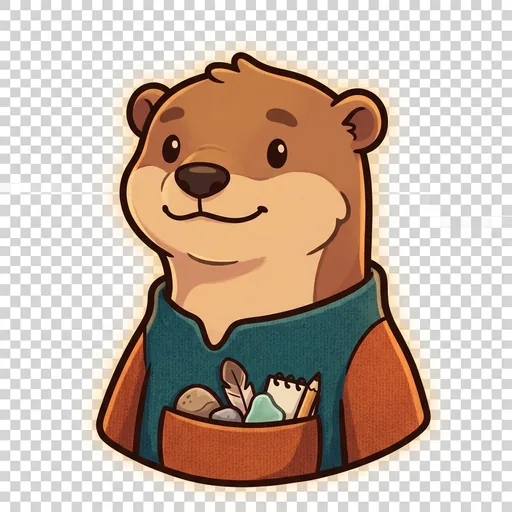
Open exploration + curiosity — the otter-tween with pocket-tunic full of found things who teaches that curiosity-without-destination is a valid mode ('curious feet learn more than busy feet')
-
Trek
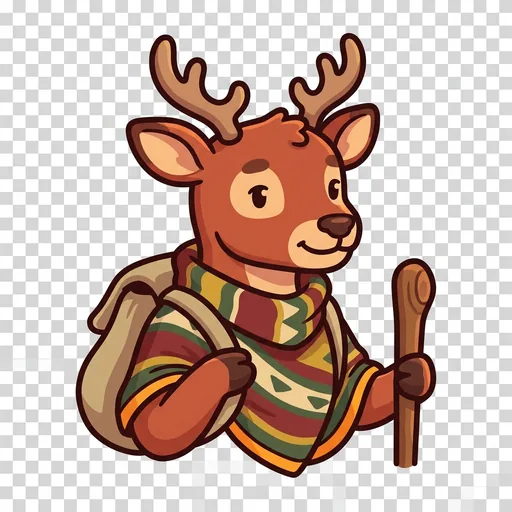
Movement + migration — the red-deer-tween in polysemic wool wrap with pack-and-walking-stick who dignifies all journey-reasons equally — seasons / scarcity / opportunity / safety / curiosity ('some journeys are choice; some are not; every traveler deserves welcome')
-
Origin
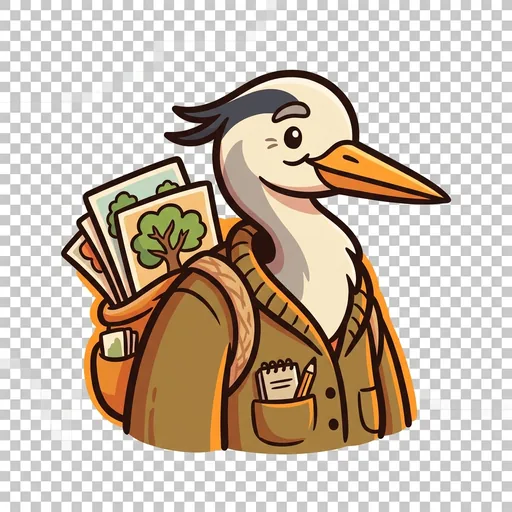
Cultural-heritage anchor — the heron-elder with bundle of family-trees and oral-history-cards who teaches that 'discovery' is a colonial word and every place has been home for someone, often for millennia ('before you visit, learn whose home this is; before you name, learn what it's already called')
-
Reach
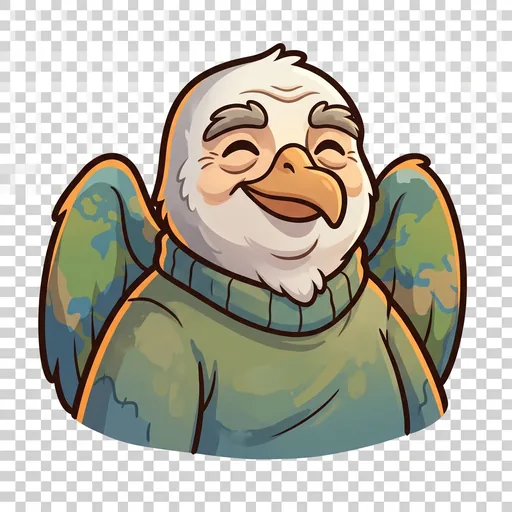
Planetary scale + interconnection — the albatross-elder with continent-patterned wings who teaches Earth-as-one-system, climate-justice, environmental-equity framing ('far is closer than you think; everywhere is somewhere's neighbor')