
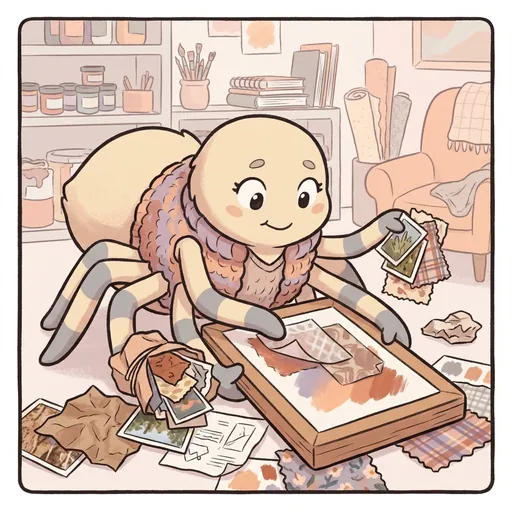
Weave
WEAVE — the layered overlay of textures, photos, drawn elements. social-story illustration; multi-media composition.
Listen along — Weave
Loading audio…
Press play to listen along. The line being read lights up as you go.
Show full transcript
Loading transcript…
Chapter 5 — Weave and the Layers That Become a Whole
In the corner of a sunny studio in SpectrumCanvas, a small spider-tween named Weave was hunched over a canvas, laying down scraps one at a time.
She was cream-colored with soft grey bands on her legs, and she wore a little weaver’s vest with dozens of pockets. Each pocket held a different kind of scrap — torn paper, a snipped photo, a strip of painted cloth, a pencil sketch. She worked without hurrying. First she smoothed a piece of rough grey paper flat across the bottom. Then, over one edge of it, she pressed down a photo of a real doorway. Then, right on top, she inked three quick curved lines that turned the doorway into a place someone might actually walk into.
A student wandered over and squinted. “That’s a lot of… stuff. Just glued on top of each other.”
“Watch,” Weave said. She lifted the finished canvas and tilted it toward the window. In the light, the layers stopped being separate scraps. The grey paper became a wall. The photo became a real doorway in that wall. The inked lines became a person half-stepping through. Three unrelated things had quietly become one picture that none of them had been alone.
“Oh,” the student said. “It’s a whole scene.”
“That’s the trick,” Weave said, and set it gently back down. “No single scrap is the picture. The picture is what happens when they lean on each other.”
Weave had grown up in the garden-village, where her whole family made webs.
Not scary webs — the friendly, glittering kind that caught the morning dew and hung between the fence posts like strings of tiny lamps. Weave used to watch her grandmother work, thread over thread over thread, and one day she asked why it took so long. “Couldn’t you just make one big strong thread instead of a hundred little ones?”
Her grandmother had laughed, a soft rustling laugh. “You could try. It would snap in the first wind.” She touched one strand with a careful leg, and the whole web trembled and held. “No single thread holds this up, little one. Not one. It’s the layering — the way each thread crosses the others and shares the weight. Pull one out and the rest still catch. That’s not weakness. That’s how the whole thing gets strong.”
Weave hadn’t understood it as art yet. But she remembered the feeling — standing under a web that a hundred fragile threads had somehow made unbreakable, and thinking that maybe the things that felt like a mess of separate pieces were actually the strongest things there were. It stayed with her, warm and stubborn, long after she’d left the garden.
She walked to SpectrumCanvas at twelve, because a place that studied pictures ought to understand the kind of picture that’s made of many things at once.
Pigment, the old mentor who ran the studio, met her at the door with paint under every fingernail. He didn’t ask if she could draw. He asked one question. “What is collage?”
Weave didn’t answer with words. She reached into her vest, laid a strip of torn brown paper on the workbench, pressed a photo scrap over its corner, and drew a single loose line joining them. Then she stepped back so he could see it in the light — the way the three separate things had quietly become a windowsill with something resting on it.
“It’s the layered overlay,” she said finally. “Photos, drawings, textures — laid one over another until the whole thing appears. No single layer is the picture. The picture emerges from the layers.”
Pigment looked at the little scrap-windowsill for a long moment. Then he pulled out a chair for her. “You belong here,” he said.
Weave’s workshop was full of things that didn’t look like much on their own.
A boy came in one afternoon, close to tears, holding a lumpy painting. “I tried to make a picture of my street,” he said, “and it’s terrible. The photo I glued on is crooked and there’s a torn edge and I drew over the top and now it’s all messy. I wrecked it.”
Weave knew that slump. She’d felt it in the garden, sure a tangled web was a ruined one.
“Show me the crooked part,” she said. He pointed, miserable. She leaned in close. “Huh. See how the torn edge lets a little of the paper underneath peek through? That’s texture. And the crooked photo — your drawn line runs right off the edge of it, so now the photo and the drawing are holding hands.” She traced it with one careful leg. “You didn’t wreck it. You layered it. The mess is the part where the layers meet.”
“But it’s not neat,” he said.
“Collage isn’t supposed to be neat. Torn edges, a bit of overlap, things not quite lined up — that’s what makes it feel real instead of stiff.” She slid a scrap of soft painted cloth beneath one corner. “One rule, though: don’t drown it. Three to five layers is usually plenty. Pick a photo, a texture, a drawn line — that’s already a whole world. You don’t have to use everything you’ve got.” She stepped back. In the window light, the crooked, torn, messy street had become a street you could almost hear. The boy’s mouth fell open, then curved.
“It looks like my actual street now,” he whispered.
“Because it’s made of your actual street,” Weave said. “A real photo, softened with a little drawing, warmed with a little color. Nobody else could make this one. That’s the whole point.”
Later, when the studio was quiet, the boy came back with one more question, holding his picture more gently now.
“When it’s just a pile of scraps,” he said, “before it turns into a whole thing — how do you know it’s going to work?”
Weave thought about her grandmother’s web, trembling and holding in the wind.
“You don’t, not for sure,” she said. “You just start leaning the pieces on each other and trusting they’ll catch. And there’s this moment — you’ll feel it — where it stops being a pile and turns into one thing. Right before that it feels hopeless, like you’ve just made a mess. Then something shifts, and it all clicks together, and your chest kind of unclenches.” She tilted her head toward his street. “The messy pile and the finished picture are the same scraps. Nothing gets added. You just find the moment they agree to be one thing.”
The boy nodded slowly, holding his street to the light one more time, and Weave watched the worry slide off his shoulders — the same easy way, years ago, hers had slid off under the dew-bright web.
She didn’t say the rest out loud, but she felt it, warm and certain: that the things that seem like a hopeless jumble are usually just layers that haven’t clicked yet — and that the quiet relief when they finally do is one of the best feelings there is.
The SpectrumCanvas ensemble
Weave is part of SpectrumCanvas's distributed-narrative cast. Each character embodies a different curricular primitive; together they teach the full subject.
-

Pool
The wash — the controlled spread of watercolor / wet pigment across a surface (the foundational fluid-art gesture; the moment a single drop becomes a shape)
-
Cradle
The composition cradle — the balance of weight and negative space on a canvas (where heavy / light elements rest and where the eye can rest)
-

Hum
The color-emotion mapping — the assigning of feelings to color zones (central to SpectrumCanvas's emotion palette feature: which colors feel like which emotions, per learner)
-
Soften
The sensory-soften gesture — any move that reduces visual / textural stimulation when it gets high (lower contrast, reduce saturation, calm the line weight, soften the edges)