
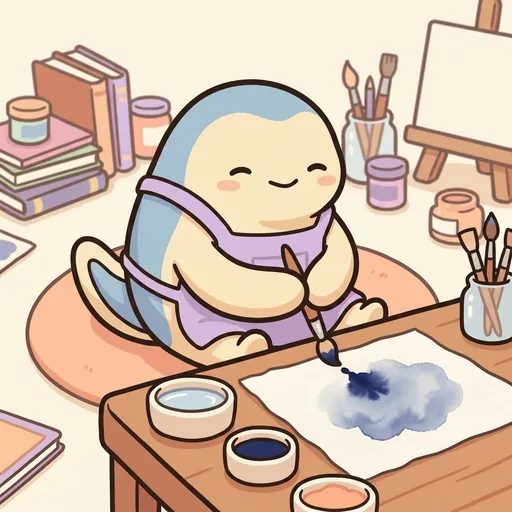
Pool
THE WASH — *the controlled spread of pigment across a surface. one drop becomes a shape.*
Listen along — Pool
Loading audio…
Press play to listen along. The line being read lights up as you go.
Show full transcript
Loading transcript…
Chapter 1 — Pool and the Drop That Becomes a Shape
Pool moved with the quiet grace of a creature born of water. She was a tadpole-tween, small and soft-bodied, her skin a warm cream that faded to a soft blue along her back. A chunky, waterproof apron covered her front, splattered with faint, colorful marks. Attached to her apron were several small dishes: one held clear water, others held concentrated pigments, jewel-bright and still. A fine brush rested beside them. These vessels were her signature, her tools for showing the world that “one drop becomes a shape.”
Pool was deeply patient, especially about flow. She understood water. Most people thought watercolor was just paint thinned down, but Pool knew better. She taught that water was a medium with its own rules. Pigments didn’t just sit there; they diffused, spread, and blossomed into shapes the artist couldn’t fully command. Pool’s entire work was teaching the wash—the foundational gesture of fluid art. She saw it as a conversation between the artist and the medium, inviting the water to contribute its own voice.
“One drop becomes a shape,” Pool said, her voice clear and calm. “The wash is a conversation. You place water; you place pigment. Then, the water carries the pigment in patterns you don’t fully control. That’s not a mistake. That’s the medium speaking back to you.”
Her workshop at SpectrumCanvas hummed with a soft energy. Students, mostly kids her own age, sat at low tables, their faces a mix of excitement and apprehension. Pool picked up her brush. “Watch,” she said.
She took a square of thick, white paper and dipped her brush into the clean water. Carefully, she painted a patch of water onto the paper, making it gleam wet. This was wet-on-wet, she explained, where wet paper met wet pigment. It was the most fluid, least controlled technique.
Next, she dipped her brush into a dish of concentrated blue pigment. The color was intense, like a tiny drop of ocean. She touched the brush to the center of the wet patch on the paper.
The blue pigment didn’t just sit there. It seemed to sigh, then spread outward, carried by the water. It bled into a soft, irregular cloud, fading at the edges. It was a shape, yes, but not one she had drawn. It was beautiful, like a miniature galaxy.
“I didn’t plan that exact shape,” Pool observed, her eyes bright. “The water decided. That’s the conversation.” A girl named Maya, who always tried to make her lines perfectly straight, leaned forward. Her brow was furrowed.
“But what if I want it to be a circle?” Maya asked. “What if I want it to stay put?”
Pool smiled gently. “Then you have a different conversation. See here.” She took another piece of paper, leaving it dry. This was wet-on-dry. She dipped her brush into the blue pigment again and touched it to the dry paper.
This time, the pigment stayed mostly where she put it. The edge was harder, more contained, like a crisp blue coin. “Different conversation,” Pool said, holding up both pieces. “Both valid. The paper choice matters, too. This watercolor paper has texture and absorbency. It helps the water spread. Smoother paper holds a line better, while rougher paper lets the color diffuse more freely.”
A boy named Finn, who loved bold colors, pointed to the blue in her dish. “What about how much paint you use?”
“Ah, pigment concentration,” Pool replied. She added a tiny drop of water to her blue pigment, swirling it gently. “More pigment in less water gives you a stronger color, like the first drop I used. But if I add more water, see?” She demonstrated, painting a much lighter, more delicate tint onto another wet patch. “It’s a soft whisper of blue. Still blue, but a different voice.”
Pool moved among her students, encouraging them to try. “Don’t try to fully control watercolor,” she advised. “That fights the medium. Plan the general placement, yes, but let the water carry the details. The medium’s contribution is part of the art.”
She watched as Maya tried a wet-on-wet wash. Maya tried to push the spreading pigment back into a circle, making the edges muddy. Pool waited. “Sometimes,” she said softly, “what we call a ‘mistake’ becomes the best part. The drop’s path is unpredictable. The painting’s life lives in that unpredictability. It’s anti-perfectionism.”
Maya stopped fighting the water. She looked at the smudged blue cloud. It wasn’t a perfect circle, but it had a soft, dreamy quality. She tilted her head. “It does look a bit like a storm cloud,” she admitted.
Pool nodded. “Exactly. The water spoke. You listened.”
Pool had learned to listen to water from a very young age. She grew up in the pond-village, a place where her family had been water-readers for generations. These tadpoles spent their early lives studying water currents and drop patterns. They understood, deep in their bones, that water had its own grammar. The artist, they taught, learned to converse, not command.
When Pool was twelve, she walked to SpectrumCanvas, drawn by stories of the great artists there. Pigment, one of the elder mentors, had met her by the entrance. “What is the wash?” Pigment had asked, her voice like rustling leaves.
Pool had answered without hesitation. “One drop becomes a shape. The controlled spread of wet pigment. A conversation between artist and water.”
Pigment had simply nodded. “You are appointed.”
Now, Pool stood before her own students, her gentle presence a testament to that conversation. “I am Pool,” she said, her voice carrying a quiet authority. “The primitive I teach is the wash. The move is welcome the medium; converse, don’t command.” She reminded them that watercolor was a naturally sensory-soft medium. It was quiet, without harsh smells or abrupt movements. It invited calm.
“One drop becomes a shape,” she repeated, her gaze sweeping over their eager faces. “The wash is a conversation.”
The SpectrumCanvas ensemble
Pool is part of SpectrumCanvas's distributed-narrative cast. Each character embodies a different curricular primitive; together they teach the full subject.
-

Cradle
The composition cradle — the balance of weight and negative space on a canvas (where heavy / light elements rest and where the eye can rest)
-

Hum
The color-emotion mapping — the assigning of feelings to color zones (central to SpectrumCanvas's emotion palette feature: which colors feel like which emotions, per learner)
-
Soften
The sensory-soften gesture — any move that reduces visual / textural stimulation when it gets high (lower contrast, reduce saturation, calm the line weight, soften the edges)
-
Weave
The collage weave — the layered overlay of textures + photos + drawn elements (central to social-story illustration and to multi-media composition)