
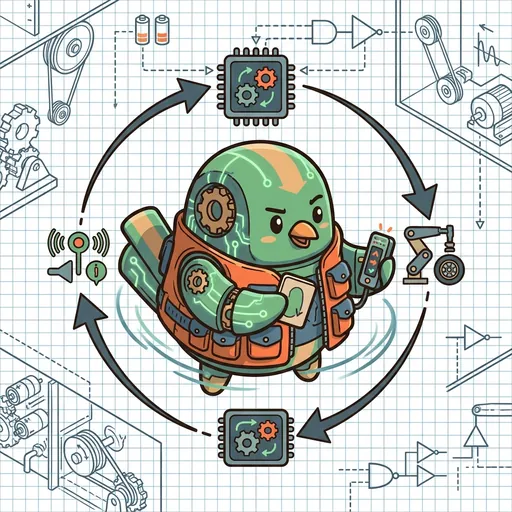
Loop
LOOP — read. decide. act. repeat. that's the whole robot brain.
Listen along — Loop
Loading audio…
Press play to listen along. The line being read lights up as you go.
Show full transcript
Loading transcript…
Chapter 4 — Loop and the Read-Decide-Act-Repeat
In the corner of the Roboforge workshop, a small pinwheel-finch named Loop crouched beside a lost robot and did the same four things, over and over, faster than anyone could follow.
The robot had wandered into a maze of cardboard walls and stopped, blinking, confused. Loop didn’t pick it up. Loop didn’t push it. Loop just watched its little sensor eye and murmured along with it, under her breath, like counting heartbeats.
“Read,” she whispered. The robot’s eye pinged the wall ahead. “Decide.” The robot paused a hair. “Act.” It nudged a few degrees left. “Repeat.”
She said it again. And again. Read. Decide. Act. Repeat. Each time took less than a blink.
A girl watching from the bench frowned. “You’re just saying the same thing forever.”
“So is the robot,” Loop said, not looking away. “That’s the trick. It never stops doing those four. It reads the wall, decides which way is more open, acts by turning a little, then reads again. Thirty times a second. It’s not thinking hard. It’s thinking fast — and small.”
The robot rounded a corner it had been stuck on for ten minutes. Then another. Then it rolled clean out the far end of the maze and sat there, blinking, as if surprised at itself.
The girl’s mouth fell open. “It solved it!”
“It didn’t solve anything,” Loop said, and there was warmth under the words. “It just did the four things one more time than the maze had corners.” She spun her little loop-card between two feathers. “Read. Decide. Act. Repeat. That’s the whole robot brain. There’s no magic in there. There’s just this — running and running until the answer shows up.”
Loop hadn’t always trusted small, repeating things.
When she was young, she’d wanted to be the kind of finch who knew — who could look at a problem once and see the whole answer, complete, like a photograph. That was what smart looked like to her. One big flash of understanding.
So the first time her flock tried to cross a strange, shifting mudflat, she’d frozen. She wanted to plan the entire path at once — every step, start to finish — before she moved. But the mud kept changing. A safe patch turned soft. A path she’d mapped vanished under a puddle. Every plan she made was wrong by the time she finished making it, and the harder she tried to see the whole thing, the more stuck and stupid she felt. Her chest went tight. I can’t hold all of it in my head, she thought. So I must not be smart enough to cross.
An old finch beside her wasn’t planning at all. He just looked down, took one step onto the nearest firm spot, looked again, took another. Look, step. Look, step. Slow. Small. Endless.
“You’re not even planning,” Loop said, almost angry.
“I’m planning constantly,” he said. “Just one step’s worth at a time.” He glanced back at her, kind. “You keep trying to know the whole flat before you touch it. But the flat won’t hold still for you. So don’t out-think it. Out-repeat it. Check, move, check, move. The mud can’t change faster than you can look.”
Loop tried it. Look, step. Look, step. It felt too simple to be smart — and then she was standing on the other side, dry-footed, before she’d noticed how she got there. The tight, not-enough feeling had loosened somewhere in the middle without her seeing it go.
She came to Roboforge at twelve, because a place full of machines was a place that lived by looking-and-moving-again.
Servo, the mentor who ran the floor, met her by a half-built robot with its sensor already twitching. He didn’t ask her to solve it. He asked, “How does it know what to do?”
Loop didn’t answer with a speech. She knelt, set one feather on the sensor, and moved her other wingtip slowly toward it. The robot’s eye tracked the wingtip. She moved it left; the robot’s little head turned left. She moved it right; it turned right. She pulled her wing away; it went still, waiting.
“It doesn’t know anything all at once,” she said. “It reads where my wing is. It decides which way that is. It acts by turning. Then it reads again — that’s why it can follow me. It’s not remembering a plan. It’s just checking, thirty times a second, and adjusting each time.”
Servo watched the robot chase her wingtip in tiny, patient corrections. “Most people think the smart part is in the machine,” he said.
“The smart part is that it never stops looking,” Loop said. “Everything else is just turning.”
Servo smiled. “You belong here.”
Her corner of the workshop filled up with kids who thought robots were doing something they weren’t.
A boy came in one afternoon holding a wheeled robot that kept crashing into walls. “It’s broken,” he said, glum. “It’s supposed to be smart. It’s not smart. It just runs into stuff.”
“Show me your program,” Loop said.
He showed her. It read the sensor once at the start, decided to drive forward, and drove forever.
“There’s your trouble,” Loop said. “It read the world one time and then stopped listening. That’s not a brain. That’s a guess it can never take back.” She tapped his screen. “Where’s the repeat?”
“The… repeat?”
“Put the reading inside a loop. Read the wall. Then decide — close wall, turn; open space, go. Then act. Then send it back to read again. Don’t let it stop checking.”
He rebuilt it, frowning. Read. Decide. Act. Then a line looping it back to the top. He set the robot down.
It rolled toward the wall — and slowed, and eased around it, and kept going, checking and turning, checking and turning, all the way across the room without a single crash.
“It’s watching now,” the boy breathed.
“It’s doing four things really fast,” Loop said. “Read. Decide. Act. Repeat. Same four your program had — you just weren’t letting it do them again.” She grinned at his face. “Nothing in there got smarter. It only got to keep looking.”
Later, when the floor had emptied, the boy came back with a quieter question.
“But it feels smart,” he said. “When it goes around the wall by itself, it feels like there’s somebody in there deciding. If it’s just four things over and over… where does the smart-feeling come from?”
Loop thought about the mudflat. About wanting to see the whole path at once and freezing solid. About look, step, look, step, and the way the far side had simply arrived.
“It comes from fast,” she said. “One read-decide-act is nothing — you’d never call it clever. But do it thirty times a second, and all those tiny turns blur together into something that looks like it’s thinking. The wonder’s real. It’s just not hiding inside the machine. It’s in how much a small, patient thing adds up to when it never stops.”
The boy looked at his robot, still parked by the far wall where it had stopped crashing.
Loop watched the puzzled crease leave his forehead — the same crease that used to sit on hers, in the mud, before she stopped trying to know everything and started just looking again.
She didn’t say the rest out loud. But she felt it, steady and light in her chest, like the calm right after you finally take the next step: the smartest-looking things in the world are usually just something simple, kept up, faster than you can watch it happen. And there’s nothing frightening in that. There’s only how much a tireless little cycle can carry.
The RoboForge ensemble
Loop is part of RoboForge's distributed-narrative cast. Each character embodies a different curricular primitive; together they teach the full subject.
-

Bolt
Chassis + mechanical structure — 'the frame holds everything; build the chassis like you mean it'
-

Sense
Sensors + perception — 'the robot only knows what it can sense; choose the senses for the job'
-

Drive
Motors + actuators + movement — 'motors turn power into motion; balance speed and control'
-

Tune
Testing + calibration + iteration — 'first run fails. that's information. tune + run again' (closes cast arc)