
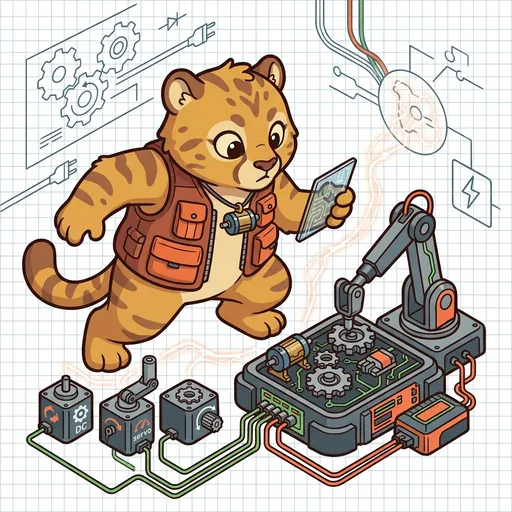
Drive
DRIVE — motors turn power into motion. balance speed and control.
Listen along — Drive
Loading audio…
Press play to listen along. The line being read lights up as you go.
Show full transcript
Loading transcript…
Chapter 3 — Drive and the Power That Becomes Motion
In the middle of the Roboforge workshop, a maze robot sat frozen an inch from the wall, and Drive was crouched beside it, listening.
The robot had rolled forward beautifully — and then kept rolling, past the turn, past the mark, right up to the bricks, where it stopped with a sad little buzz. Drive didn’t scold it. They put one hand flat on its chassis, the way you’d calm a nervous animal, and turned the power dial down a notch.
“Again,” Drive said. “But this time, ease off before the wall. Don’t slam. Feather it.”
They tapped the go button. The robot rolled — slower now, and just before the bricks it eased, coasted the last hair of distance, and settled exactly on the line. Drive let out a breath and grinned.
A younger builder watched from the bench, arms crossed. “You gave it less power and it did better?”
“Motors turn power into motion,” Drive said, patting the robot. “But the trick isn’t how much motion. It’s the right motion — speed when you want speed, and the sense to slow down before you crash.” They spun a wheel with one finger and let it whir down to a stop. “Max power all the time is how you end up nose-first in a wall. I did that a lot before I learned better.”
Drive learned it the hard way, on a hill, with a cart they’d built themselves.
They’d been small then, and impatient. The cart had one big motor and one setting — full blast — and Drive had been so proud of how fast it went. Fast off the line. Fast down the path. Fast, fast, fast, right until the corner at the bottom of the hill, where fast was exactly the wrong thing to be. The cart didn’t turn. It launched off the path, clipped a fence post, and folded a wheel under itself with a crunch that Drive felt in their teeth.
They sat in the grass next to the wreck and something hot and tight pushed up behind their eyes. All that work. All that speed. And it was faster at breaking itself than at getting anywhere.
An older tinker had wandered over, looked at the mangled wheel, and sat down in the grass too. She didn’t say told you so. She just asked, quietly, “It went fast, though?”
“Too fast,” Drive said, miserable. “I couldn’t stop it.”
“Then it wasn’t really yours, was it,” she said. “A thing you can’t slow down isn’t fast. It’s just falling in a straight line.” She handed Drive a little dial — a knob that could turn power up or down. “Speed’s easy. Anyone can pour on power. Control is the hard part. Control is what turns a runaway into a machine.”
Drive turned the little dial over and over in their hands, and the hot tight feeling loosened into something quieter — the beginning of an idea.
Drive came to Roboforge at twelve with that same dial still in their pocket, worn smooth.
Servo, the mentor who ran the workshops, didn’t ask them to show off how fast they could make something go. He set three motors on the bench — a spinning one, a servo with a little arm, a chunky stepper — and said, “Move something. Your choice which one, your choice what.”
Most kids grabbed the fastest motor. Drive didn’t. They looked at the whole bench first, then picked up a small gripper claw, wired it to the servo, and made it close — slowly, gently — around a single dry leaf without crushing it.
“That one’s the slowest,” Servo said, testing.
“That’s why it’s right,” Drive said. “The job was don’t break the leaf. Fast would’ve mashed it. I matched the motor to what the job actually needed.” They set the leaf down, whole. “Right motor. Right power. Not max-everything.”
Servo looked at the uncrushed leaf for a long moment. “You belong here,” he said.
Drive’s corner of the workshop was where the maze robot came to life.
Leo, who loved building, spoke first. “It needs to roll forward. And turn corners.”
“Good,” Drive said. “So — the wheels. What spins nice and steady for rolling?”
Maya, always thinking a step ahead, said, “DC motors. They just spin and spin. Good for going forward.”
“Yep.” Drive handed her two. “Now the hard one. How does it turn?”
Sense, who lived for gadgets, tapped their chin. “A servo? To steer a front wheel to an exact angle?”
Drive didn’t say no. They crouched to the robot’s height and thought about it out loud, which was the thing the kids loved most. “We could. A servo gives you precise angles, and precise is usually good.” They tilted their head. “But watch — for a robot this size, there’s a way with fewer parts. Two DC motors, one on each wheel. To turn left, you just let the right wheel spin faster than the left. The robot swings around, like a tank.”
Leo’s eyes went wide. “So we don’t even need the steering part?”
“The motors do the steering,” Drive said, delighted. “Speed on one side, less on the other. That’s the turn.” They showed Leo how to twist the motor wires tight. “Solid connection. No wobbly bits — a loose wire is a robot that surges when you least want it.” Then, softer, to all three: “And here’s the real secret. The program won’t pour full power in. It reads the sensors, eases the speed up and down, slows before the wall. That’s Loop and Tune’s job. But the motors have to be the right ones first, or no amount of clever code saves you.” They patted the robot. “Speed you can’t control isn’t speed. It’s just a crash that hasn’t happened yet.”
Later, when the others had gone and the workshop was quiet, Sense lingered by the bench.
“When we turn the power down,” they asked, “doesn’t the robot just… do less? Feels like giving up on the fast part.”
Drive thought about the hill. About the crunch, and the hot tight feeling in the grass, and the little dial worn smooth in their pocket.
“I used to think that too,” they said. “Like slowing down was losing.” They turned the robot’s wheel gently, feeling it resist and give. “But it’s the opposite. When you ease off on purpose — when you choose to go slower right before the turn — that’s the moment the machine actually becomes yours. There’s this steady, sure, hands-on-the-wheel feeling. Like you and the thing are moving together instead of it dragging you along.” They looked toward the workshop door, toward the hill they could almost see. “Fast is easy. Anybody can let go and fall. But that quiet, in-control feeling — knowing you can stop exactly where you mean to — that’s the best feeling in the whole shop.”
Sense nodded slowly, and Drive watched the worried crease smooth off their face — the same way, years ago, the grass and a little dial had smoothed the tightness out of their own.
The RoboForge ensemble
Drive is part of RoboForge's distributed-narrative cast. Each character embodies a different curricular primitive; together they teach the full subject.
-

Bolt
Chassis + mechanical structure — 'the frame holds everything; build the chassis like you mean it'
-

Sense
Sensors + perception — 'the robot only knows what it can sense; choose the senses for the job'
-

Loop
Iteration + sensor-driven control loops — 'read. decide. act. repeat. that's the whole robot brain'
-

Tune
Testing + calibration + iteration — 'first run fails. that's information. tune + run again' (closes cast arc)