
Bolt
BOLT — *the frame holds everything. build the chassis like you mean it.*
Listen along — Bolt
Loading audio…
Press play to listen along. The line being read lights up as you go.
Show full transcript
Loading transcript…
Chapter 1 — Bolt and the Frame That Holds
The workshop hummed with a nervous energy. Piles of metal beams, shiny motors, and tangled wires lay scattered across the long workbench. Drive, a whirlwind of impatience, already held a small motor, eyeing a long aluminum rail. Sense, more methodical but equally eager, had a handful of tiny sensors, ready to stick them anywhere they might fit. This was it: their first robot.
“Okay, team,” Drive announced, bouncing on the balls of his feet. “Let’s get these wheels on. We need speed!”
Sense nodded, holding up a small ultrasonic sensor. “And it needs to see. I can mount this right here, on the front.” He gestured vaguely at the air.
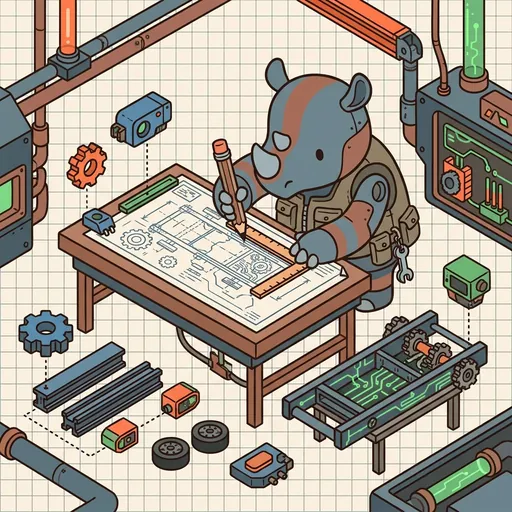
Just then, a figure stepped forward, moving with a quiet, deliberate grace. This was Bolt. He was small, sturdy, and built like a compact tank, his cool-steel-grey skin striped with soft rust. A chunky-cartoon workshop-vest, embroidered with a tiny wrench-charm, covered his broad chest. He didn’t rush, but his presence commanded attention.
Bolt held up a thick, laminated card. On it was a simple line drawing: a robot chassis, a skeletal frame with labeled boxes indicating where different components might go. It was called a frame-card.
“Before we attach anything,” Bolt said, his voice calm but firm, “we plan the chassis + mechanical structure.” He tapped the card. “The frame holds everything. Build the chassis like you mean it.”
Drive groaned, letting the motor clatter onto the bench. “But the chassis is just… the boring part. Can’t we just bolt things together and see what happens?”
Sense, though less vocal, looked equally deflated. He wanted to solve problems with clever sensors, not with metal beams.
Bolt offered a small, dry smile. “Clever sensors and fast motors are useless if their foundation wobbles. A wobbly robot is a confused robot. It cannot drive straight. It cannot sense accurately.” He paused, letting the truth settle. “The frame is the foundation. Boring and sturdy beats clever and wobbly every time.”
He laid the frame-card flat on the workbench. “First, we sketch. Where does each component go? Think about it.”
Drive picked up a pencil, then frowned. “But… where do they go?”
“Start with the heaviest part,” Bolt instructed. “The battery. Where should it sit?”
“On top, so it’s easy to reach?” Sense suggested, already imagining himself swapping out power packs.
Bolt shook his head. “Heavy stuff low, light stuff high. A low center of gravity makes a robot stable. Imagine a tall tower versus a flat brick. Which one tips over more easily?”
They thought about it. “The tower,” Drive admitted.
“Exactly. So, the battery goes low and centered.” Bolt pointed to a spot on the frame-card. “This gives us balance. Now, the motors. They drive the wheels. Where should they be?”
“Near the wheels, obviously,” Drive said, feeling a surge of confidence.
“Good. And how will they connect to the wheels? Directly? With gears? Does the frame need to support the motor and the axle?” Bolt’s questions were like tiny wrenches, tightening their thinking.
They spent the next half hour sketching. Drive, surprisingly, found himself enjoying the challenge. He drew a rough rectangle for the chassis, then placed a heavy square for the battery in the middle, low to the ground. Then came the motors, two on each side, connected by lines to the wheels.
Sense, meanwhile, considered the sensors. “These need to see over the chassis, right? So, high up?”
“Yes,” Bolt confirmed. “But not so high it becomes top-heavy. And how will they attach? A flimsy bracket will vibrate, giving you bad readings.” He showed them a small, sturdy bracket he’d pulled from a bin. “Every part needs a solid mounting point. No jiggle, no wobble.”
They sketched out three different layouts. The first looked like a jumbled mess, wires crossing everywhere. Bolt pointed to it. “Wiring. It needs room. Run it alongside structural beams, not through them. Otherwise, you pinch a wire, and your robot stops.”
The second sketch was better, but the battery was still too far back, making the robot prone to tipping when it accelerated. Bolt didn’t just tell them it was wrong; he had them imagine the robot speeding forward, then braking hard. “What happens to the weight?” he asked. “It shifts. If your heavy battery is at the back, your robot might do a wheelie, or even flip.”
Finally, after much erasing and redrawing, they had a design that felt right. The battery was centered and low. The motors were firmly mounted. The sensors had clear lines of sight from sturdy elevated points. There was even a clear path for the wires, tucked neatly along the frame.
“This is good,” Bolt said, his voice holding a note of genuine approval. “Three iterations. Each one better than the last. You planned first. Then you will assemble.” He gave a small nod. “NOW we attach motors.”
Servo, their mentor, who had been quietly observing from a corner, stepped forward. He looked at the final sketch, then at Bolt. “Boring chassis,” Servo said, a knowing twinkle in his eye. “Sturdy robot. Bolt holds the foundation.”
The team, for the first time, looked at the metal beams not as just raw material, but as the very bones of their creation, the silent promise of everything to come.
The RoboForge ensemble
Bolt is part of RoboForge's distributed-narrative cast. Each character embodies a different curricular primitive; together they teach the full subject.
-

Sense
Sensors + perception — 'the robot only knows what it can sense; choose the senses for the job'
-
Drive
Motors + actuators + movement — 'motors turn power into motion; balance speed and control'
-

Loop
Iteration + sensor-driven control loops — 'read. decide. act. repeat. that's the whole robot brain'
-

Tune
Testing + calibration + iteration — 'first run fails. that's information. tune + run again' (closes cast arc)