
Frame
TEXT STRUCTURE — the underlying organizational pattern of a passage: compare-contrast, sequence, cause-effect, problem-solution, description. Identifying the structure helps the reader anticipate and integrate the content.
Press play to listen along. The line being read lights up as you go.
Show full transcript
Loading transcript…
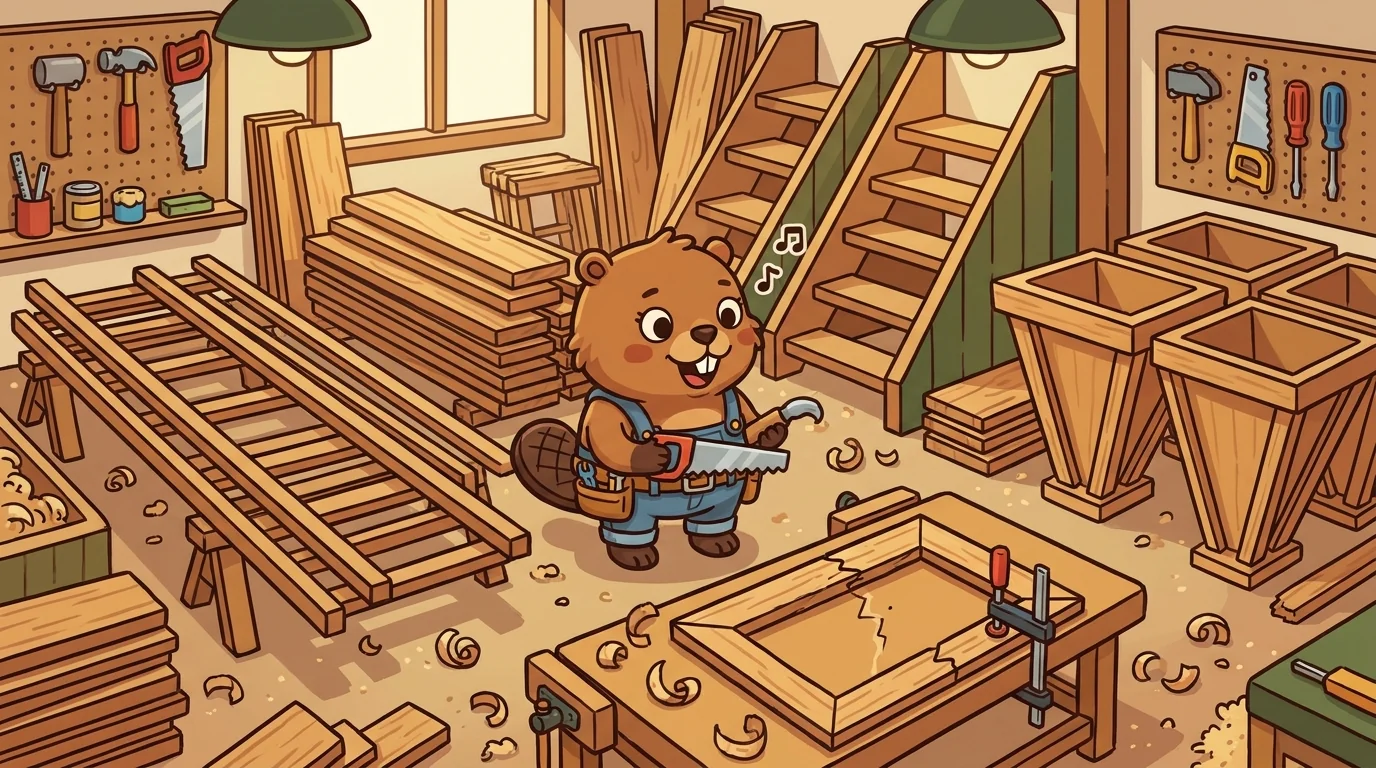
Frame is a beaver-tween carpenter. She loves wood. She loves building.
Her small workshop smells like fresh-cut pine and sawdust. It is packed with every kind of wooden frame you can imagine. There are tall stacks of wood planks. Tiny wood shavings curl on the floor. Frame hums a little tune as she works.
She has parallel-bar frames. These look like two long, straight pieces of wood. They have smaller cross-supports holding them together. They stand side-by-side, like train tracks.
Then there are staircase frames. These frames step up, one piece a little higher than the last. They look like tiny wooden stairs. Each step leads to the next.
She also has funnel frames. These are wide at the top. They get narrower and narrower at the bottom. They push everything towards one small point.
Some frames are broken-fixed frames. You can see where they were once snapped. But Frame has carefully glued and clamped them. Now they are strong again. You can still see the repair, though.
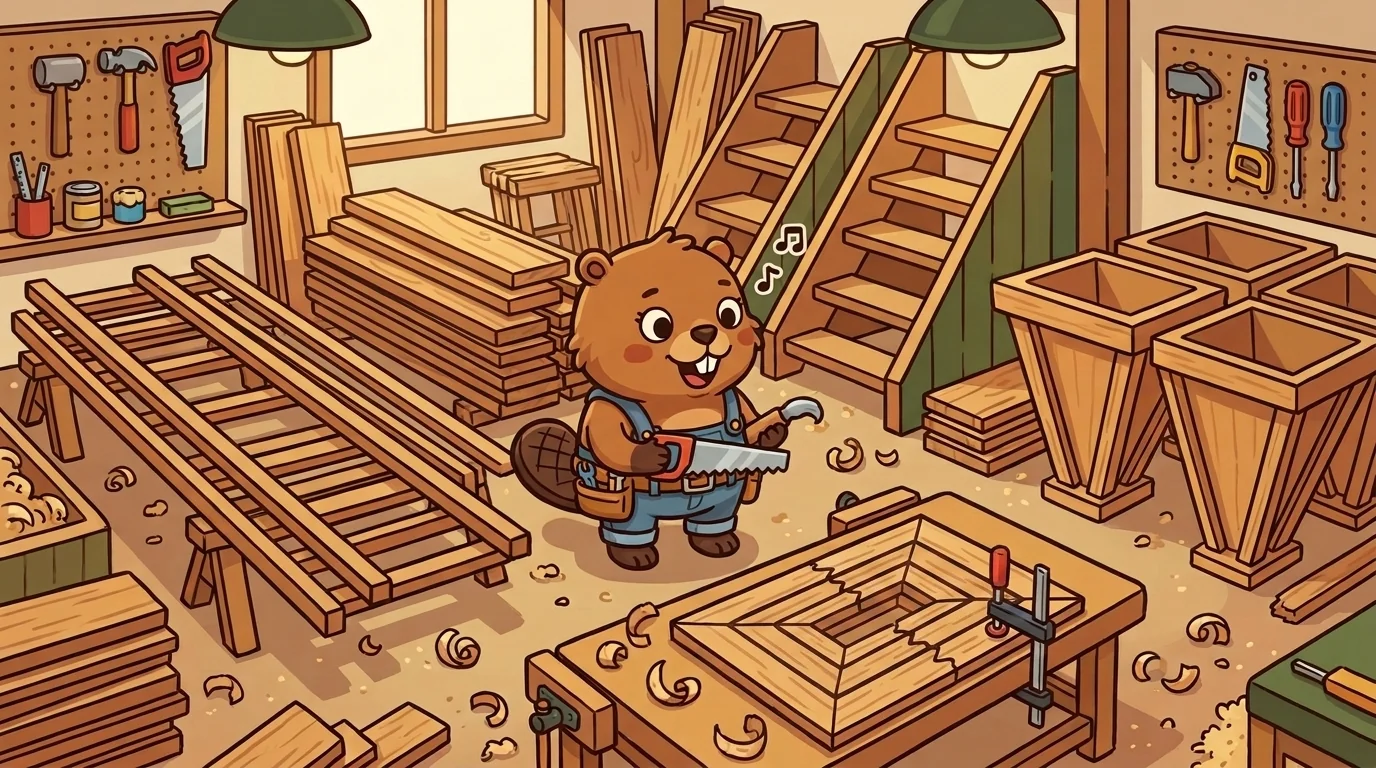
And her favorite: expanding frames. These start small in the middle. Then they grow outward in every direction. They spread out like a splash in a puddle.
Each of these special frame-shapes matches a text structure. Frame uses them to show kids how stories and articles are built.
The parallel-bar frames match compare-contrast passages. These passages talk about two things. They show how they are alike. They show how they are different.
Staircase frames match sequence passages. These passages tell things in order. First this happened. Then that happened.
Funnel frames match cause-effect passages. These passages show why something happened. One thing causes another. Or many things cause one big thing.
Broken-fixed frames match problem-solution passages. These passages tell about a problem. Then they show how to fix it.
Expanding frames match description passages. These passages tell all about one thing. They give many details from all sides.
Frame shows these frames to her students. She holds up the right frame. It makes the structural shape easy to see.
Frame grew up in a beaver-family of dam-builders. Her parents were famous. They built real, strong dams in the kingdom's small rivers. Young Frame loved to watch them work. She saw them choose logs. She saw them pack mud.
By age six, Frame knew that dams have special shapes. She knew these shapes were important. Some dams were straight-bar dams. They stretched in a single line across a narrow river. Others were staircase dams. These were many small, stepped dams going down a slope. They looked like giant stairs for the water. Some were V-shaped dams. These pushed the river's flow toward a central spillway. They focused the water's power.
The shape of a dam showed how it worked. Frame learned this early. She grew up thinking that structures had their own shapes. And those shapes told you everything.
She was thirteen when she thought about passages. Her village schoolteacher was a kind old badger. He had big, bushy eyebrows. He would pace the classroom.
"Some passages are put together in special ways," he explained one day. "Some are compare-contrast. Some are sequence. Others are cause-effect. Some show a problem and a solution. And some just describe things." He tapped his chin. "Knowing the way a passage is built helps you read it better."
Frame's ears perked up. She sat up straight in her wooden desk. "Like dams!" she blurted out. The other students looked at her. The teacher stopped pacing.
"What do you mean, Frame?" he asked, a small smile starting.
"Each dam has a shape," Frame explained. She thought about her parents' work. "Each shape does something special. Passages must work the same way!"
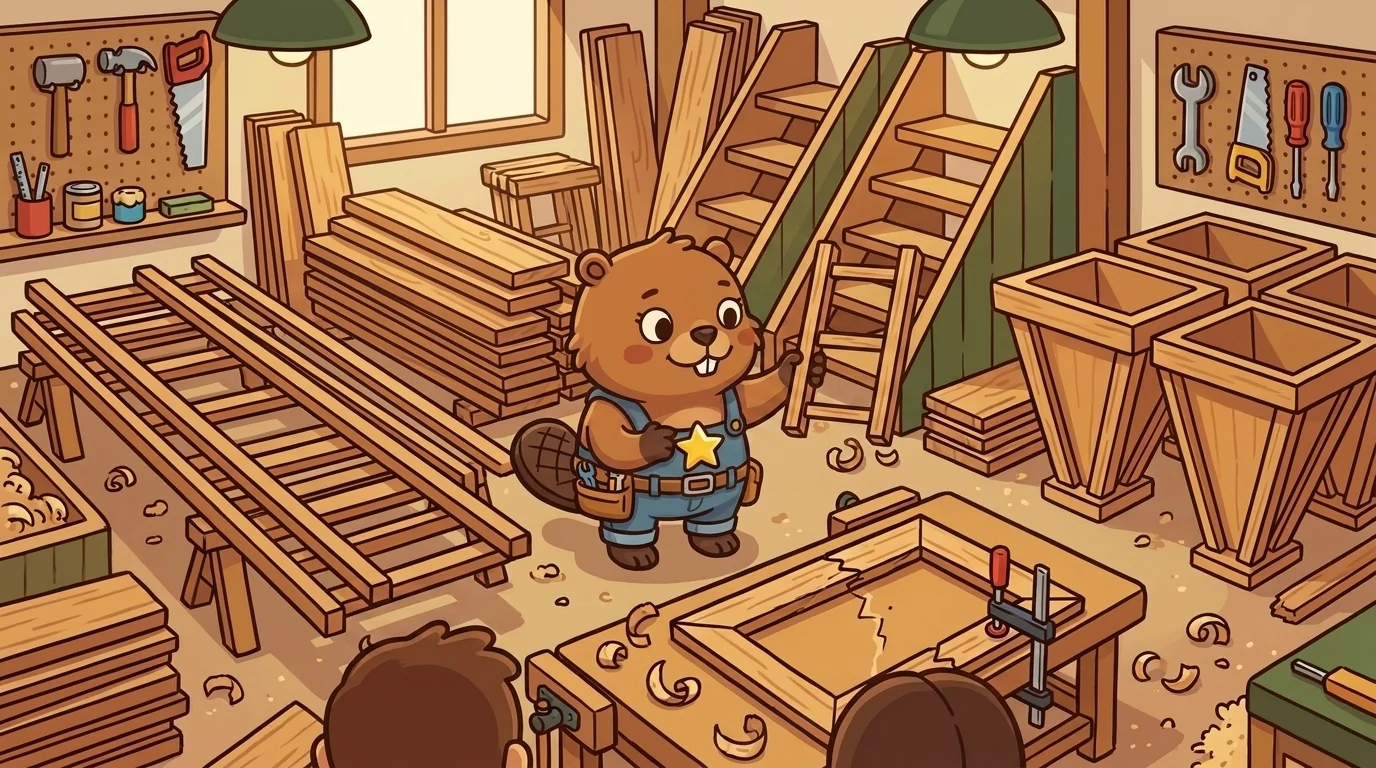
The teacher's smile grew wide. He clapped his paws together. "Exactly, Frame! Exactly!" He looked so happy. He even gave her a gold star sticker. It was the biggest one he had.
Frame walked to the ReadQuest academy when she was nineteen. It was a long walk. She carried her tools in a big wooden box. She has been the academy's text-structure teacher for eleven years now. She loves her job.
In her classroom, she starts every first-day lesson the same way. Her workbench is right at the front. On it, she has one of each kind of frame. They sit there, waiting.
She clears her throat. "Hello, everyone," she says. Her voice is calm and clear. "I am Frame. I build wooden frames in different shapes. Each shape matches a text structure. Watch."
She picks up the parallel-bar frame. The wood feels smooth in her paws. "This is the compare-contrast structure," she says. She holds it up high. "Two things are placed side by side. Their similarities are listed. Their differences are listed. The parallel-bar frame shows this. Two parallel pieces. Cross-supports between them. Easy to see."
Next, she picks up the staircase frame. She runs a paw along its stepped pieces. "This is the sequence structure," she explains. "Events are listed in order. First, then, next, finally. Each event builds on the one before it. The staircase frame shows this. Stepped rising pieces. One after the other."
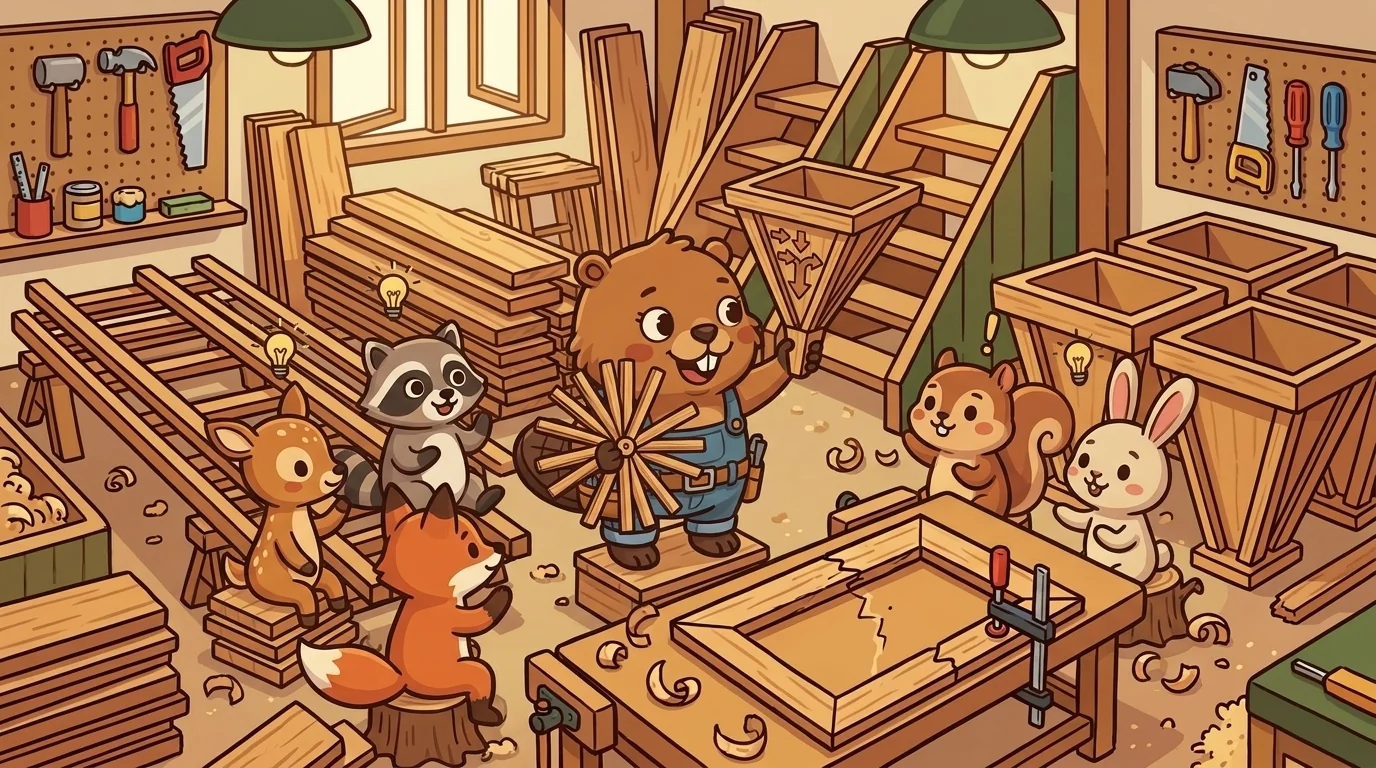
Then she lifts the funnel frame. It feels heavy in her hands. "This is the cause-effect structure," she says. "Many things can happen. They all lead to one big result. Or one thing happens. It makes many other things happen. The funnel matches this. Wide at the input. Narrow at the output. It pushes things to a point."
She carefully picks up the broken-fixed frame. She points to the mended spot. "This is the problem-solution structure," she tells the class. "A problem is presented. Then a way to fix it is proposed. The broken-fixed frame shows this. A damaged piece. Visibly repaired. It's fixed!"
Finally, she holds up the expanding frame. She turns it slowly. It looks like a wooden starburst. "This is the description structure," she says, her voice soft. "You start with one main subject. Then you describe it from many angles. You add details. The expanding frame matches this. A small center. It grows outward in all directions. It just keeps getting bigger."
The students always — always — find the frame-and-structure pairing clear. Their eyes get wide. They nod their heads. Before Frame, they often read passages. But they didn't see how they were built. Frame makes the patterns visible. They learn to find the frame-shape of each passage. This helps them guess what comes next. It helps them put all the information together.
Frame also teaches the signal-words for each structure. These words are like little clues. For compare-contrast, look for: like / unlike / similarly / however. For sequence, look for: first / then / next / finally. For cause-effect, look for: because / since / therefore. For problem-solution, look for: problem / solution / however / instead. For description, look for: for example / such as / specifically.
Sometimes, students ask Frame if finding these text shapes is hard. Frame always says the same thing. She smiles.
"It is not hard," she says. "It is just seeing the shape. Read the passage. Ask yourself: what shape does this make? Is it compare-contrast? Sequence? Cause-effect? Problem-solution? Description?" She pauses. "Each shape has signal-words. Each shape has a wooden frame right here in my workshop. Pick the frame. Then you've found the structure."
She still keeps the five frames on her workbench. They are always there. The children sometimes ask to hold them. Frame always lets them. They feel the smooth wood. They trace the shapes with their fingers. It helps them remember.
The ReadQuest ensemble
Frame is part of ReadQuest's distributed-narrative cast. Each character embodies a different curricular primitive; together they teach the full subject.
-

Crest
Main idea / central message (the *peak* of the passage)
-

Hunch
Inference (reading between the lines)
-

Anchor
Evidence / textual citation
-

Plume
Author's purpose / voice / tone
-

Pith
Vocabulary in context (deriving word meaning from surrounding text)
-

Yonder
Predicting — alert young-hare creature who reads the trail's clues to guess what's around the bend; a wrong guess just means the story surprised you
-

Vista
Visualizing — dreamy young-deer creature who turns words into a movie in the mind; the writer gives the words, the reader gives the pictures
-

Nettle
Questioning the text — question-quilled hedgehog who pokes a passage with why/how/what-if; asking questions means you're awake, not that you don't understand
-

Sheaf
Summarizing — warm-handed harvester who gathers a whole passage into one tidy armful, keeping the important middle and letting loose details fall