Anchor
EVIDENCE — supporting any reading-claim with specific evidence from the text. Without textual evidence, a claim is unsupported. The strength of a reading is the strength of its citations.
Press play to listen along. The line being read lights up as you go.
Show full transcript
Loading transcript…
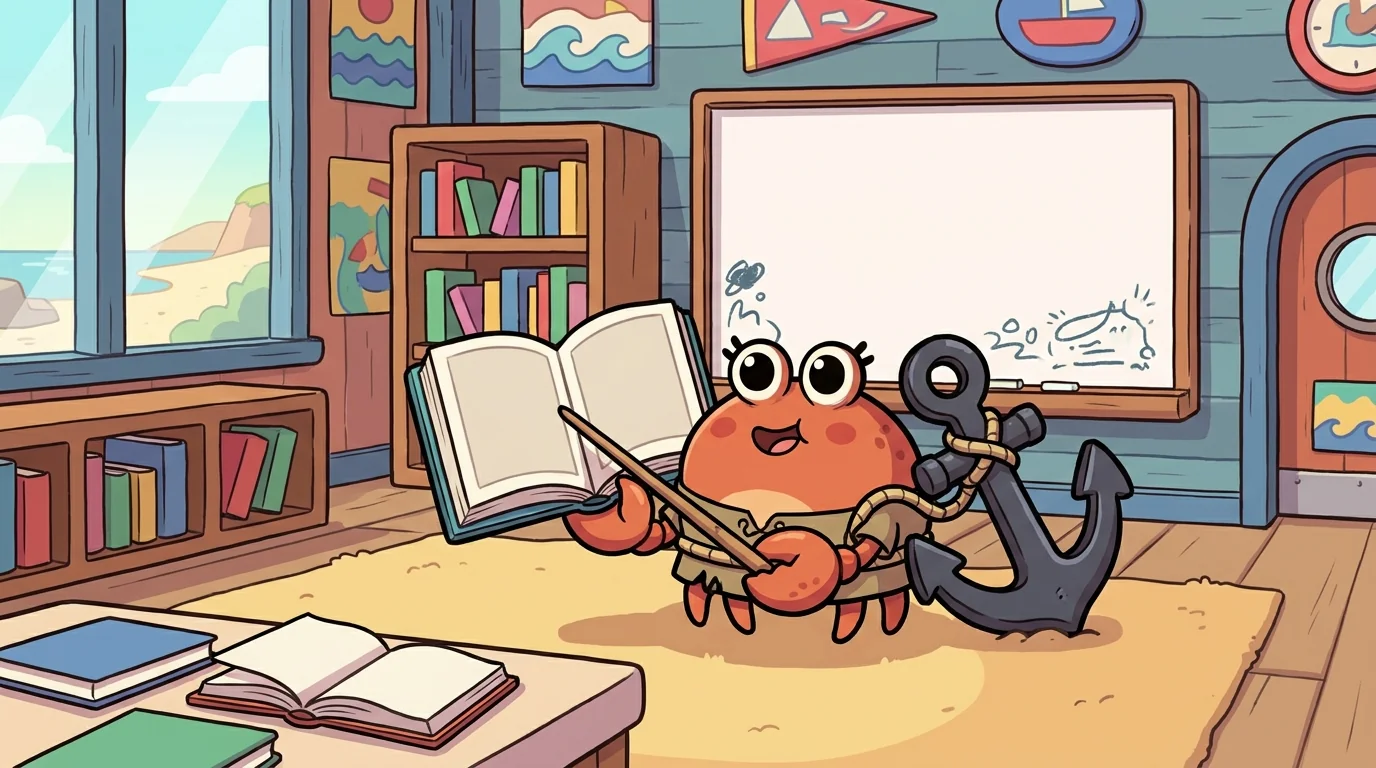
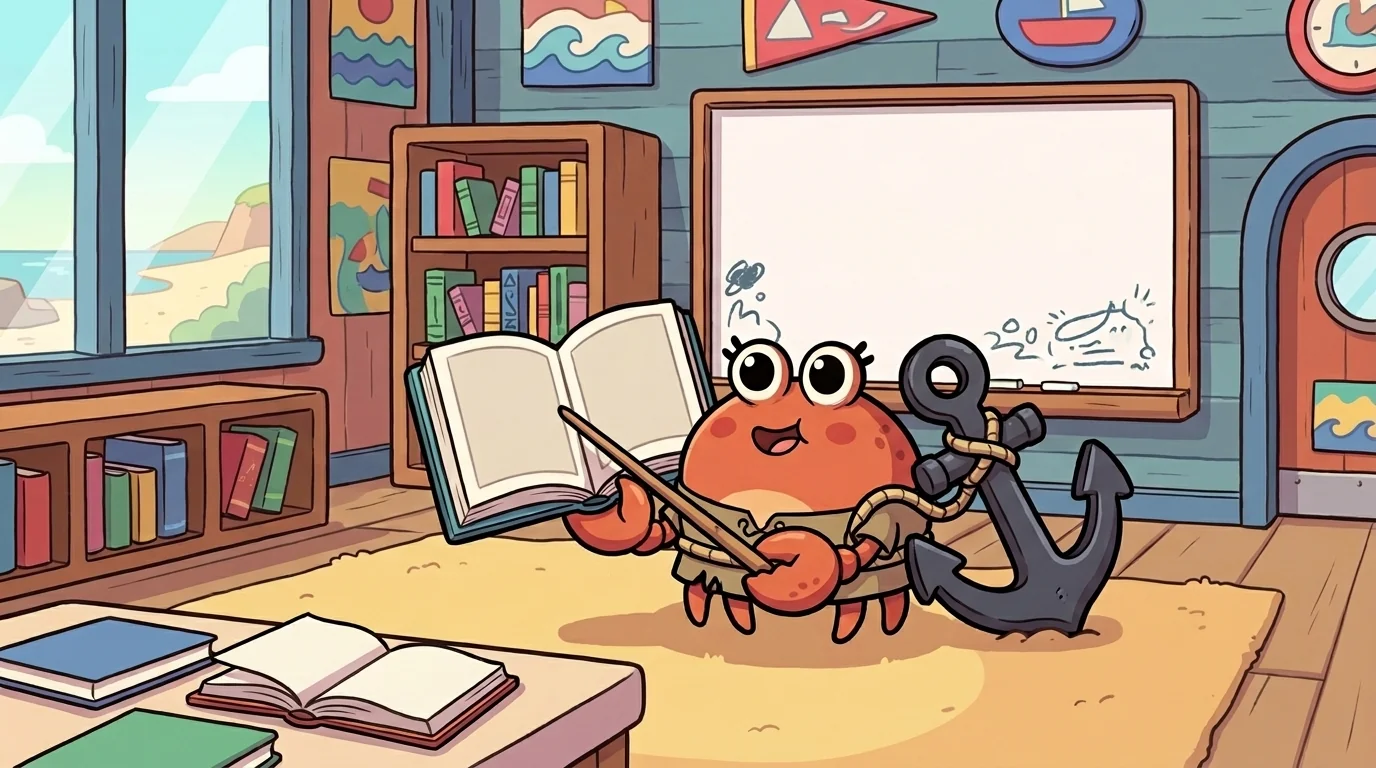
Anchor is a small, heavy crab kid. She always carries a small ship's-anchor. It's real metal and very heavy. The anchor is her special tool. It helps her teach.
Anchor will not believe what you say about a story unless you can show proof from the book. If a student says, "The character is sad," Anchor asks, "Where in the text?" The student must point to a certain sentence or phrase. It has to be right there in the story. This sentence must back up their idea. Only then will Anchor lift her small ship's-anchor. It's a little teaching trick. The anchor stays tied to her body with a short rope. But she can raise it a bit when she agrees with a student's proof.
If there's no proof, the anchor stays down. Your idea is just floating. It has no tie to the book. The student must find the proof.
Anchor grew up in a town by the sea. It was called Bollard. That's a funny name, because bollards are the big posts ships tie up to in a harbor. Her family had been harbor-masters for ages. They were the people who kept the harbor safe. They made sure ships were tied up tight before big storms came. Their family motto was: "Show me the line. Show me where it ties. Then I will trust the anchor."
Anchor's real name was Quill. She learned this lesson deep down, right from when she was a little crab kid. By the time she was ten, she knew it well. Every idea about a ship's safety needed proof you could see. Saying "the ship is safe" was not enough. The harbor-master had to see the rope. They had to see the knot. They had to see the anchor on the bottom. Only then could they truly believe the ship was safe.
When she was sixteen, Quill started using this idea for books. She found out the same rule worked. An idea about a story — like "the character is sad" or "the author is being funny" or "the place is scary" — wasn't enough. Not without words from the book to back it up. The reader needed to point to the exact words that proved their idea. If not, the idea was just floating. It had no anchor.
Quill walked to the ReadQuest academy when she was twenty. She changed her name to Anchor. That happened when the master gave her the job of finding proof in books. She has been Anchor for twelve years now.
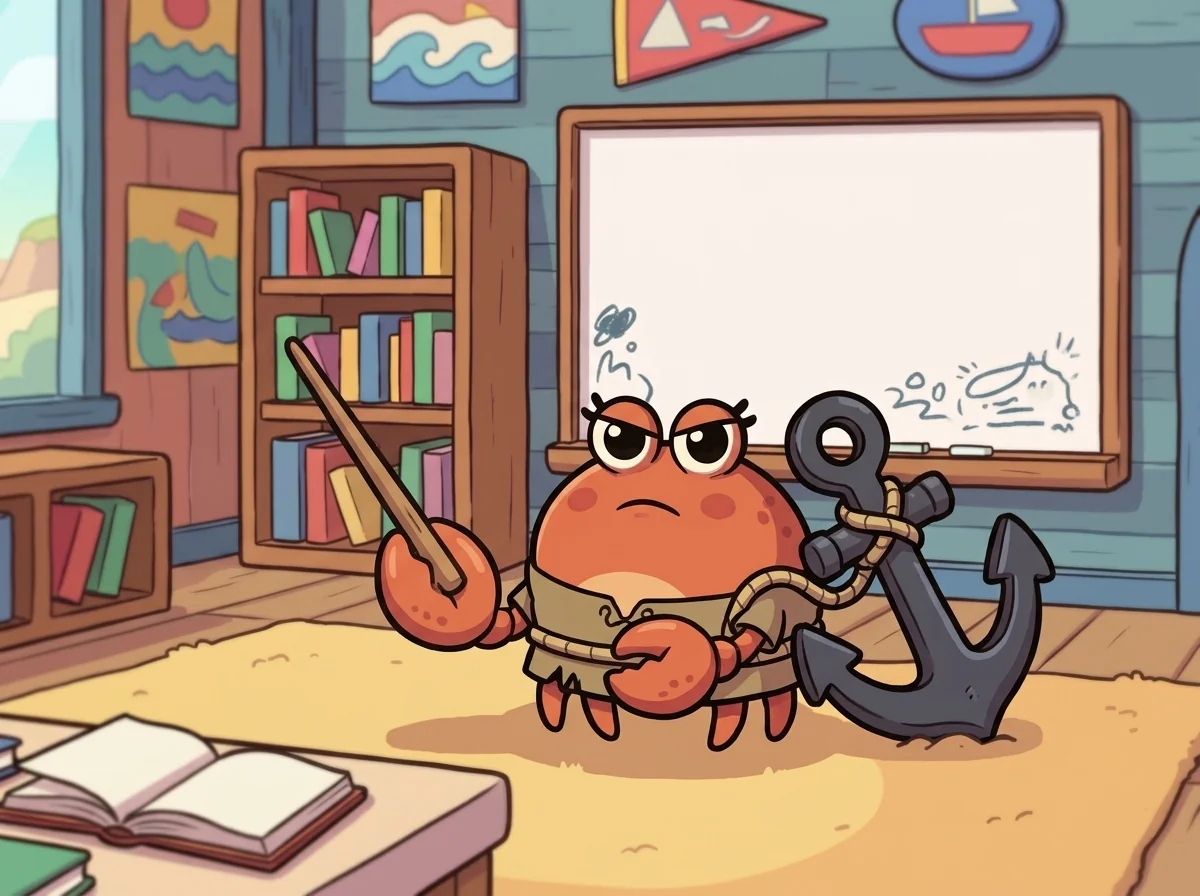
In her classroom, she starts every first day the same way. She sits at the front. Her small ship's-anchor rests on the floor by her feet. She looks at the class.
"I am Anchor," she says. Her voice is deep and steady. "I do not believe ideas about stories without proof from the book. If you say the character is sad, I will ask where in the text? If you can point to a sentence, the anchor lifts. If you cannot, the anchor stays down. Your idea is unanchored."
She shows them how it works. She reads a short passage from a book:
"Marco sat on the kitchen step. The dog whined at the door. He did not move."
She looks at a student. "What is Marco feeling?" she asks.
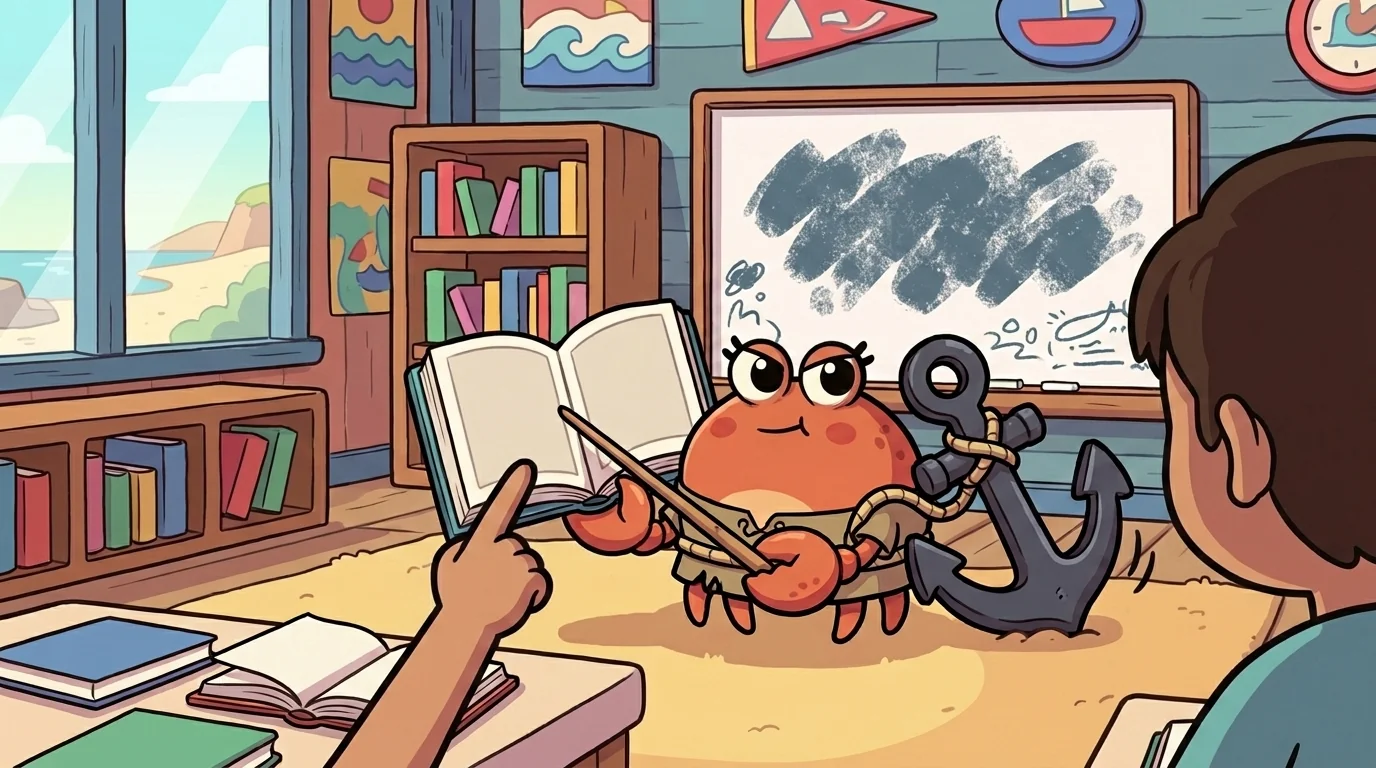
The student thinks for a moment. "He is sad," they say.
Anchor nods slowly. "Show me where in the text," she says. Her eyes are serious.
The student leans forward. They try to point to a word. But the story doesn't actually say, "Marco is sad." The student looks stuck. Their finger hovers over the page. They frown. Then their eyes light up. They had an idea!
"Wait!" the student says. "The proof is in what he does! Or, what he doesn't do." They point to the last sentence. "Marco did not move when the dog whined. That is proof of sadness. Or at least, he feels something very strong."
Anchor's small ship's-anchor lifts slightly. It makes a soft clinking sound. "The anchor lifts," she says. "Your idea has support. The book does not say Marco is sad. That is an idea you made up in your head. (Hunch would help you with that part!) But what Marco did — he did not move — that ties your idea down. Your reading is supported."
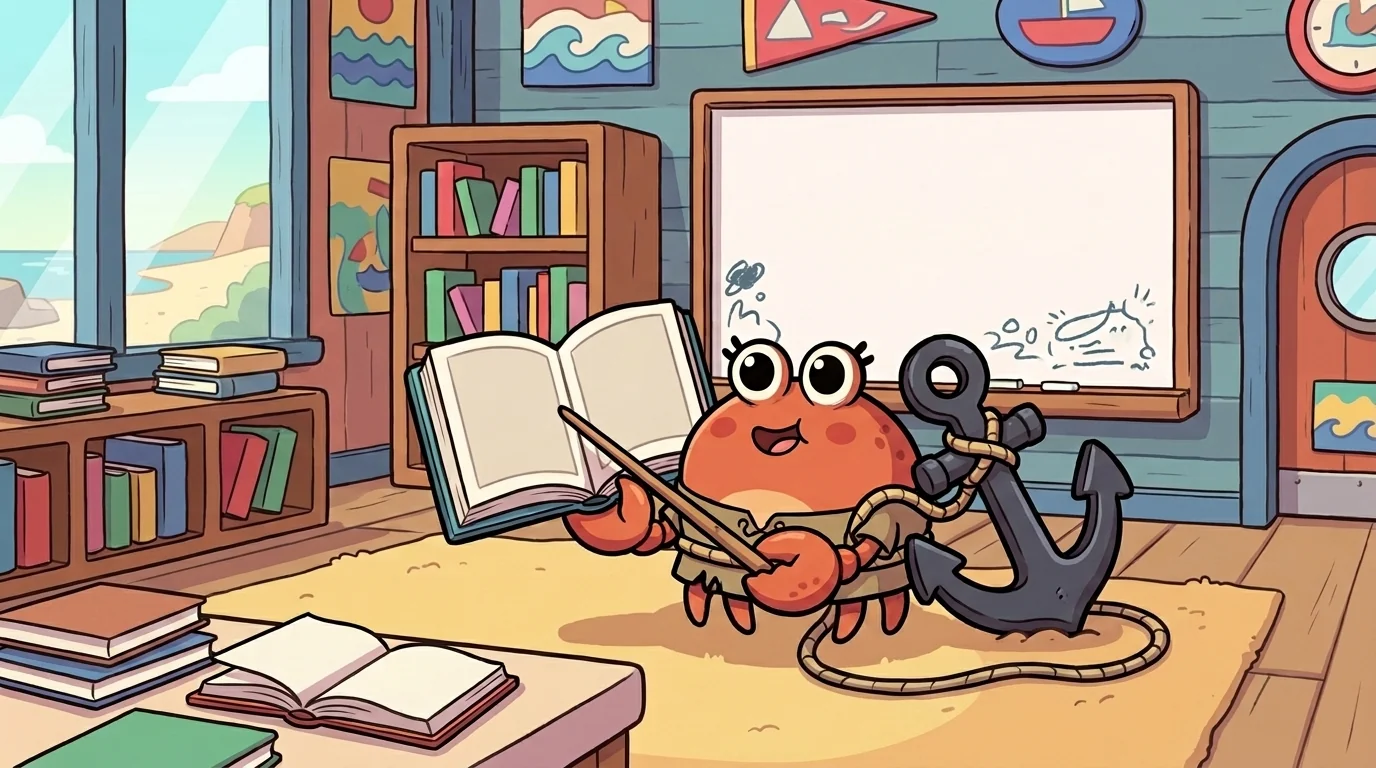
The students always — always — find this amazing. Their eyes get wide. They had often made ideas about books. But they never knew those ideas needed proof. Anchor's real ship's-anchor shows them the rule. It makes it easy to see.
Sometimes students ask Anchor if finding proof is hard. Anchor always says the same thing.
"It is not hard," she says. "It is just showing where your idea ties to the book. For every idea you have about a story, ask yourself: what exact sentence proves this? Point to it. Your idea is now anchored. If you don't show the proof, your idea is floating. Readers cannot trust floating ideas."
She still keeps the small ship's-anchor at her feet. It's always there. The children sometimes ask if they can help her lift it. It's too heavy for just one kid. But teamwork is allowed! She always lets them try. A few kids gather around. They grab the rope. They pull together. The anchor lifts a little higher with their help.
In twelve years, Anchor has helped thousands of kids. She has taught them to tie their ideas about books to the actual words.
The ReadQuest ensemble
Anchor is part of ReadQuest's distributed-narrative cast. Each character embodies a different curricular primitive; together they teach the full subject.
-

Crest
Main idea / central message (the *peak* of the passage)
-

Hunch
Inference (reading between the lines)
-

Plume
Author's purpose / voice / tone
-

Frame
Text structure (compare-contrast, sequence, cause-effect, problem-solution, description)
-

Pith
Vocabulary in context (deriving word meaning from surrounding text)
-

Yonder
Predicting — alert young-hare creature who reads the trail's clues to guess what's around the bend; a wrong guess just means the story surprised you
-

Vista
Visualizing — dreamy young-deer creature who turns words into a movie in the mind; the writer gives the words, the reader gives the pictures
-

Nettle
Questioning the text — question-quilled hedgehog who pokes a passage with why/how/what-if; asking questions means you're awake, not that you don't understand
-

Sheaf
Summarizing — warm-handed harvester who gathers a whole passage into one tidy armful, keeping the important middle and letting loose details fall