
Tint
COLOR MIXING — additive (light) vs subtractive (pigment) — same color words, opposite math.
Listen along — Tint
Loading audio…
Press play to listen along. The line being read lights up as you go.
Show full transcript
Loading transcript…
Chapter 5 — Tint and the Two Kinds of Color
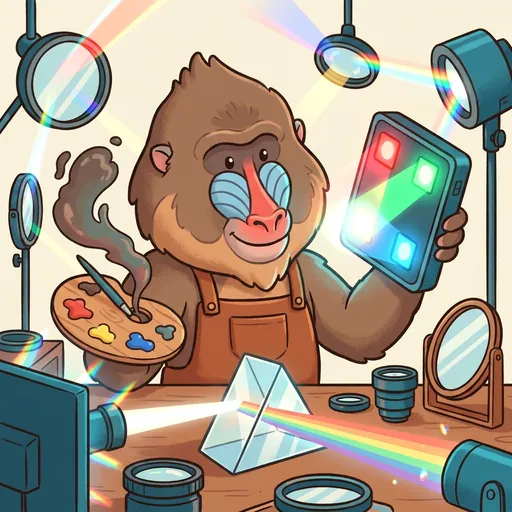
At her workbench in PrismForge, a mandrill-tween named Tint set two “reds” side by side and dared them to disagree.
On her left sat a paint-palette, a smear of red pigment glistening in one well. On her right glowed a little screen of tiny lights, one of them burning red. A student had wandered in and slouched against the doorframe, watching her fuss.
“Both red,” the student said. “So what.”
“Watch what happens when I add green to each,” Tint said. Her soft blue-and-red face-marks caught the light as she leaned in.
She dabbed green pigment into the red well and stirred. The color slid, thickened, and went a dull, muddy brown. Then she reached to the screen and switched a green light on beside the red one. Where the two glows overlapped, the wall lit up a clean, sunny yellow.
The student pushed off the doorframe. “That’s — those are the same colors. Red and green. How did one turn brown and one turn yellow?”
“Same color words,” Tint said, and she almost sang it. “Opposite math.” She tapped the palette. “This one subtracts. You start with a white surface, and every pigment you add eats up more of the light bouncing back to your eye. Pile them on, you get closer to nothing. To dark.” She tapped the screen. “This one adds. You start in the dark and pour light in. Pile it on, you get closer to everything. To white.”
The student stared at the brown blob, then at the yellow glow, then back. “Nobody told me there were two of them.”
“Almost nobody gets told,” Tint said. “That’s the whole problem.”
Tint had learned the confusion the hard way, back home.
Her family were the colorists of the rainforest village — the ones who knew how to make dyes hold and how to read the light through the canopy. When Tint was little, she thought she had it figured out: mixing colors meant piling paints together. Red and yellow made orange. Blue and yellow made green. She was proud of it. She was certain.
Then one evening she watched her grandmother tilt her own face toward the last of the sun. The brown of her skin came from pigment — that was the eating-light kind, Tint knew that much. But the shimmer along her brow, that impossible ridge of blue, wasn’t paint at all. It was light itself, bounced and sorted by the tiny structure of the skin. Two completely different things, living on one face.
“How is your face doing two colors two ways at once?” Tint had asked, frustrated, because it broke her tidy little rule.
Her grandmother had only smiled. “Because color was never one thing, small one. It is what the light brings, and it is what the surface keeps. You have been mixing them up because everyone does.” She’d touched Tint’s cheek. “It isn’t a mistake to be ashamed of. It’s just a door you hadn’t walked through yet.”
Tint had sat with that a long time. The jumbled, off-balance feeling — the sense that she’d been half-wrong her whole short life — slowly turned into something lighter. Not I was stupid. Just: there’s a second room, and now I can see the doorway.
She walked to PrismForge at thirteen, carrying the palette in one hand and, tucked in her satchel, the little light-board she’d built from salvaged bulbs.
Optic, the mentor who kept the workshops, met her at the gate. He didn’t ask her to prove she was clever. He asked one thing. “What is color mixing?”
Tint didn’t answer with a speech. She knelt, set the light-board on the flagstones, and switched on red and green together — a wash of yellow spilled across the stone. Then she pulled out her palette and, right beside the yellow glow, stroked red and green pigment together into a patch of brown.
She looked up. “Same colors. Both times. One’s light and one’s paint, so one adds and one subtracts. Yellow, and brown. Knowing which one you’re standing in is half the work.”
Optic looked at the two patches sitting next to each other, arguing quietly. Then he nodded. “You are appointed.”
Tint’s workshop filled up with kids who arrived sure they already understood color, and left understanding it better.
A girl came in one afternoon nearly in tears over a screen. She’d been trying to mix a color on the computer the way she mixed it in art class — and it kept coming out wrong, garish, nothing like she wanted. “I know how to make colors,” she said. “I’ve been doing it for years. Why is the screen lying to me?”
Tint didn’t tell her she was wrong. “You’re not wrong,” she said. “You’re just in the other room and nobody moved you.” She pulled the paint-palette over. “Show me how you make a soft grey with paint.”
The girl mixed a little of everything — the colors dulled each other down toward a gentle grey-brown. “Like that.”
“Good. That works because paint takes light away. Every color you add absorbs a bit more.” Tint turned the girl toward the screen. “But this thing doesn’t have any light to take away. It starts black. It only gives.” She switched all three — red, green, blue — and the square blazed white. “On paint, everything-together goes dark. On light, everything-together goes bright. Opposite ends.”
The girl watched the white square. “So on the screen I should be… adding light, not mixing paint in my head.”
“That’s it. That’s the whole trick.” Tint grinned. “Not what colors — which world. Ask which world first. Then the math behaves.”
The girl tried again, thinking in light this time. The color came out exactly as she’d pictured it. She let out a breath she’d clearly been holding for an hour.
Later, when the workshop had emptied, the girl lingered at the door.
“It’s kind of embarrassing,” she said quietly. “That I never knew. That I mixed them up for so long.”
Tint thought about the last of the sun on her grandmother’s face, and the tidy little rule that had shattered so gently. “It isn’t embarrassing,” she said. “Everyone starts inside one room and thinks it’s the whole house. You didn’t do color wrong — you just met the second half of it today.” She looked at the girl. “How’s it feel now?”
The girl considered. “Lighter,” she said, surprised. “Like something that was crooked just… clicked straight.”
Tint nodded, warm all the way through. That was the feeling she loved best — not the moment someone learned a fact, but the moment the tangle in their chest came loose and let go.
The PrismForge ensemble
Tint is part of PrismForge's distributed-narrative cast. Each character embodies a different curricular primitive; together they teach the full subject.