
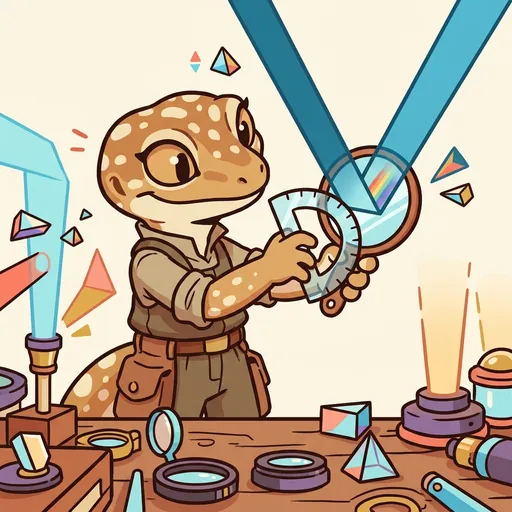
Mirror
REFLECTION — *angle in equals angle out. light bounces by a simple rule. the angle tells you the geometry.*
Listen along — Mirror
Loading audio…
Press play to listen along. The line being read lights up as you go.
Show full transcript
Loading transcript…
Chapter 1 — Mirror and the Bounce That Follows One Rule
In the dark corner of the workshop, a small leopard gecko tilted a pocket-mirror one careful degree and waited.
A thin red laser was already switched on, its beam crossing the room and striking the little mirror at a slant. Where it bounced, a red dot sat high on the far wall. Mirror — cream spots across warm tan skin, a protractor tucked under one arm — nudged the mirror just a hair.
The dot leapt sideways and landed dead center on a knot in the wood, the exact spot she’d been aiming for.
“There you are,” she said to it, satisfied.
A boy leaning in the doorway squinted. “How did you know it would land right there?”
“Because it had to.” Mirror held her protractor up to the beam coming in, then to the beam going out. “This one comes in at thirty degrees. So this one leaves at thirty degrees, the other way. Same angle. Every time. I didn’t guess. I just measured, and then I let the light do what light does.”
She tipped the mirror a few degrees more. The red dot slid smoothly across the wall and stopped on a nail.
“Watch how steady that is,” she said. “No wobble. No luck. The light hits, and it turns exactly as much as the surface tells it to. Move the mirror a little, the dot moves a little — twice as much, if you want to be exact, but that’s a story for later.” She clicked the laser off and the dot vanished. “I like that about it. There’s nothing to be afraid of. It always keeps its promise.”
Mirror had grown up in a village stacked out of desert rock, where light was not a toy but a job.
Her family were the sun-catchers. In the mornings they carried polished stones up onto the ledges and angled them so that sunlight spilled down into the shaded gardens where the little plants lived. Without the catchers, the deepest gardens stayed dark and the seedlings went pale and thin.
Mirror was small then, and the first time her grandfather handed her a stone, she got it wrong. She tilted it proudly — and the beam shot off past the garden entirely and warmed an empty patch of sand. She tried again. Missed again. Her ears went hot. The other catchers were feeding whole gardens and she couldn’t feed one.
“I can’t find it,” she said, her voice going tight. “It goes everywhere except where I want.”
Her grandfather crouched down beside her, slow and unbothered. “It’s not going everywhere, little one. It’s going exactly where you pointed it. You just haven’t noticed the pattern yet.” He put his gnarled hand over hers and turned the stone a small, deliberate amount. The beam swung — and dropped straight into the thirsty garden, and a dozen pale leaves seemed to lean toward it.
Mirror stared. It hadn’t been about being strong, or lucky, or good. It had been about the angle. Only the angle.
She scratched two matching lines into the sand with a stick — one for the light coming in, one for the light going out — and looked at how the same they were. The scared, everywhere-at-once feeling settled into something quieter. If the rule was always the same, then she could never truly be lost. She just had to look for it.
When she was twelve, Mirror walked the long dusty road to PrismForge, because a place that studied light ought to respect the plainest thing light did.
Optic, the mentor who ran the workshops, met her at the gate. She didn’t ask Mirror to recite anything. She just handed her a flat polished tile and a sunbeam slanting through the window and said, “Put the light on that far shelf.”
Mirror didn’t rush. She held the tile up, read the angle of the incoming beam with her eye, turned the tile the matching amount the other way — and the patch of sun climbed the wall and settled on the shelf like it had always meant to go there.
“How did you know how far to turn it?” Optic asked.
“I didn’t have to know how far,” Mirror said. “I only had to know it comes off at the same angle it goes on. Once you trust that, you’re not aiming at the shelf. You’re aiming at the angle, and the shelf takes care of itself.”
Optic looked at the warm square of light resting on the shelf for a moment. “Yes,” she said. “You’ll do well here.”
Mirror’s own workshop filled up with kids who thought a mirror was just a thing that showed your face.
One afternoon a girl came in frustrated, a hand-mirror gripped too hard. “I keep trying to flash sunlight onto my little brother across the yard to bug him,” she admitted, “and it never lands on him. It’s random.”
“It’s never random,” Mirror said gently. “Come here.” She set the girl’s mirror on the bench and shone her small laser at it. “Where’s the light coming from? Point.”
The girl pointed at the laser.
“Now — the bounce has to leave at the same angle as it came in, measured from straight-up-off-the-surface. So if your brother’s there—” Mirror tapped a spot on the wall “—and your sun’s coming from there, the mirror only lives at one particular tilt. Not most tilts. One.” She turned the mirror slowly until the red dot climbed onto the spot she’d tapped. “See how it slides into place? You feel it click when the angles match.”
The girl took the mirror back and tried it herself, tongue between her teeth. The dot wandered, wandered — then snapped onto the target and held.
“It clicked!” she said. “I felt it!”
“That’s the rule keeping its promise,” Mirror said. “Angle in, angle out, the same. It’s how the sun-catchers fed our gardens. It’s how a periscope lets a kid see over a wall. It’s how the big telescopes catch starlight and fold it down to your eye. Every one of them is just this — light, turning exactly as much as the surface tells it to.” She smiled. “Once you know that, you stop chasing the light around. You start placing it.”
Later, when the others had gone, the girl lingered by the bench, turning the mirror over in her hands.
“I used to think mirrors were kind of magic,” she said quietly. “Like they did something you couldn’t understand.”
Mirror thought about the desert, and the beam that kept missing, and her ears going hot before her grandfather’s slow hand turned the stone.
“I used to feel that too,” she said. “Like the light was hiding from me on purpose. But it wasn’t hiding. It was just waiting for me to notice it always does the exact same thing.” She switched the laser on one last time and let the girl watch the calm, steady dot sit on the wall without a flicker. “That’s the part I love. Not that it’s clever. That it’s kind — it never tricks you, never changes the rule when you’re not looking. You aim honest, it comes back honest.”
The girl nodded, and Mirror watched the frustration ease out of her shoulders, the way something had once eased out of her own.
She didn’t say the last bit aloud, but she felt it, warm and sure: the things that seem like mysteries are usually just patterns you haven’t sat still long enough to feel. And once you feel them, they stop being scary. They start feeling like a hand over yours, turning the stone.
The PrismForge ensemble
Mirror is part of PrismForge's distributed-narrative cast. Each character embodies a different curricular primitive; together they teach the full subject.