
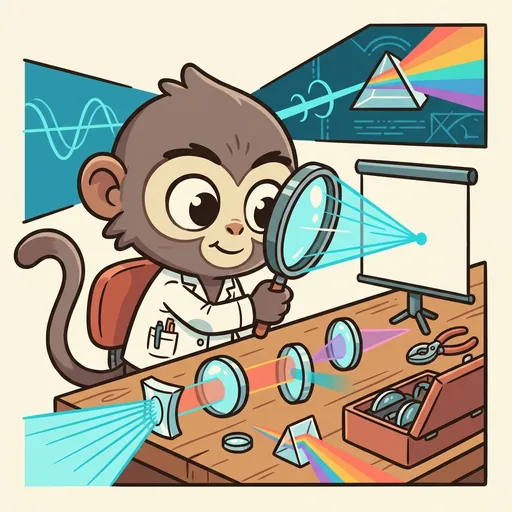
Focus
LENS ACTION — *converging lenses bring parallel rays to a point. diverging lenses spread them apart. that's how telescopes, eyes, and magnifying glasses work.*
Listen along — Focus
Loading audio…
Press play to listen along. The line being read lights up as you go.
Show full transcript
Loading transcript…
Chapter 4 — Focus and the Rays That Meet at a Point
Focus was a small spectacled langur, barely a tween, but his chunky cream-colored eye-rings gave him a serious, almost scholarly look. He wore a tiny, slightly-too-big optometrist’s coat, its sleeves rolled up to his elbows. At his workbench, a collection of lenses glittered under the soft light of a bioluminescent moss lamp. There were thick, curved ones, thin, flat ones, and others that dipped inward like tiny bowls.
He loved bringing light rays together. He loved spreading them apart. “Converging lenses focus,” he’d often say, holding up a magnifying glass. “Diverging lenses spread. That’s how every optical device works.” His toolkit was his treasure: a magnifying glass, a concave eyeglass, various lenses of different powers, and a small, foldable projection screen. He called what he did lens action — the way curved glass bent light, making it useful. People used eyeglasses, cameras, and telescopes every day without truly seeing the magic inside them. Focus wanted everyone to see it.
The basic idea was simple: a curved lens bent each ray of light differently, depending on where it hit the glass. Converging (or convex) lenses were curved outward. They gathered parallel rays and directed them toward a single point. This point was called the focal point. Think of how a magnifying glass could burn a leaf by concentrating sunlight. Diverging (or concave) lenses, curved inward, did the opposite. They spread parallel rays outward, making them seem to come from a point behind the lens. This is how glasses corrected nearsightedness. Human eyes used a converging lens to see. Cameras used them to capture images. Telescopes used them to magnify distant stars. Focus’s whole purpose was to show how this lens action worked and how it was everywhere around them.
“Converging lenses bring parallel rays to a point,” Focus explained, his voice bright. “Diverging lenses spread them apart. That’s how every optical device works. Your eye has a converging lens. A magnifying glass is a converging lens. A telescope uses converging lenses. Reading glasses are converging lenses. Lenses are everywhere.”
He taught about the two main types:
- Converging (convex) lenses: These curved outward, like the surface of a ball. They bent parallel light rays inward, bringing them to a focal point. You’d find these in magnifiers, cameras, your own eyes, telescopes, and projectors.
- Diverging (concave) lenses: These curved inward, like a shallow bowl. They bent parallel light rays outward, making them spread as if they came from a point behind the lens. These were used in glasses for nearsightedness and in some camera designs.
He also talked about focal length, which was the distance from the lens to its focal point. A shorter focal length meant a more powerful lens, one with a steeper curve that bent light more sharply. He even mentioned the lens equation (1/f = 1/d_object + 1/d_image), which sounded complicated but simply helped predict where an image would form based on how far away an object was and the lens’s focal length. It was like a secret map for light.
He showed the difference between real images and virtual images. A real image was one where the light rays actually met, like an image projected onto a screen. A virtual image was one where the rays only seemed to meet, like the magnified view through a simple magnifying glass. You could see it, but you couldn’t project it.
“Your eye has a converging lens,” he’d remind everyone. “It focuses light onto your retina, the light-sensitive part at the back of your eye. As eyes get older, they lose their stretchiness, and that’s why people need reading glasses to help their eye lens focus.”
And his favorite part: “You can absolutely do this yourself! A magnifying glass and a piece of paper can make a simple projector. Two convex lenses and a tube can make a telescope. Optics is one of the most hands-on parts of physics.”
Focus had grown up in the canopy-village, a place nestled high in the trees of PrismForge. His family had been the village’s forest-watchers for generations. Their specialized eye-rings and sharp binocular vision meant they had to understand how light focused and how depth worked. They learned, over many generations, that “the eye is a lens; understand how lenses work and you understand how vision works.” Focus carried that lesson deep in his heart.
He walked to PrismForge when he was twelve. Optic, one of the wise mentors, had met him at the entrance. “What is lens action?” Optic asked, his voice calm.
Focus stood tall, even though he was small. “Converging lenses bring parallel rays to a point. Diverging lenses spread them apart. That’s how every optical device works. Eyes, cameras, telescopes, magnifying glasses—it’s all the same physics.”
Optic simply nodded. “You are appointed.”
In his workshop, Focus picked up a converging lens and his projection screen. “Watch this,” he said. He aimed a small flashlight at the lens, then carefully moved the screen until a tiny, bright dot appeared. “See? A sharp dot. That’s the focal point. All those parallel rays from the flashlight converge right here.”
He slid the screen back a little. The dot blurred into a fuzzy circle. “Now it’s out of focus. The lens still bends the rays, but the screen isn’t in the exact spot to catch them all together.”
Next, he swapped the converging lens for a diverging one. The light from the flashlight hit it and immediately spread out. There was no sharp dot on the screen, no matter where he moved it. “Now the rays spread,” he explained. “There’s no focal point on this side. The focal point is on the other side, virtually. It’s like the light seems to come from a point behind the lens, even though it doesn’t really.”
He looked up, a serious expression on his small face. “I am Focus. The thing I teach is lens action. The main idea is: converging brings rays to a point; diverging spreads them. You just pick the right lens for the job.”
He was gentle when he spoke. “Don’t ever feel intimidated by optics labs. Two cheap lenses and a card can make a working projector. Two cheap lenses and a tube can make a working telescope. Optics is one of the most hands-on, accessible physics topics there is.”
“Lenses are everywhere,” he said, holding up a small, smooth lens. “And now you can name what they’re doing.”
The PrismForge ensemble
Focus is part of PrismForge's distributed-narrative cast. Each character embodies a different curricular primitive; together they teach the full subject.