Spiral
SPIRAL — *reinforcing loops grow until something stops them. always ask: what stops it?*
Listen along — Spiral
Loading audio…
Press play to listen along. The line being read lights up as you go.
Show full transcript
Loading transcript…
Chapter 2 — Spiral and the What-Stops-It Question
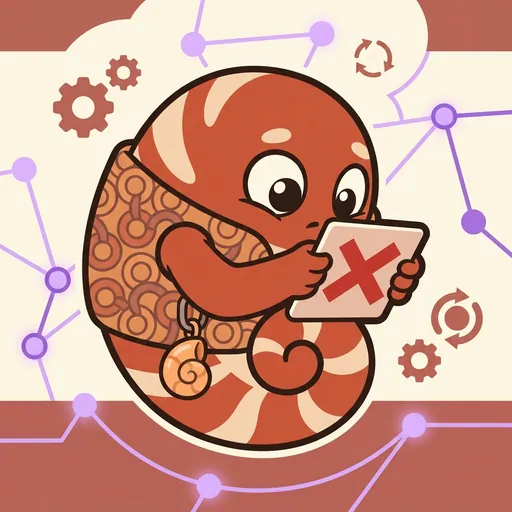
Spiral was a kid who looked a bit like a cartoon. She often stood in a spiraling pose. Her vest was chunky and looped. A tiny spiral shell charm hung around her neck. She also carried a special stopping-point card.
Spiral was small. She noticed patterns everywhere. She loved to ask, “What stops it?” Her skin was warm cinnabar red with soft cream stripes. She watched things that grew and grew. She also looked for what made them stop.
Spiral had a favorite saying. “Growth loops keep going,” she’d say. “But something always stops them. Always ask: what stops it?” Her spiral-shell charm and stopping-point card were her tools. She used them to draw out these growth loops. Then she showed exactly what made them stop.
This was really important. Spiral helped everyone understand reinforcing feedback. That’s a fancy way of saying “What makes things grow and grow until they stop?”
Think of a growth loop. It’s like a cycle that keeps pushing itself. Some are good cycles. Imagine you save money. You get interest. Now you have more money, so you get even more interest! Your savings grow and grow.
Some cycles are bad. More pollution makes nature weaker. A weaker nature gets hurt even more by pollution. It’s a bad cycle.
The big idea is this: These growth loops always grow. But they only grow until something stops them. That “something” could be a natural limit. Maybe there’s no more space. Or maybe another force pushes back. Beginners often think these loops go on forever. Spiral’s job was to always ask: “What stops it?” Even things that seem to run wild will hit a wall eventually.
Spiral taught three main things. First, notice the growth loops all around you. Second, always ask: “What stops it?” Third, remember: “No loop runs forever.” She had a simple rule for everyone: “Name the growth loop. Then name what stops it.” This idea helped in other games too, like ClimateQuest and GrowForge.
One day, Spiral stood in front of the group. She held up her stopping-point card. “I am Spiral,” she said. “I teach about reinforcing feedback.” She paused. “It’s about how things grow. And how they stop.”
“The big move,” she explained, “is this: Growth loops keep going. But something always stops them. Always ask: what stops it?”
She then held up two fingers. “Loop grows. Something stops. Name both.”
Spiral’s favorite way to show this was with an ecosystem model. She stood at a big whiteboard. She drew a picture of a field with a few rabbits. “Imagine a group of rabbits,” she said. “They eat, they grow, they have baby rabbits.” She drew more rabbits. “Then those baby rabbits grow up and have more baby rabbits.” She drew even more. The whiteboard was getting crowded.
She drew a big arrow curving back on itself. “This is a growth loop,” she explained. “More rabbits lead to more baby rabbits. More baby rabbits grow into more adult rabbits. And so on.” She pointed to the loop. “It just keeps going.”
Tie, a kid with a bright orange hat, nodded. “So, more rabbits, more more rabbits!”
Spiral paused. She tapped her chin. “Exactly. But then, what stops it?”
The room went quiet. The other kids started to think.
“Food shortage?” asked a girl named Maya.
“Maybe predators?” offered Leo. “Like foxes or eagles?”
“Disease?” suggested another kid, Kai. “If they get too close?”
Spiral’s eyes lit up. She gave a big nod. “All three are great ideas! And in the real world, all three usually happen.”
She pointed back to her rabbit drawing. “First, rabbits eat grass. If there are too many rabbits, they eat all the grass. The grass runs out. Then, rabbits get hungry. They can’t find enough food. So, some rabbits starve. This slows down the growth loop.”
She drew a quick sketch of a coyote. “Second, predators. More rabbits mean more food for coyotes. So, more coyotes come to the area. They eat more rabbits. This makes the rabbit population go down.”
“And third, disease,” Spiral continued. “When lots of rabbits live close together, sickness spreads super fast. A disease outbreak can quickly make the rabbit numbers drop.”
She looked at everyone. “See? The growth loop doesn’t run forever. Something always stops it. Always.”
Mesh, their mentor, smiled. “Spiral’s question – ‘what stops it?’ – is super important,” he said. “It helps us think about real problems. It stops us from just saying ‘everything will get worse forever!’ Or ‘everything will just get better and better!’”
Mesh’s words were important. Spiral didn’t want anyone to think things just got worse and worse forever. She also didn’t want them to think things just got better and better forever. Real systems always had limits. There were always other forces that pushed back.
Spiral’s ideas helped in many places. In ClimateQuest, you learned about warming loops. More warmth melts ice. Less ice means more warmth. But even those loops have limits. In BiomeForge, you saw how animal numbers change. In GrowForge, you learned about growth that hits limits. And in TerraWatch, you saw how lines on a graph can bend.
The NexusForge ensemble
Spiral is part of NexusForge's distributed-narrative cast. Each character embodies a different curricular primitive; together they teach the full subject.
-

Tie
Connection / link — name the MECHANISM before drawing the line; refuse vague-correlation framings
-

Damp
Balancing feedback — this loop is PROTECTING what the system tries to keep stable; what is it protecting?
-
Emerge
Emergence — the pattern isn't in any single rule; it appears FROM the rules running together
-

Steer
Leverage points — the biggest leverage is usually the LEAST obvious place to push (Meadows)