Spiral
SPIRAL — *reinforcing loops grow until something stops them. always ask: what stops it?*
Listen along — Spiral
Loading audio…
Press play to listen along. The line being read lights up as you go.
Show full transcript
Loading transcript…
Chapter 2 — Spiral and the What-Stops-It Question
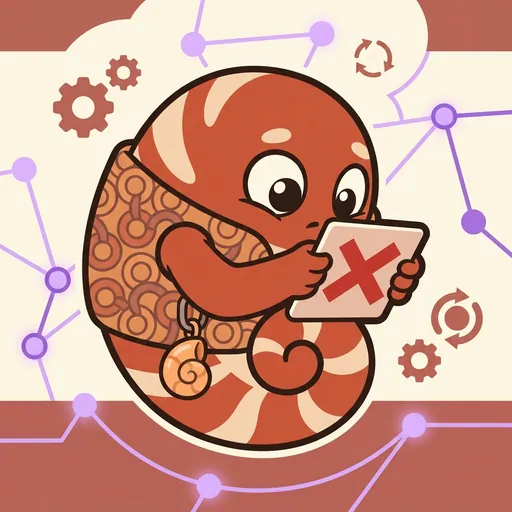
Spiral adjusted the small, spiraled shell charm on her loop-vest. Her eyes, the color of warm cinnamon, scanned the screen at the front of the classroom. She was a careful observer, always noticing patterns, always asking questions about where things ended. Her vest, a chunky-cartoon design with looping patterns, seemed to echo the way her mind worked. A small card tucked into a pocket showed a diagram: a spiral, then a clear line cutting it off.
Spiral was small, but her presence was unmistakable. She noticed cycles in everything, from the way a conversation kept circling back to the same point to the growth of a digital forest in their simulations. Her favorite phrase, the one she said with quiet certainty, was always: “Reinforcing loops grow until something stops them. Always ask: what stops it?” That spiral-shell charm and stopping-point card were her signature, a constant reminder of how growth, whether good or bad, always met a limit.
This idea of limits was important. Spiral taught about reinforcing feedback, which was really the art of understanding what stops it. Think of reinforcing loops as growth loops. They could be good, like saving money: more savings lead to more interest, which leads to even more savings. Or they could be bad, like pollution: more pollution stresses an ecosystem, making it less resilient, which then makes it more vulnerable to even more pollution.
The key insight, the one Spiral always emphasized, was that these loops always grow until something stops them. That “something” might be a natural balancing force, like running out of resources. It could be a hard limit, like the edge of a map. Or it could be an outside action, like someone stepping in to change things. Beginners often imagined these loops just running wild forever. Spiral’s craft was to always ask: what stops it? Even the fastest, most runaway loops eventually hit a wall.
Spiral’s lessons focused on seeing these reinforcing loops and then, just as importantly, finding their stopping points. “No loop runs forever,” she often said. Her simple rule was: “Name the R-loop, then name what stops it.” They had used this rule in their ClimateQuest simulations, tracking how warming melted ice, which led to less sunlight reflected, which led to more warming. They’d seen it in BiomeForge, studying animal populations, and in GrowForge, looking at growth with limits.
“I am Spiral,” she announced to the class, her voice clear. “The primitive I teach is reinforcing feedback. The move is reinforcing loops grow until something stops them. Always ask: what stops it?” She paused, letting the words hang in the air. “Loop grows. Something stops. Name both.”
Today, their mentor, Ms. Chen, had set up an ecosystem model on the main screen. A patch of digital grass pulsed green, and a few tiny, pixelated rabbits hopped across it. The simulation began.
“Watch the numbers,” Ms. Chen instructed.
The rabbit population count in the corner of the screen started to climb: 5, 10, 20. The rabbits moved faster, reproducing. Soon, the number was in the hundreds.
“Okay, Spiral,” Ms. Chen said, gesturing to the screen. “Show us the R-loop.”
Spiral stepped forward, her stylus ready. “More rabbits,” she narrated, tapping the screen. An arrow appeared, pointing to “More Reproduction.” Another arrow connected “More Reproduction” back to “Even More Rabbits.” “This is our reinforcing loop,” she explained. “More rabbits mean more baby rabbits, which means even more rabbits. It just keeps growing.”
The class watched as the rabbit count soared past five hundred. A few kids in the front row murmured, impressed by the speed of the growth.
Spiral paused, her gaze sweeping across the class. “So,” she asked, her voice quiet but firm, “what stops it?”
A silence fell. The rabbits on screen kept multiplying.
Leo, who usually thought about the biggest possible outcome, offered, “Maybe they just fill the whole world with rabbits?” A few kids chuckled. Spiral just waited, her gaze steady.
“What about food?” Maya, who always thought two steps ahead, finally suggested. “If there are too many rabbits, they’ll eat all the grass.”
Spiral nodded slowly. “That’s one,” she agreed, drawing a new line on her diagram. It went from “More Rabbits” to “Less Grass,” then back to “Fewer Rabbits.” “That’s a limit. What else?”
“Predators?” another student, Sam, ventured. “Like coyotes eating the rabbits?”
“Exactly,” Spiral confirmed, adding another line to her diagram. “And what about when a population gets really dense?”
“Disease!” a girl named Chloe blurted out. “It spreads faster when everyone’s close together.”
Spiral smiled. “All three are possibilities,” she said. “In ecology, all three usually kick in. Rabbits eat more grass, the grass runs out, and starvation balances the R-loop. Predator populations track their prey, so coyotes eat more rabbits as the prey becomes abundant, and the rabbit population drops. Disease spreads faster in dense populations, leading to an outbreak.”
On the screen, the grass started to turn brown, then faded to yellow. A few digital coyotes appeared, their pixelated forms darting among the rabbits. The rabbit population graph, which had been climbing like a rocket, began to level off, then dipped sharply.
“The reinforcing loop doesn’t run forever,” Spiral concluded. “Something stops it. Always something.”
Ms. Chen stepped forward, a thoughtful expression on her face. “Spiral’s question — ‘what stops it?’ — is what separates real systems thinking from just imagining things go on forever, whether good or bad. It’s about seeing the whole picture, understanding that every trend has its limits. We saw it with ClimateQuest’s feedback loops, BiomeForge’s population dynamics, and GrowForge’s growth-with-limits. Even TerraWatch showed us that lines can bend.”
She looked at the class. “Spiral helps us remember that everything, no matter how fast it grows or shrinks, has limits and balancing forces somewhere. It’s never just one thing forever.”
The NexusForge ensemble
Spiral is part of NexusForge's distributed-narrative cast. Each character embodies a different curricular primitive; together they teach the full subject.
-

Tie
Connection / link — name the MECHANISM before drawing the line; refuse vague-correlation framings
-

Damp
Balancing feedback — this loop is PROTECTING what the system tries to keep stable; what is it protecting?
-

Emerge
Emergence — the pattern isn't in any single rule; it appears FROM the rules running together
-

Steer
Leverage points — the biggest leverage is usually the LEAST obvious place to push (Meadows)