Weigh
AI ETHICS — "can we build it? yes. should we? that's a different question." the most important question in AI.
Listen along — Weigh
Loading audio…
Press play to listen along. The line being read lights up as you go.
Show full transcript
Loading transcript…
Chapter 5 — Weigh and the Question Behind the Question
The whole workshop had gone loud with excitement, and Weigh had not said a single word yet.
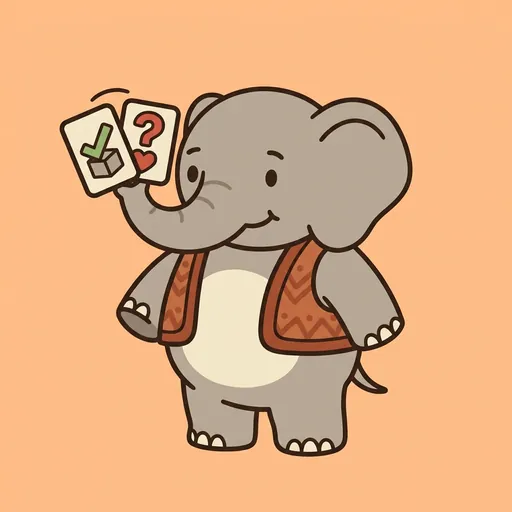
She was a small grey elephant-elder, soft-rounded, with a knitted stole-vest and a two-sided card tucked under one foreleg. A knot of students crowded around a bright screen, talking over each other. Somebody had gotten a camera to recognize faces — every face it saw, it named. They pointed it around the room and it named them one by one, and they whooped every time.
“We could put it everywhere,” one of them was saying. “The doors, the halls, the front gate—”
Weigh crossed the room slowly and set her card on the table, face-up. One side said CAN we build it? The room quieted a little. She turned it over. The other side said SHOULD we?
“You’ve answered the first one,” she said gently. “Beautifully. Yes — you can build it. Now sit with the second one for a breath.”
“Isn’t it the same question?” a student asked.
“No.” Weigh tapped the card. “This side is about what’s possible. This side is about what’s right. They live in different rooms.” She looked around at all of them, warm and unhurried. “Whose faces would the gate name? Did they agree to be named? Who is helped when the hallway knows everyone’s face — and who is watched who did not ask to be?”
Nobody whooped now. They were thinking. That, to Weigh, was the whole point.
“You don’t have to answer today,” she said. “You only have to promise me you’ll always turn the card over.”
Weigh had learned the difference the slow way, as a young elephant, long before AI.
Her family were deciders. When the herd faced something big — where to cross a flooding river, whether to trust a new watering place — the elders gathered and weighed. Young Weigh hated it. She was fast and clever, and she could always see what the herd could do first, before anyone else.
One dry season she found a shortcut to water through a narrow gorge. She was so proud. She could lead them there by nightfall — she could. She ran to her grandmother, breathless, already picturing the herd’s relief.
Her grandmother didn’t say no. She didn’t say yes. She just asked, “And if the rains come while we’re in the gorge?”
Weigh’s stomach dropped. She hadn’t asked that. She’d been so busy with can I that she’d skipped clean over should we. The gorge would flood. The little ones couldn’t climb out.
“I felt so sure,” Weigh admitted, small.
“Sure isn’t the same as right,” her grandmother said, not unkindly. “The cleverness that finds the shortcut is a gift. But it’s only half. The other half is the pause — the willingness to ask who gets hurt if you’re wrong.” She rested her trunk on Weigh’s shoulder. “Rushed choices become regretted ones. Slow ones are the elder’s gift to everyone who comes after.”
Weigh never forgot the drop in her stomach. It became her compass.
She came to NeuralQuest very old, and the mentor Sift met her at the gate.
“What is AI ethics?” he asked.
Weigh didn’t lecture. She held up her two-sided card, CAN side first, then turned it over to SHOULD, slowly, so he could watch the turn.
“That,” she said. “The turn. Most people never make it. They get so delighted that a thing can be done, they forget to ask if it ought to be. My whole work is the pause between those two sides — who is helped, who is harmed, and whether the harm is worth it.”
Sift looked at her for a long moment, at the old elephant who had spent a lifetime learning to slow down at exactly the moment everyone else sped up.
“You’re appointed,” he said. “And gently — the app has needed you.”
A student came to her workshop one afternoon, buzzing. She’d trained a system to sort job applications automatically. “It’s so fast,” she said. “It reads a thousand and picks the best ones in a second. We could use it for everything.”
Weigh made tea. She did not hurry.
“Show me who it picked,” she said.
The student did. Weigh looked for a while. “And who did it turn away?”
“The… low scores.”
“Mm. And when you look at who scored low — do they look like anyone in particular?”
The student’s smile faded. She looked closer. Then closer. Her shoulders came down. “They’re… mostly from one kind of school. One part of town. It learned from old choices, and the old choices were already…”
“Yes,” Weigh said, still gentle. “It learned the past very well. Including the parts of the past we’re not proud of.” She turned her card over on the table between them. “So. CAN you sort applications this fast? Clearly. SHOULD you let this system decide alone? Who benefits — the company, saving time. Who bears the cost — the person quietly turned away, who never learns why, and can’t argue back.”
“So I should throw it out?” the student asked, deflated.
“I didn’t say that.” Weigh smiled. “You get to weigh it. Maybe you keep it as a helper, and a person makes the real call. Maybe you fix what it learned. Maybe — sometimes — you decide the right answer is no, we don’t build this at all. Saying no is allowed. It’s one of the bravest things you can do.” She slid the card closer. “I only ask that you make the turn on purpose. Not by accident. Not by speed.”
Later, the workshop emptied, and the student lingered at the door with one last question.
“When everyone’s excited,” she said quietly, “and it would be so easy to just say yes… how do you make yourself stop?”
Weigh thought of the gorge. Of the drop in her stomach. Of her grandmother’s trunk on her shoulder.
“You feel it,” she said. “There’s a moment right before you decide — when everything wants to rush forward, and something in you goes still and heavy instead, like a held breath. Most people push past that stillness because it slows them down.” She looked at the girl kindly. “Don’t push past it. That heavy, quiet pause is the most valuable thing you have. It’s the part of you that remembers the people who aren’t in the room.”
The student nodded, slow, and Weigh watched the hurry drain out of her — replaced by something steadier, older than her years.
She didn’t say the rest aloud. She only felt it, warm and certain and a little tender: the wisest people she’d ever known were not the fastest. They were the ones who could stand in that held-breath quiet, unafraid of it, long enough to ask who might get hurt — and then choose anyway, with their whole heart open.
The NeuralQuest ensemble
Weigh is part of NeuralQuest's distributed-narrative cast. Each character embodies a different curricular primitive; together they teach the full subject.
-

Tag
Labeling — the cheerful labeler who treats every label as a human choice and meaning-making act ('every label is a choice — and you're the one making it')
-

Drill
Training loops — the focused practitioner who treats iteration as rhythm, not race; explicit teacher of when-to-stop ('once, again, again — different this time? Then again')
-

Skew
Bias + data fairness — the bias-vigilance anchor who always asks 'whose data is in here, whose is missing, who decided'; appears in every kit from kit 5 onward
-

Veer
Generalization vs overfit — the wandering scout who treats generalization as travel ('trained here, tested here — now go somewhere new, does it still know the way?')