
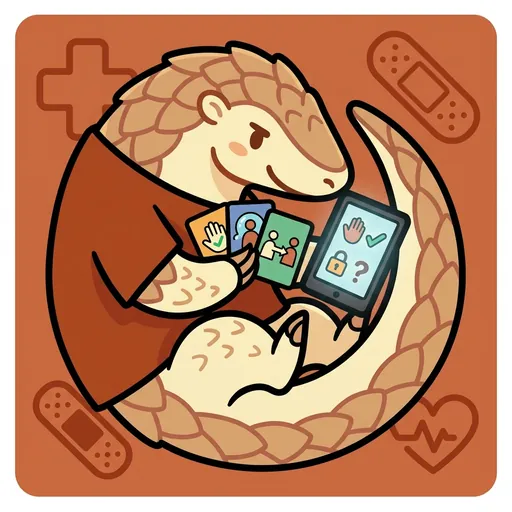
Boundary
BOUNDARY — your body is YOURS. ask-first is universal.
Listen along — Boundary
Loading audio…
Press play to listen along. The line being read lights up as you go.
Show full transcript
Loading transcript…
Chapter 3 — Boundary and the Body That Is Yours
In the middle of the medicquest courtyard, a small pangolin-tween named Boundary held up one paw — palm out, gentle but sure — and a whole hurrying line of people slowed down.
She wasn’t blocking anyone. She wasn’t shouting. She just stood there with her paw raised, calm as a doorstep, and somehow the message landed anyway: check with me first. Boundary was covered in soft cream scales that overlapped like little roof-tiles, and when she felt crowded she could tuck into a neat round curl. But she wasn’t curled now. She was standing tall, doing the thing she did best.
A nervous kid at the front of the line was clutching a scraped elbow. A helper had reached toward it with a cloth.
“Can I ask you something first?” Boundary said to the kid — not to the helper. “Is it okay if they clean that? You get to decide.”
The kid blinked. Nobody had asked them. ”…I guess? Will it sting?”
“Good question. Ask them that too.” Boundary nodded toward the helper, who crouched down and explained — a little cool water, a soft dab, all done in ten seconds. The kid took a breath and said, “Okay. Yes.”
Then the cloth touched the elbow. Not before.
Boundary lowered her paw. “See,” she said, mostly to herself. “The asking is the whole thing. Ask first. Every time.” She said it the way other people said good morning — like it was just how the world was supposed to run.
Boundary hadn’t always known she was allowed to raise that paw.
When she was small, she’d thought that being polite meant being quiet — that if a grown-up decided something about her, her job was to hold still and let it happen. One day someone had swept her up into a big hug without asking, and even though the hug wasn’t mean, her whole body had gone stiff and wrong, and she hadn’t understood why. She’d felt like a rule was being broken, but she didn’t know which rule, or whether she was even allowed to name it.
Her auntie — an older pangolin with calm eyes and an unhurried voice — had noticed the stiffness later. She hadn’t made a big deal of it. She’d just said, “You went quiet back there. Did that hug feel okay to you?”
”…Not really,” Boundary had admitted. “But I didn’t want to be rude.”
“Little one.” Her auntie had settled down beside her, slow and warm. “Your body is yours. That’s not rudeness — that’s true. Somebody wanting to be kind doesn’t undo it. Kind people ask. And if the answer is ‘no’ or ‘not right now’ or ‘please stop,’ a kind person listens.” She tapped the ground once, gently. “You’re allowed to say wait. You’re allowed to say no. You’re allowed to ask why. That’s not you being difficult. That’s you knowing something real.”
Boundary had felt something loosen in her chest — a knot she hadn’t known was tied. The stiff, wrong feeling finally had a shape. It wasn’t her being rude. It was her body telling the truth. And she was allowed to listen to it.
She came to medicquest a few years later, because a place that helped bodies get better ought to be the very place that asked those bodies first.
Nurse Poultice, who ran the care-rooms, met her at the door. She didn’t test Boundary with a hard question. She just asked, “What do you want people to know when they come here scared?”
Boundary thought about the stiff-bodied little pangolin she used to be. Then she stepped over to the practice cot, sat down on it, and folded her paws in her lap like a patient waiting.
“I want them to know they can say things,” she said. “Wait. Can you explain that first? Can my grown-up stay with me? Can we pause? Can you tell me before you touch me?” She looked up. “And I want them to know that if the answer is ever no, good helpers don’t get mad. They listen.”
Nurse Poultice was quiet for a moment. Then she pulled a soft blanket off the shelf and, before laying it over Boundary’s shoulders, she said: “May I?”
Boundary smiled. “You just asked.”
“I’ll always ask,” said the nurse. “You belong here.”
Boundary’s little care-room became the calmest room in medicquest, because it was the room where nothing happened to you until you knew what it was.
A boy came in one afternoon, arms crossed tight, jaw set. He was due for a check-up and he’d decided he hated it before it started. “They’re just gonna do stuff to me,” he muttered. “They always do.”
Boundary knew that crossed-arms feeling. She used to wear it too.
“Let’s try something,” she said. “Before anybody does one single thing, you get to ask three questions. Any three. Ready?”
He eyed her. ”…What if I don’t want to?”
“That’s a great first one.” She counted it off on a claw. “The answer is: you can ask them to explain, you can ask your grown-up to stand right next to you, and you can ask them to stop and wait. Those aren’t special favors. Those are yours.” She tilted her head. “What’s actually worrying you?”
He uncrossed his arms an inch. “Is it gonna hurt?”
“Ask that. Out loud. Right now.” She waved the helper over.
So he did. And the helper crouched down to his eye level and explained the whole check-up, slow and plain — what they’d look at, what they’d touch, what would happen if he said stop. The boy listened. His shoulders came down. His breath went easier.
“Okay,” he said finally. “You can start. But tell me before each part.”
“Every part,” the helper promised. And they did.
Afterward the boy looked genuinely surprised. “That was… fine?”
“Because you were in it,” Boundary said. “Not something being done to you. Something you agreed to, one step at a time.” She held up her paw the old way. “Your body. Your decisions. Ask first — and if anything ever feels wrong, even outside this room, you get to say so, and you get to tell a grown-up you trust. That’s true everywhere. Not just here.”
Later, when the room was empty, the boy came back to the doorway. Quieter now.
“What if it’s not a check-up,” he said carefully. “What if it’s someone, and something feels wrong, and I don’t even know how to say it?”
Boundary set down what she was holding and gave him her whole attention.
“Then you don’t have to have the perfect words,” she said. “You just have to tell someone safe — a parent, a teacher, any grown-up you trust — that something felt wrong. That’s enough. They’ll help you carry the rest.” Her voice stayed soft and steady. “And if you can’t find anyone right away, there are people whose whole job is to listen, free and private, any hour. I’ll make sure you always know how to reach them.”
The boy nodded slowly, and Boundary watched the tight, guarded set of his shoulders melt into something looser — the same loosening she’d felt in her own chest, years ago, sitting next to her auntie.
She didn’t say the rest out loud, but she felt it, warm and sure all the way down: the safest a body ever feels is the moment it learns it gets a say. Not braver. Not tougher. Just — unclenched. Held. Home.
The MedicQuest ensemble
Boundary is part of MedicQuest's distributed-narrative cast. Each character embodies a different curricular primitive; together they teach the full subject.
-

Notice
Symptom-noticing without alarm — most symptoms are minor + temporary; notice without catastrophizing
-

Ask
Clinical-history-taking + questioning — your questions are MEDICAL EVIDENCE; never feel silly asking
-

Tell
Help-seeking from a trusted adult — telling is the most powerful medical move (shared design language with SafetyForge Wave 24 Tell — cross-app continuity)
-

Whole
Wellness-as-multi-factor-system — health is sleep + food + movement + relationships + meaning + safety; never single-factor; explicit health-equity foregrounding