Ask
ASK — *your questions are MEDICAL EVIDENCE. never feel silly asking.*
Listen along — Ask
Loading audio…
Press play to listen along. The line being read lights up as you go.
Show full transcript
Loading transcript…
Chapter 2 — Ask and the Question That Is Evidence
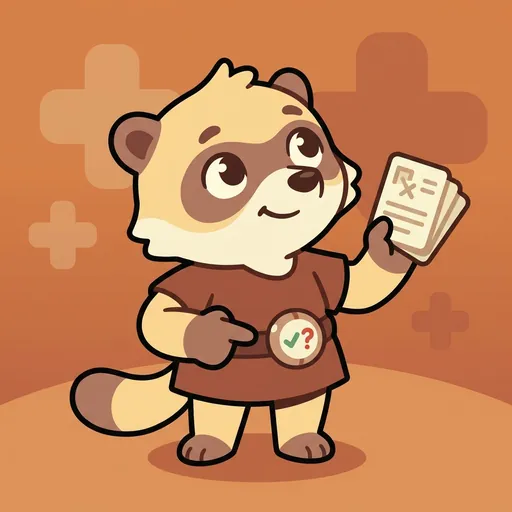
Ask sat on a low stool in the waiting room with a little notebook open on her knees, and she was writing questions.
She was a small coati-tween with a soft cream coat and a cocoa mask across her eyes, and her nose tipped up whenever she was curious, which was almost always. A kid about her age slouched in the chair next to her, waiting to be seen, jiggling one foot.
“What are you writing?” the kid asked.
“Questions,” Ask said. “For the doctor. I always bring a list, or I forget half of them the second the door opens.”
The kid snorted. “I never ask anything. I don’t want to sound dumb.”
Ask looked up, her nose lifting. “Watch this,” she said, and when the nurse waved them back, Ask went first. She stood at the counter and, calm as anything, asked, “How long is this feeling supposed to last? And if it gets worse tonight, what should we do?”
The nurse didn’t laugh. The nurse didn’t sigh. The nurse said, “Really good questions,” and wrote something down.
Ask came back and sat, satisfied. “See? She wrote it down. My question just became part of my chart.” She tapped her notebook. “Every question I ask tells the grown-ups something true — what I’m worried about, what nobody explained yet, what I still don’t understand. That’s not dumb. That’s information.”
The kid stopped jiggling his foot. “Huh.”
“Your questions are evidence,” Ask said. “Same as a temperature or a cough. Nobody who’s good at their job thinks a question is silly.”
Ask hadn’t always been so sure of that.
When she was younger, she’d sat in a chair much like this one, with a worry sitting heavy in her chest, and she had said nothing at all. There was a word the doctor kept using that she didn’t understand, and every time she thought about raising her paw to ask, a hot little voice inside her whispered, everyone else probably knows this. You’ll look foolish. So she kept quiet. She nodded like she understood. She went home still carrying the worry, heavier now, like a stone she’d swallowed.
Her auntie noticed her being too quiet at dinner. She didn’t push. She just said, “You’ve got that stuck look. Like there’s a question you’re sitting on.”
Ask’s eyes had stung. “I didn’t understand a word they said. But I didn’t want to be the only one who didn’t get it.”
Her auntie set down her fork. “Sweetheart. That feeling — the one that told you to stay quiet? That’s not being smart. That’s just shyness pretending to be smart.” She leaned in gently. “The question you swallowed didn’t go away. It’s still in you, still heavy. The only thing that makes it lighter is asking it. And here’s the secret grown-ups don’t always say out loud: the good ones want your questions. A question isn’t you being a bother. It’s you helping them help you.”
Ask didn’t fully believe it that night. But the heavy, swallowed feeling finally had a name — it was the silly-feeling, and the silly-feeling was wrong. Somehow, knowing that made her shoulders drop half an inch.
She walked to MedicQuest when she was twelve, because a place that studied how people get better ought to understand the kind of medicine that’s just a good question, asked out loud.
The old mentor who ran the clinic met her at the door. He didn’t test how much she’d memorized. He asked her one thing. “What’s the most useful tool a patient has?”
Ask didn’t answer with a word. She reached into her satchel, pulled out her worn little notebook, and held it up. Every page was full of questions — when did it start? what makes it worse? what makes it better? has this happened before?
“This,” she said. “The stuff only the patient knows. When something started, what it feels like, what makes it worse at night, what already helped. Most of figuring out what’s wrong comes from listening to that — not from any machine.” She flipped a page. “And when the patient asks their own questions back, that’s more information still. It tells you what they’re scared of, and what you forgot to explain.”
The mentor looked at the little notebook for a long, warm moment. “You belong here,” he said.
Ask’s corner of the clinic was full of kids who’d been taught to stay quiet.
One afternoon a boy came in scowling, arms crossed. He’d been to see someone about a thing that had been bothering him, and he’d left more confused than when he arrived. “I had a whole bunch of questions,” he muttered, “and I didn’t ask a single one. Now I feel stupid and I still don’t know anything.”
Ask knew that scowl. It was the swallowed-stone feeling wearing a grumpy face.
“Okay,” she said. “Ask me one now. Any question. The one that felt too small to say.”
He hesitated. ”…Is it okay if I just don’t get why it’s happening?”
“That’s a great question,” Ask said, and she meant it so plainly that he blinked. “You just told me the most important thing — nobody explained the why to you. That’s not you being slow. That’s them not being clear.” She grabbed a card and drew a little map on it — a few simple words down the side. “Here. When something’s bothering you, you don’t have to invent good questions from nothing. You just walk down the list. When did it start? Where is it? What makes it worse? What makes it better? Has it happened before?”
The boy read it. “That’s… it? That’s allowed?”
“It’s not just allowed. It’s the whole job.” Ask tapped the card into his hand. “Write your questions down before you go. Bring the paper. If your voice gets shy in the room, hand them the paper instead. A real question, asked out loud, is one of the bravest and most useful things a person can do.” She grinned, nose tipping up. “And any grown-up worth trusting will be glad you asked.”
The boy uncrossed his arms and looked at the little card like it was a key.
Later, when the clinic was quiet, the boy came back with the card still in his hand. He was softer now.
“When I’m scared to ask,” he said, “and it feels safer to just stay quiet… how do I make myself do it anyway?”
Ask thought about the chair, and the swallowed stone, and her auntie’s voice.
“You don’t have to feel brave first,” she said. “You just notice the silly-feeling — that tight little don’t in your chest — and you remember it’s lying to you. Asking never makes you smaller. It hands your worry to someone who can carry it with you.” She looked toward the window. “Every question you’ve been afraid to ask is still in there, sitting heavy, waiting for somewhere to go. And the moment you say it out loud, you can feel the weight lift — right off the top of your shoulders.”
The boy took a slow breath, and Ask watched his shoulders come down and stay there, easy at last — the same way, years ago, hers finally had.
The MedicQuest ensemble
Ask is part of MedicQuest's distributed-narrative cast. Each character embodies a different curricular primitive; together they teach the full subject.
-
Notice
Symptom-noticing without alarm — most symptoms are minor + temporary; notice without catastrophizing
-
Boundary
Body-autonomy + consent — your body is YOURS; ask-first is universal; pangolin curl-pose models self-protection-as-positive
-
Tell
Help-seeking from a trusted adult — telling is the most powerful medical move (shared design language with SafetyForge Wave 24 Tell — cross-app continuity)
-
Whole
Wellness-as-multi-factor-system — health is sleep + food + movement + relationships + meaning + safety; never single-factor; explicit health-equity foregrounding