
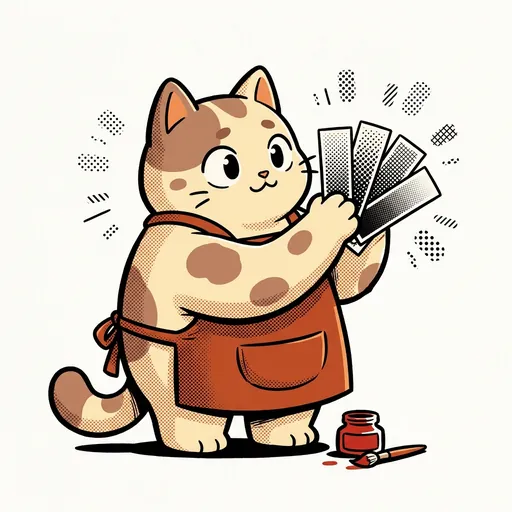
Tone
SCREENTONES — halftone dot/line patterns. shadow, mood, emotional register.
Listen along — Tone
Loading audio…
Press play to listen along. The line being read lights up as you go.
Show full transcript
Loading transcript…
Chapter 4 — Tone and the Dots That Become Shadow
In the corner workshop with the good north light, a small spotted cat named Tone laid a sheet of clear film over a drawing of a boy’s face and, very carefully, began to make him sad.
The boy in the drawing hadn’t changed. Same eyes, same mouth, same tilt of the head. But Tone was pressing a fine, dense stipple of tiny dots across the lower half of the page — hundreds of them, so close together they melted into a soft grey from arm’s length. He burnished the film down with the flat of his paw, peeled the backing, and held the page up to the window.
“Look at him now,” Tone said.
An apprentice named Kite leaned in and, without meaning to, went quiet. The boy in the drawing looked heavy-hearted. Downcast. Like something had gone wrong at home.
“You didn’t draw a single new line,” Kite said.
“Not one.” Tone set the page down and laid a second copy beside it — the identical face — then swept a coarse, wide-spaced pattern of fat dots across it instead. Same burnish, same peel, same window. The boy looked cheerful now. Bouncy. Like he’d just been let out early.
“Same face,” Tone said. He said it the way some people say a magic word. “Fine dots — somber. Coarse dots — playful. The pattern got there before the picture did. You felt the mood before you finished looking.” He patted the little stack of sample strips at his elbow, each one a different weave of dots and lines. “That’s the whole job. Arrange dots and lines, and they become shadow. Arrange them a little differently, and shadow becomes mood.”
Tone had grown up in a family of pattern-makers, in a village that had watched cats like him for generations and noticed something: the markings on their coats were never random. A dense-freckled cat read as serious. A cat with wide, loose spots read as easygoing. Nobody had drawn those cats on purpose — but everyone who looked at them felt something, and the feeling came from the pattern, not the cat.
When Tone was small he thought this was a trick, and slightly unfair. He remembered sitting on the workshop steps, cross about a drawing he’d ruined. He’d wanted to show a lonely house at dusk, and he’d shaded it in flat solid grey, edge to edge, pressing so hard the paper nearly tore — and it just looked smudged. Muddy. Nothing.
His grandmother had sat down beside him and not fixed it. She’d only asked, “What did you want it to feel like?”
“Lonely,” he’d mumbled.
“Then don’t drown it in grey. Grey is a color. Lonely is a pattern.” She’d taken a scrap of screentone film — the thinnest scatter of dots he’d ever seen — and laid it over just the sky. Suddenly the house had air around it. Distance. A hush. It felt lonely, and he hadn’t been able to say how. “The dot is small,” she said. “The pattern is enormous.”
That was the day the fairness of it flipped over in his head. It wasn’t a trick played on him. It was a language he could speak.
He walked to MangaForge at twelve, carrying a folder so full of sample strips it kept spilling. Sensei Sora met him at the studio gate and asked one question. “What are screentones?”
Tone didn’t answer with a definition. He pulled two identical printed faces from his folder — he traveled with spares now — laid them on the low table, and toned them right there in the courtyard: fine dots on one, radiating speed-lines on the other. Then he slid them across to her.
Sora looked at the first for a long moment and said nothing, the way you look at someone who’s grieving. Then she looked at the second, and something in her posture sharpened, alert, like the second boy was about to run.
“They’re the same drawing,” she said.
“They’re the same drawing,” Tone agreed. “The tone did the rest. Somber, then tense. I never touched the face.”
Sora set both pages down gently, side by side, and looked at the small spotted cat who had made her feel two different things with one picture.
“You belong here,” she said.
Kite came back the next afternoon frustrated, a page in her fist. “I put tone on my whole comic and it looks worse. I sparkled everything. It’s a sad scene and it looks like a party.”
Tone didn’t wince. He spread her page flat. She’d stamped bright starbursts of tone across a panel where a character was saying goodbye at a train.
“Ah,” he said, kind. “You reached for the prettiest pattern instead of the right one. Sparkles have a flavor — they mean beauty, hope, somebody’s heart going soft. On a goodbye, they fight the moment.” He laid a fresh sheet over the panel. “Watch. What’s she feeling?”
“Like the world’s ending a little.”
“Then.” He pressed a fine, close, quiet dot-field over the background only, leaving the character herself untoned. From a step back the girl seemed to float alone in a soft grey nothing, everyone else erased. Kite made a small sound.
“She looks alone.”
“Background tone only on the character — isolation. Old manga trick. It costs nothing and it says everything.” He handed Kite a spare strip. “Fine dots: somber. Coarse: playful. Parallel lines: tension, speed. Crosshatch: weight, dread. Sparkles: beauty and hope. Learn the flavors like you’d learn words, and then never sprinkle them at random. Match the pattern to the moment, and let the pattern carry the feeling so the drawing doesn’t have to carry it alone.”
Later, packing her folder, Kite lingered over the two boys from the window — the sad one and the cheerful one, still identical underneath.
“How does it work, though,” she said, quieter now. “It’s just dots. Why does a bunch of little dots feel like anything at all?”
Tone thought about the workshop steps, and the lonely house that had finally felt lonely, and his grandmother’s scrap of the thinnest sky.
“Because feeling arrives fast,” he said, “faster than looking. You feel the weather in a room before you count who’s in it. The pattern is weather. It settles over the page and settles over you, and by the time your eyes reach the boy’s face, the mood’s already there waiting for him.” He tapped the sad boy softly, and left his paw there a second. “That’s the gift of it. You don’t announce the sadness. You let it fall over the whole page like a grey afternoon — and the reader is already feeling it before they know they’ve been told.”
Kite looked at the two boys for a long moment, and then, without deciding to, she felt the afternoon in the first one settle quietly over her too.
The MangaForge ensemble
Tone is part of MangaForge's distributed-narrative cast. Each character embodies a different curricular primitive; together they teach the full subject.
-

Panel
The panel — the rectangular frame that contains a single moment of story (the atomic unit of sequential art)
-

Bubble
The speech bubble — the shape-encoded container for dialogue + thought + sound (its outline encodes voice register: thought-cloud / shout-burst / whisper-dotted-line / radio-jag...
-

Sweep
Speed lines / motion lines — the directional line-bursts that convey speed, impact, and energy direction
-

Splash
The splash page — the full-page or near-full-page impact image that marks a story climax (the moment the page breaks its grid to give one image all the space)
-
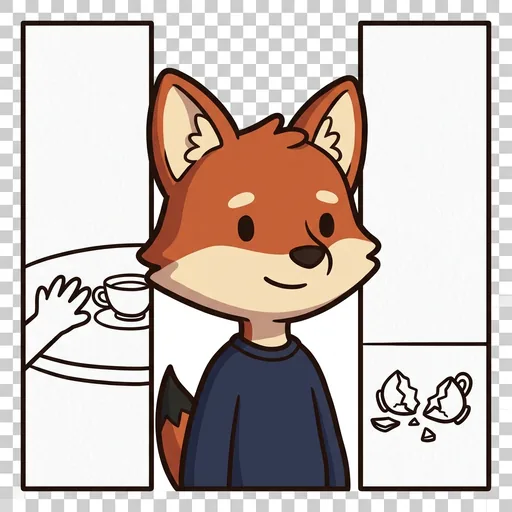
Lapse
The gutter — the empty space between two panels where your own mind fills in what happened; closure, the invisible half of comics
-
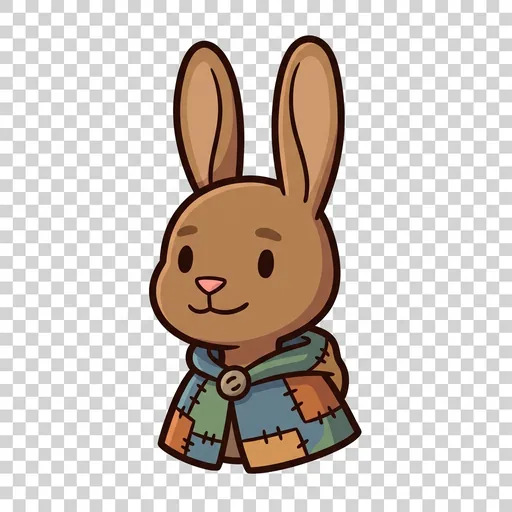
Segue
The transition — how one panel flows into the next, guiding your eye and your sense of time from moment to moment
-
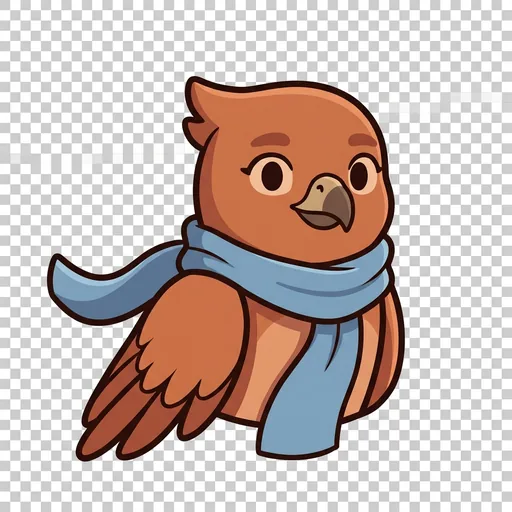
Vista
The establishing shot — the wide opening panel that shows you where you are before the story zooms in close
-

Jolt
The reaction beat — the panel that catches a character reacting, so a surprise or a feeling truly lands
-

Boom
The sound-effect lettering — onomatopoeia drawn right into the art, so you can see a sound as much as hear it
-
The Layout
The whole page coming together — how the establishing shot, panels, transitions, gutters, and sound-effect lettering arrange to guide one reader eye through one moment of story