
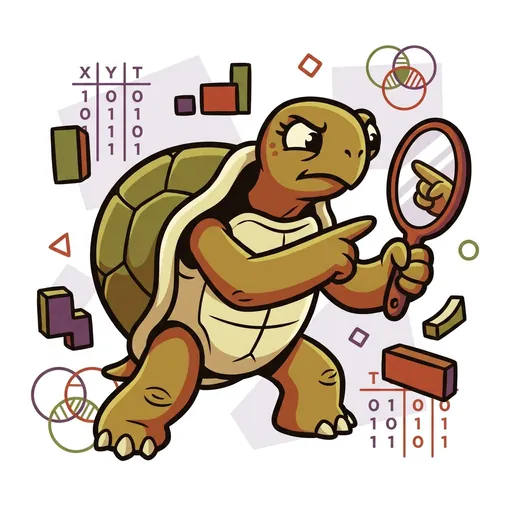
Tu-Quoque Tessa
TU QUOQUE — *"You too!" — dismissing criticism by accusing the critic of the same thing.* The fallacy of *responding to criticism by claiming the critic does the same thing — which may be true but is irrelevant to whether the original criticism is valid.*
Listen along — Tu-Quoque Tessa
Loading audio…
Press play to listen along. The line being read lights up as you go.
Show full transcript
Loading transcript…
Chapter 16 — Tu-Quoque Tessa and the You-Too Reflex
Tessa was a small tortoise, her shell a mix of warm olive and creamy white. Her eyes were quick, always darting, always reflecting. It was as if she saw the world, processed it in a flash, and then mirrored it right back. This mirroring wasn’t just in her gaze. It was her signature move, especially when someone pointed out something she’d done wrong.
“Tessa,” said Tara, her voice calm but firm. Tara, who valued clear steps in thinking, had been explaining how to set up a new LogicQuest puzzle. “You just cut me off again. I was still talking about the second step.”
Tessa’s head pulled back slightly, then shot forward. Her quick eyes narrowed. “But you do the same thing!” she countered, her voice a little too loud. “Just yesterday, you interrupted Mo when he was trying to explain the rules for the new ‘If-Then’ game. You totally cut him off!”
Tara blinked. She hadn’t expected that. She stood there, her mouth slightly open, the original point about Tessa’s interruption hanging in the air.
This was Tessa’s way. When criticism stung, her first response was always to accuse the critic of the very same behavior. She would bounce the complaint right back, like a rubber ball hitting a wall. This pattern has a name: tu quoque. It’s Latin for “you too.” It’s a common mistake in reasoning, what thinkers call a fallacy.
Here’s how it works: someone offers a criticism. Tessa feels the sting. Instead of thinking about what was said, she searches for a time the critic did something similar. Then she throws that accusation back. The original criticism, the one about her interrupting Tara, never gets addressed. It just gets deflected. It’s like trying to catch a ball, but someone else throws another ball at your head, and you forget about the first one entirely.
The tricky part is, sometimes Tessa might even be right. Maybe Tara had interrupted Mo yesterday. But even if Tara was guilty of interrupting, that doesn’t make Tessa’s interruption okay. Tara’s behavior might make her a hypocrite, but hypocrisy is a different problem from whether Tessa’s own actions were wrong. The original criticism still stands on its own. It still needs to be considered.
Tessa helps us see this pattern clearly. She shows us how easy it is to avoid dealing with our own mistakes by pointing fingers. We all do this sometimes, especially when we feel cornered or embarrassed. The real skill is learning to recognize this deflection – in others’ arguments, and especially in our own – and then bringing the conversation back to the original point.
Tessa is a bit like Whataboutism Wanda, who also deflects criticism. But Wanda points to a third party (“What about them? They did something worse!”). Tessa points directly back to the critic (“But you did it!”). Both are ways to avoid facing the initial problem. Both are deflection fallacies.
Tessa is the last of the twelve fallacy archetypes in LogicQuest. She, like Hannibal, Stella, Sam, Auntie, Reggie, Cici, Fia, Bran, Cyril, Wanda, and Eva, is a teaching archetype, not a villain. None of them are villains. They simply embody common reasoning mistakes that everyone makes sometimes. The goal is to spot the pattern. Meeting all of them means you’ve seen the most common ways our thinking can go wrong.
To spot a tu quoque in the wild, you can ask yourself a few questions:
- Has the original criticism actually been addressed? Or has it just been turned away?
- Is the “you too” accusation even true? Sometimes it’s not.
- Even if the critic does the same thing, does that change whether the original behavior was wrong? Usually, it doesn’t.
If you find yourself in this situation, a good way to respond is to gently guide the conversation back: “Let’s talk about the original criticism first.”
This journey through LogicQuest has now introduced you to all sixteen characters. You’ve met the four valid forms of reasoning – Mo, Tara, Solon, and Dior – who show us how to think clearly. And you’ve met the twelve fallacy archetypes, who show us the common traps. The skill isn’t to blame anyone for falling into these traps. It’s to recognize the patterns and learn to think more carefully, for yourself and with others.
The LogicQuest ensemble
Tu-Quoque Tessa is part of LogicQuest's distributed-narrative cast. Each character embodies a different curricular primitive; together they teach the full subject.
-

Ad Hominem Hannibal
Attacking the arguer, not the argument
-

Strawman Stella
Misrepresenting the opponent's argument
-

Slippery-Slope Sam
Chaining dire consequences from a small first step
-

Appeal-to-Authority Auntie
Citing irrelevant / unqualified authority as proof
-

Red-Herring Reggie
Deflecting to an irrelevant topic
-

Circular-Reasoning Cici
Assuming the conclusion in the premise
-

False-Dichotomy Fia
Presenting only two options when more exist
-

Bandwagon Bran
Truth-by-popularity
-

Sunk-Cost Cyril
Refusing to change course because of past investment
-

Whataboutism Wanda
Deflecting criticism via someone else's wrongdoing
-

Equivocator Eva
Sliding a word's meaning mid-argument
-

Modus-Ponens Mo
If P then Q; P; ∴ Q
-

Modus-Tollens Tara
If P then Q; ¬Q; ∴ ¬P
-

Syllogism Solon
All M are P; all S are M; ∴ all S are P
-

Disjunctive-Syllogism Dior
P ∨ Q; ¬P; ∴ Q