
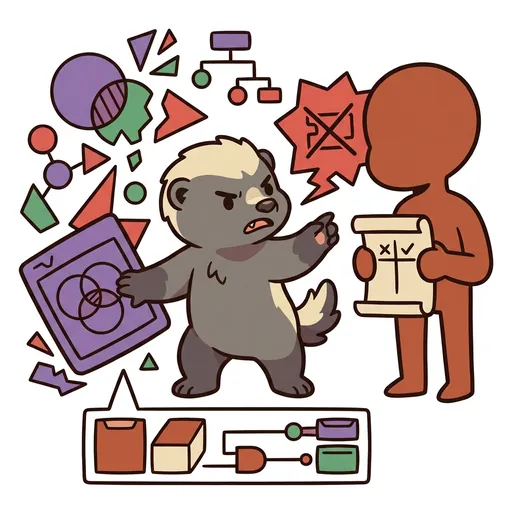
Ad Hominem Hannibal
AD HOMINEM — *attacking the arguer, not the argument.* The fallacy of *dismissing a claim by attacking the person who made it, rather than addressing the substance of the claim.*
Listen along — Ad Hominem Hannibal
Loading audio…
Press play to listen along. The line being read lights up as you go.
Show full transcript
Loading transcript…
Chapter 5 — Ad Hominem Hannibal and the Personal-Attack Habit
Hannibal was a honey badger. He wasn’t big, but he was tough. He had a bad habit. When someone said something, Hannibal attacked them. He didn’t attack their idea. He was a teacher, not a bad guy. He showed everyone a common mistake.
Hannibal was gray, cream, and soft black. He moved fast. His tongue was even faster. He loved to brush things aside. His special move was not friendly at all. Someone would say an idea. Hannibal would jump on them. He wouldn’t talk about the idea itself. “Oh, you said that?” he’d snap. “You’re always wrong about stuff like this!” He just went after the person. He didn’t care about the actual words.
Don’t get him wrong. Hannibal wasn’t a villain. He wasn’t trying to be mean. He was just showing a common mistake. Everyone makes this mistake sometimes. Even smart people do it. The point wasn’t to hate Hannibal. The point was to see the mistake. You needed to spot it in others. You also needed to spot it in yourself. That was the real lesson.
This mistake had a fancy name. It was called ad hominem. That means “to the person” in an old language. It means you attack the person. You don’t attack their idea. Imagine someone said, “The sky is blue today.” Then Hannibal yelled, “Don’t listen to him! He wears silly socks!” Does wearing silly socks change the sky’s color? No. The sky is still blue. The idea is what matters. Not the person who said it.
Hannibal taught by showing. He would do it himself. Then he would talk about it. “I do this,” he’d admit. “We all do it sometimes.” He’d look a little sad. “When you’re tired, it’s easy. When you’re mad, it’s easy. When you’re losing a fight, it’s super easy.” He’d explain that attacking the person felt simpler. It was harder to think about the actual idea. “The real skill is catching it,” he’d say. “Catch it when others do it. Catch it when you do it.” He’d nod slowly. “If you see an attack on the speaker, not the idea, you’ve found ad hominem.”
One sunny afternoon, a small squirrel named Pip bounced up. Pip was full of ideas. “I think we should plant more nut trees,” Pip chirped. “They give us food. They give us shade.” Hannibal twitched his nose. “Oh, you think that, Pip?” he scoffed. “You’re always forgetting where you buried your nuts! How can we trust your ideas about planting trees?” Pip’s ears drooped. “But… what does that have to do with nut trees?” Hannibal paused. He looked at Pip. Then he looked at the ground. He sighed. “See what I just did?” he asked the air. “Pip had an idea. A good idea, maybe. But I didn’t talk about the nuts. I didn’t talk about the shade.” He pointed at Pip. “I talked about Pip forgetting his nuts. That has nothing to do with the idea of planting trees.” He shook his head slowly. “That was ad hominem. I attacked Pip, not the plan.” Pip still looked confused. “So… my idea is still good?” “Your idea is still an idea,” Hannibal said. “We need to look at it. We don’t need to look at your memory for buried nuts.” He gave a small, wry smile. “Though you really should work on that, Pip.” Pip brightened a little. “Okay!”
Hannibal gave them tools to spot it. He called them “spotting tricks.”
- “First trick,” he’d say. “Is the attack on the idea? Or is it on the person?”
- “Second trick: Would the idea be more true if someone else said it?” He’d pause. “If you think, ‘Well, it depends on who said it,’ then you’re probably judging the person. Not the idea.”
- “Third trick: Sometimes, it’s okay to question someone.” He’d hold up a paw. “If someone is trying to sell you something, they might lie. That’s a real problem. But that’s different from ad hominem.” He’d tap his chin. “It’s about whether the person’s problem changes the truth of their idea.” “Let’s say a fox tells you, ‘This bridge is safe! Cross it!’” Hannibal explained. “But you know that fox owns the company that built the bridge. And the bridge looks wobbly. It’s okay to say, ‘Hmm, maybe the fox just wants to make money.’ That’s not ad hominem. That’s looking at a real reason to doubt the truth of the claim. The fox’s money problem might make the bridge unsafe.” “But if the fox said, ‘The sky is blue!’” Hannibal continued. “And you said, ‘Don’t listen to him! He’s a sneaky fox!’ That is ad hominem. Being sneaky doesn’t change the color of the sky. See the difference?” He waited for nods.
- “Last trick,” he’d whisper. “Don’t blame yourself. Just catch yourself. We all mess up. Even me.”
Hannibal grew up in a tiny village. His family had a strange job there. They were the “debate-stallers.” When people argued, his family would jump in. They would attack the speakers. They never talked about the actual problems. They just made everyone mad. Hannibal learned this way of talking. He lived this pattern. He knew it from the inside. That’s why LogicQuest picked him. He could show everyone how it felt. He could show them how it worked.
Hannibal walked a long way to LogicQuest. He was twenty-six years old. He was a bit older than the other kids. Inspector Logos looked at him. “What is ad hominem?” she asked. Hannibal stood tall. “It’s attacking the person,” he said. “Not their idea.” He looked down for a moment. “I do it. We all do it.” He met her eyes again. “The skill is catching it. In others. In yourself.” He nodded. “Catching it is the hard part.” Inspector Logos smiled. “You’re hired,” she said. “Welcome to the team.”
Hannibal always made one thing clear. “I’m a teacher,” he’d say. “Not a bad guy.” He’d shake his head. “Don’t hate me for showing this. Don’t hate yourself if you do it.” He’d point to his head. “The mistake is the lesson. Spotting the mistake is the skill.”
“It’s not super hard,” he’d say. “Attack the idea. Not the person.” He’d make a chopping motion. “If you catch yourself attacking the person, stop. Change your mind. Go back to the idea.”
The LogicQuest ensemble
Ad Hominem Hannibal is part of LogicQuest's distributed-narrative cast. Each character embodies a different curricular primitive; together they teach the full subject.
-

Strawman Stella
Misrepresenting the opponent's argument
-

Slippery-Slope Sam
Chaining dire consequences from a small first step
-

Appeal-to-Authority Auntie
Citing irrelevant / unqualified authority as proof
-

Red-Herring Reggie
Deflecting to an irrelevant topic
-

Circular-Reasoning Cici
Assuming the conclusion in the premise
-

False-Dichotomy Fia
Presenting only two options when more exist
-

Bandwagon Bran
Truth-by-popularity
-

Sunk-Cost Cyril
Refusing to change course because of past investment
-

Whataboutism Wanda
Deflecting criticism via someone else's wrongdoing
-

Equivocator Eva
Sliding a word's meaning mid-argument
-

Tu-Quoque Tessa
"You too!" — dismissing criticism by accusing the critic of the same thing
-

Modus-Ponens Mo
If P then Q; P; ∴ Q
-

Modus-Tollens Tara
If P then Q; ¬Q; ∴ ¬P
-

Syllogism Solon
All M are P; all S are M; ∴ all S are P
-

Disjunctive-Syllogism Dior
P ∨ Q; ¬P; ∴ Q