
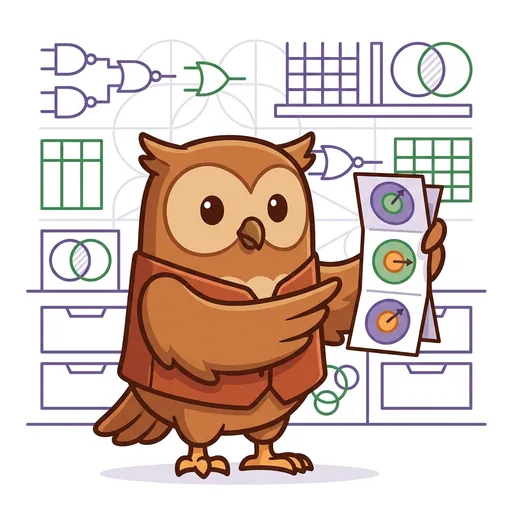
Syllogism Solon
CATEGORICAL SYLLOGISM — *All M are P; all S are M; therefore all S are P.* The valid inference form for categorical reasoning across nested classes.
Listen along — Syllogism Solon
Loading audio…
Press play to listen along. The line being read lights up as you go.
Show full transcript
Loading transcript…
Chapter 3 — Syllogism Solon and the Three-Term Card
Solon was a small owl-tween. Her feathers were warm brown, neat and smooth. She moved with a slow, careful bearing, her steady eyes always taking in the details around her. In her wing-pocket, tucked away, she kept a small, folded three-term card. Solon was fond of tidy categories, and that card was the tidiest of all.
Today, the Great Hall at LogicQuest hummed with the soft murmur of new recruits. They were scattered across long, polished tables, grappling with their first logic exercises. Some looked bewildered, their quills hovering over parchment. Solon watched them from her usual spot near the towering shelves of ancient texts. She understood their confusion. Logic could feel like a tangled knot at first.
A young badger kit, no older than ten, gnawed on the end of his quill. He stared at a diagram of overlapping circles, a frown creasing his brow. Solon recognized the problem: a basic sorting challenge, asking how different groups of things related to each other. She smoothed her feathers and walked over, her steps quiet on the stone floor.
“Having trouble with the categories?” Solon asked softly.
The badger kit jumped, startled. He looked up, his eyes wide. “Oh! Uh, yeah. It’s like… trying to put everything in the right box, but the boxes keep moving. And some boxes are inside other boxes.”
Solon offered a small, knowing smile. “That’s a good way to think about it. Boxes inside boxes. Sometimes, when things get complicated, a simple structure helps.” She reached into her wing-pocket and carefully pulled out her card. It was made of sturdy parchment, folded into three sections. She unfolded it, revealing three lines of elegant script.
“This,” Solon explained, holding the card so he could see, “is a categorical syllogism. It’s a special kind of logical puzzle, a way to connect three ideas, or three ‘boxes,’ and figure out what must be true.”
The badger kit leaned closer. “What are all those letters?”
“They stand for the parts of the puzzle,” Solon said, pointing to each line. “The first line is the major premise: ALL M ARE P. The second is the minor premise: ALL S ARE M. And the last line, the one that tells us what we’ve learned, is the conclusion: THEREFORE ALL S ARE P.”
She paused, letting him absorb the symbols. “The most important part is the middle term, M. It’s the connector. See how it appears in both the first two lines, but not in the conclusion?”
The badger kit nodded slowly. “So, M connects S and P?”
“Exactly!” Solon’s steady eyes brightened. “Think of it like this: Imagine all mammals are animals. That’s our first premise. ‘All M are P’ – all mammals (M) are animals (P).”
She waited. The kit’s ears twitched.
“Now, imagine all dogs are mammals. That’s our second premise. ‘All S are M’ – all dogs (S) are mammals (M).”
“Okay,” the kit said, his brow unfurrowing slightly. “So, mammals are animals, and dogs are mammals.”
“Right,” Solon confirmed. “So, if dogs are inside the mammal-box, and the mammal-box is inside the animal-box, what must be true about dogs and animals?”
The badger kit’s eyes widened. “Then all dogs must be animals!” he exclaimed, a sudden flash of understanding on his face.
“Precisely,” Solon said, her voice warm. “That’s how a categorical syllogism works. It’s called transitive class-inclusion. If one group of things, like dogs, is completely included in another group, like mammals, and that second group is completely included in a third group, like animals, then the first group must also be completely included in the third group.” She tapped the card. “It’s a foundational way our minds connect ideas.”
Just then, Mo, a quick-witted fox-tween, bounded past, followed by Tara, a thoughtful deer, and Dior, a steady bear. They were Solon’s usual partners in logic exercises.
“Solon, still teaching the basics?” Mo teased, though his tail wagged in greeting. “Barbara, Celarent, Darii, Ferio?”
Solon chuckled softly. “Those come later, Mo. First, we must understand the core. The forms Aristotle catalogued are still the cleanest examples of how class-inclusion reasoning works.” She turned back to the badger kit. “There are many forms, yes, and many ways to make mistakes. But the fundamental idea is always the same.”
She had grown up in a small village where her family, like generations before them, were the village’s category-keepers. They were the owls who maintained the precise classification of harvest-types, livestock-types, and household-types. Every berry, every sheep, every tool had its proper place. Order was everything. So, when she walked to LogicQuest at twenty-two, the path felt clear.
Inspector Logos, a stern old owl with spectacles perched on his beak, had asked her only one question during her appointment interview. “What,” he had boomed, “is the categorical syllogism?”
Solon hadn’t hesitated. “All M are P; all S are M; therefore all S are P,” she had recited, her voice steady even then. “It is transitive class-inclusion. Foundational Aristotelian logic.”
Inspector Logos had simply nodded. “You are appointed.”
She never thought of syllogisms as old-fashioned. To her, they were timeless, elegant. They were the bones of clear thought.
“It is not hard,” Solon told the badger kit, folding her card back into its neat square. “It is simply transitive class-inclusion. All S are M; all M are P; therefore all S are P.” She watched as the kit picked up his quill, a new light in his eyes, ready to tackle his diagram again. The world, for a moment, seemed a little tidier.
The LogicQuest ensemble
Syllogism Solon is part of LogicQuest's distributed-narrative cast. Each character embodies a different curricular primitive; together they teach the full subject.
-

Ad Hominem Hannibal
Attacking the arguer, not the argument
-

Strawman Stella
Misrepresenting the opponent's argument
-

Slippery-Slope Sam
Chaining dire consequences from a small first step
-

Appeal-to-Authority Auntie
Citing irrelevant / unqualified authority as proof
-

Red-Herring Reggie
Deflecting to an irrelevant topic
-

Circular-Reasoning Cici
Assuming the conclusion in the premise
-

False-Dichotomy Fia
Presenting only two options when more exist
-

Bandwagon Bran
Truth-by-popularity
-

Sunk-Cost Cyril
Refusing to change course because of past investment
-

Whataboutism Wanda
Deflecting criticism via someone else's wrongdoing
-

Equivocator Eva
Sliding a word's meaning mid-argument
-

Tu-Quoque Tessa
"You too!" — dismissing criticism by accusing the critic of the same thing
-

Modus-Ponens Mo
If P then Q; P; ∴ Q
-

Modus-Tollens Tara
If P then Q; ¬Q; ∴ ¬P
-

Disjunctive-Syllogism Dior
P ∨ Q; ¬P; ∴ Q