Sunk-Cost Cyril
SUNK COST — *refusing to change course because of past investment.* The fallacy of *letting unrecoverable past costs determine current decisions when they should be evaluated independently.*
Listen along — Sunk-Cost Cyril
Loading audio…
Press play to listen along. The line being read lights up as you go.
Show full transcript
Loading transcript…
Chapter 13 — Cyril and the Past-Investment Trap
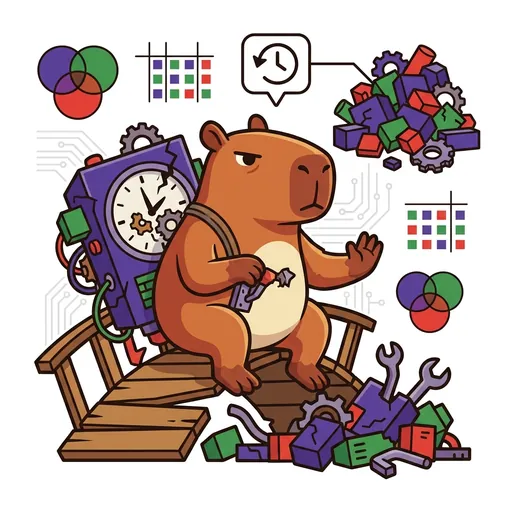
Cyril, a capybara known for his quiet focus, squinted at the tangle of dried gourds and twisted vines. The air in the community workshop hummed with the frantic energy of the annual Invent-a-Thon. Other participants, mostly younger, scampered between workbenches, their projects whirring and clanking. Cyril, however, moved with a deliberate, almost ponderous grace. His own invention, a Rube Goldberg machine designed to gently water a small potted fern, was a testament to patience. Or perhaps, to something else entirely.
He had envisioned a series of natural mechanisms. A river stone would roll down a bamboo chute, triggering a lever made from a sturdy branch. This branch would then tip a hollowed-out gourd, spilling water onto the fern. The first few steps worked perfectly. The stone rolled. The branch tipped. But the gourd, suspended by a delicate network of vines, consistently refused to pivot correctly. It either swung wildly, missing the fern entirely, or jammed against its wooden support, refusing to release its precious cargo.
Cyril had spent three full days on this single component. He’d carefully selected the gourd for its size and shape. Then he spent hours hollowing it out, sanding its edges smooth, and drilling tiny holes for the vine-hinges. He’d experimented with different vine thicknesses, different suspension points, even different types of knots. Each attempt ended with the same frustrating result: a splash of water on the floor, or no splash at all.
A small, wiry badger named Pip, barely tall enough to see over Cyril’s workbench, bounced closer. Pip’s own invention, a spring-loaded acorn launcher, was already complete and sat gleaming with polished metal parts. “Still stuck on the gourd, Cyril?” Pip asked, his voice bright and direct. “Looks like it’s giving you trouble.”
Cyril sighed, a soft puff of air that barely disturbed the dust motes dancing in the sunlight. “It’s… recalcitrant,” he admitted, using a word few others in the workshop would bother with. He adjusted a vine, his steady eyes fixed on the problematic gourd. “I’ve tried everything.”
“Why don’t you just use a small bucket?” Pip suggested, ever practical. “Or even a plastic cup? It would be lighter, and you could just glue it on.”
Cyril’s ears twitched. He carefully placed his tools on a neatly organized tray. “A plastic cup wouldn’t fit the aesthetic,” he explained, his voice even. “The whole point is to use natural materials. I found this gourd myself, deep in the elderberry thicket. It took me half a day to clean it.”
Pip tilted his head. “But it’s not working, is it? And the Invent-a-Thon is tomorrow. You could probably finish the whole thing in an hour with a bucket.”
Cyril picked up a small file, running it along the edge of the gourd he was holding. “I’ve already spent so much on this,” he said, his gaze distant. “Three days. I can’t quit now. All that effort would be wasted.”
Pip, who was more accustomed to immediate results and quick fixes, looked genuinely puzzled. “But if it’s not going to work anyway, isn’t the time you spend now also wasted?”
Cyril paused, the file still in his hand. He knew Pip had a point. He knew, intellectually, that the hours he’d already invested were gone, regardless of what he did next. He often reminded himself, and sometimes others, of a simple truth: “Past investment is gone either way.” The decision to continue should only ever be about future costs and future benefits. “Evaluate from future, not past.” He had even written it on a small card tacked above his own workbench at home. Yet, here he was, unable to let go.
“It’s not wasted if I make it work,” Cyril insisted, though a flicker of doubt crossed his steady eyes. “I just need to find the right balance. The perfect pivot point.” He picked up a different vine, thicker than the last, and began to thread it through the gourd’s tiny holes. The new vine was stiff, difficult to manipulate, and promised to make the gourd even heavier.
Pip watched for a moment, then shrugged, a gesture of resignation. “Okay, Cyril. Good luck.” He scampered off towards his own completed acorn launcher, already planning how to demonstrate its impressive range.
Cyril continued to work, his brow furrowed in concentration. The new vine was indeed harder to thread, chafing against the gourd’s edges. His fingers ached. He knew, deep down, that a simpler solution existed. He could easily attach a small, lightweight wooden cup, stained to look natural. The entire machine would then function flawlessly within the hour. But the thought of discarding the gourd, the hours of careful preparation, the effort of finding it in the thicket – it felt like admitting defeat. It felt like a loss.
He worked late into the evening, long after the other participants had packed up and gone home. The workshop grew quiet, save for the occasional creak of the old wooden floorboards and the soft rasp of Cyril’s file against the gourd. He tried to ignore the persistent voice in his head. It sounded suspiciously like his own advice, whispering about future from here, not past from there.
By midnight, the gourd still refused to cooperate. It swung, it jammed, it failed. Cyril finally leaned back, his shoulders slumped, his usually steady eyes clouded with exhaustion. He looked at the intricate, failing mechanism, then at the simple, empty fern pot. The Invent-a-Thon was only hours away.
Sometimes, the path we’ve already walked, the effort we’ve already poured into something, can feel like an unbreakable chain. It binds us to a decision, not because it’s the best path forward. Instead, turning back means acknowledging the steps already taken lead nowhere. This particular trap, where past, unrecoverable costs weigh more heavily than future possibilities, is known as the sunk-cost trap. It’s not about being foolish; it’s about being human. It’s about the quiet, stubborn reluctance to admit that sometimes, the best investment we can make is to simply stop.
The LogicQuest ensemble
Sunk-Cost Cyril is part of LogicQuest's distributed-narrative cast. Each character embodies a different curricular primitive; together they teach the full subject.
-

Ad Hominem Hannibal
Attacking the arguer, not the argument
-

Strawman Stella
Misrepresenting the opponent's argument
-

Slippery-Slope Sam
Chaining dire consequences from a small first step
-

Appeal-to-Authority Auntie
Citing irrelevant / unqualified authority as proof
-

Red-Herring Reggie
Deflecting to an irrelevant topic
-

Circular-Reasoning Cici
Assuming the conclusion in the premise
-

False-Dichotomy Fia
Presenting only two options when more exist
-

Bandwagon Bran
Truth-by-popularity
-

Whataboutism Wanda
Deflecting criticism via someone else's wrongdoing
-

Equivocator Eva
Sliding a word's meaning mid-argument
-

Tu-Quoque Tessa
"You too!" — dismissing criticism by accusing the critic of the same thing
-

Modus-Ponens Mo
If P then Q; P; ∴ Q
-

Modus-Tollens Tara
If P then Q; ¬Q; ∴ ¬P
-

Syllogism Solon
All M are P; all S are M; ∴ all S are P
-

Disjunctive-Syllogism Dior
P ∨ Q; ¬P; ∴ Q