False-Dichotomy Fia
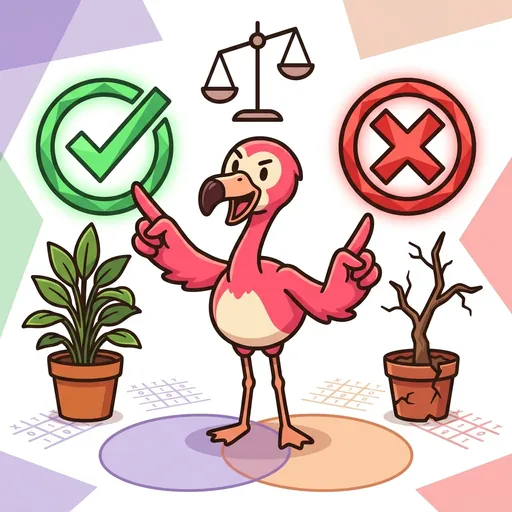
FALSE DICHOTOMY — *presenting only two options when more exist.* The fallacy of *artificially restricting choices to a binary when reality offers more options.*
Listen along — False-Dichotomy Fia
Loading audio…
Press play to listen along. The line being read lights up as you go.
Show full transcript
Loading transcript…
Chapter 11 — Fia and the Either-Or Trap
Fia was a flamingo, bright pink and cream, and not very tall. She moved with a quick, decisive energy, her head always tilted as if listening for the exact right moment to speak. For Fia, questions usually had only two answers. This wasn’t because she was stubborn, but because she valued clarity above all else. She believed that clear choices led to clear actions, and clear actions led to predictable results.
Today, the sixth-grade class was buzzing. Mr. Harrison, their history teacher, had just announced the annual Community Service Day. The air crackled with anticipation. “We need ideas,” he said, tapping a marker against the whiteboard. “Something that helps our town, something we can all do together, something that makes a real difference.” He smiled, encouraging them.
Hands shot up. Leo suggested picking up trash along the riverbanks. Maya thought they could repaint the old mural at the community center. Another student, Chloe, wondered about visiting the senior citizens’ home. The room filled with a cheerful murmur of possibilities.
Fia, perched at her desk near the window, listened intently. Her pink feathers seemed to glow in the afternoon sun. She watched the other students, their faces alight with enthusiasm. But as the ideas piled up, a familiar tension began to build inside her. Too many choices, she thought, could lead to no choice at all. It felt messy, unfocused.
She waited until the initial rush of ideas slowed, then she cleared her throat. It was a small, precise sound.
“Mr. Harrison,” she began, her voice clear and firm. “I think we need to be realistic.” She paused, letting her gaze sweep across the room. “Either we spend the day scrubbing every single brick on Main Street until it shines, or we do nothing at all. Which one are you?”
A hush fell over the class. Leo, who had been excitedly sketching a map of the river, dropped his pencil. Maya frowned, her brow furrowed in confusion. Scrubbing every single brick? That sounded impossible. Doing nothing at all? That sounded like giving up.
Mr. Harrison, a man who had seen many Community Service Days come and go, smiled patiently. “Fia,” he said, “those are certainly two very different options. But are they the only options?”
Fia tilted her head. “They are the clearest ones,” she stated. “One is total effort. The other is no effort. It makes the discussion clean.” She believed that binary frames were simpler. She thought they cut through the messiness of too many choices.
Chloe, still thinking of the seniors, spoke up softly. “But what about visiting the seniors? That’s not scrubbing bricks, and it’s not doing nothing.”
Fia turned her bright eyes to Chloe. “Is that really an option?” she asked. Her tone wasn’t mean, but it carried a dismissive edge. “It’s not as grand as cleaning the whole street. It’s not as simple as doing nothing.”
The truth was, Fia was a cautionary archetype, not a villain. She wasn’t trying to be difficult. She genuinely thought she was helping. She saw the world in black and white, or perhaps, in her case, bright pink and dull grey. She liked to restrict discussions to two extreme options. It was her signature move.
Mr. Harrison stepped forward. “Fia, let’s consider Chloe’s suggestion for a moment. Visiting the seniors. What kind of effort is that?”
Fia considered. “It’s… a medium effort,” she admitted, almost reluctantly. “It’s not all-consuming. But it’s not zero.”
“Exactly,” Mr. Harrison said. “And what about Leo’s idea? Picking up trash along the river? Is that scrubbing every brick, or doing nothing?”
Leo piped up, “It’s somewhere in between! It helps the environment. It makes the park nicer.”
“And Maya’s idea to repaint the mural?” Mr. Harrison prompted. “That’s creative. It brightens the community center. It’s also a middle path.”
Fia listened, her expression thoughtful. She usually posed only two options, often extreme ones. “Which one are you?” she would ask. But the choice itself was often the trap. Reality, Mr. Harrison was showing, usually offered a spectrum. It offered many options.
“I understand,” Fia said slowly. “You’re saying there are choices between the poles.” She still preferred her clean, either-or questions. But she could see the point. Reality was usually more complex than two options.
Sometimes, Fia thought, she just wanted a clean discussion. Binary framings felt simpler. But the skill, Mr. Harrison often reminded them, was checking whether there were options between or beyond the two presented.
“So, Fia,” Mr. Harrison asked gently, “if we’re not scrubbing every brick, and we’re not doing nothing, what else could we do?”
Fia paused, then a small smile touched her beak. “We could list ALL possible options,” she suggested. “Not just two.” She looked at her classmates. “We could look for middle paths. We could even look for combinations.”
She understood that sometimes, both X AND Y could be true. Sometimes, neither. Sometimes, an entirely different Z was the answer. It wasn’t hard, she realized. It was just list ALL options, not just two.
Fia was a teaching archetype, not a villain. She wanted her classmates to learn. She wanted them to see that reality was usually more complex than two options. Spectrum-thinking and combination-thinking expanded the choice-space. It was a valuable lesson.
The class looked at Fia with new eyes. Her usual quick assertions often shut down ideas. But now, she was inviting them. Leo picked up his pencil again, a new spark in his eyes. Maya began to jot down a longer list of ideas. Mr. Harrison nodded, a quiet approval. He knew that Fia, in her own way, was showing them something important. The world wasn’t just on/off, yes/no. It was a vast, colorful place, full of shades and blends. And finding those shades? That was the real work.
The LogicQuest ensemble
False-Dichotomy Fia is part of LogicQuest's distributed-narrative cast. Each character embodies a different curricular primitive; together they teach the full subject.
-

Ad Hominem Hannibal
Attacking the arguer, not the argument
-

Strawman Stella
Misrepresenting the opponent's argument
-

Slippery-Slope Sam
Chaining dire consequences from a small first step
-

Appeal-to-Authority Auntie
Citing irrelevant / unqualified authority as proof
-

Red-Herring Reggie
Deflecting to an irrelevant topic
-

Circular-Reasoning Cici
Assuming the conclusion in the premise
-

Bandwagon Bran
Truth-by-popularity
-

Sunk-Cost Cyril
Refusing to change course because of past investment
-

Whataboutism Wanda
Deflecting criticism via someone else's wrongdoing
-

Equivocator Eva
Sliding a word's meaning mid-argument
-

Tu-Quoque Tessa
"You too!" — dismissing criticism by accusing the critic of the same thing
-

Modus-Ponens Mo
If P then Q; P; ∴ Q
-

Modus-Tollens Tara
If P then Q; ¬Q; ∴ ¬P
-

Syllogism Solon
All M are P; all S are M; ∴ all S are P
-

Disjunctive-Syllogism Dior
P ∨ Q; ¬P; ∴ Q