
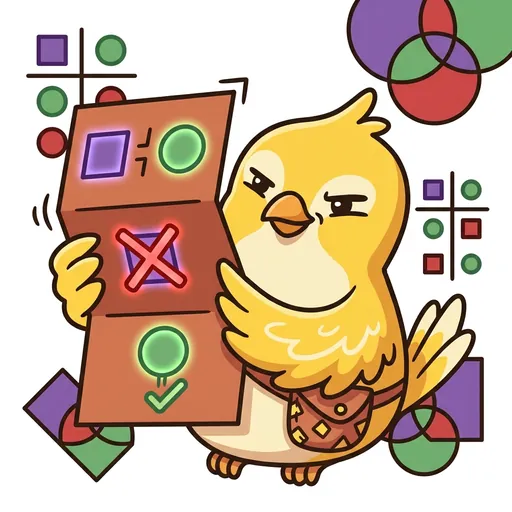
Disjunctive-Syllogism Dior
DISJUNCTIVE SYLLOGISM — *P or Q; not P; therefore Q.* The valid inference form for *eliminating-by-process-of-elimination* reasoning.
Listen along — Disjunctive-Syllogism Dior
Loading audio…
Press play to listen along. The line being read lights up as you go.
Show full transcript
Loading transcript…
Chapter 4 — Dior and the Either-Or Card
Dior was a tiny finch, barely bigger than a teacup. Her feathers, a bright mix of yellow and cream, seemed to hum with energy. She had quick, darting eyes that missed nothing, always scanning, always taking in details. Dior loved to narrow things down. It was her favorite way to think.
In her small wing-pocket, she always carried a folded either-or card. It was her most important possession. The card showed three simple lines. The top line said: P OR Q. The middle line said: NOT P. And the bottom line, the best part, declared: THEREFORE Q.
This card was more than just paper. It held the secret to a powerful way of thinking: the disjunctive syllogism. That’s a big name for something pretty straightforward. It means finding the answer by eliminating all the wrong ones.
Imagine you’ve lost your house keys. You might think, “They’re either in the kitchen OR the living room.” (That’s the P OR Q part). You check the kitchen. No keys. (That’s the NOT P part). So, where must they be? In the living room! (THEREFORE Q). It was a simple, elegant method. Dior called it “the survivor wins.”
Some kids thought it was just a trick, a clever shortcut. Dior would narrow her eyes. “It’s not a trick,” she’d say, her voice firm. “It’s real reasoning. When you’ve looked at every single possibility and crossed out the ones that aren’t true, whatever’s left has to be the answer.”
The hardest part, she explained, wasn’t the elimination itself. It was making sure you listed all the possibilities in the first place. “You have to be honest,” she’d insist. “You can’t just pick two options and hope. You have to list them ALL. Every single one.”
Dior had a clear way of teaching this. She’d hold up her card. “First, the form,” she’d say. “P or Q. Not P. Therefore Q.” She’d tap the card. “But what if there are three places the keys could be? P or Q or R. Then you just eliminate P. Eliminate Q. And R is the answer.”
“The most important rule,” she’d continue, “is that your ‘either-or’ list must be exhaustive.” She’d pause for effect. “That means it has to include every single possible option. Imagine you thought the keys were in the kitchen or the living room. But really, they were in your backpack the whole time. If you didn’t list ‘backpack’ as an option, then eliminating kitchen and living room wouldn’t help you find them. Your list wasn’t exhaustive.”
She loved to point out how useful this was. “Detectives use it all the time,” she’d say, “to figure out who committed a crime. Or when you’re troubleshooting a broken gadget. Is it the battery, or the switch, or the wire? You test each one, eliminate the working parts, and the problem reveals itself.” It was also perfect for logic puzzles, the kind that made your brain hum.
Dior came from a small, quiet village nestled deep in the Whispering Woods. Her family had always been the village’s “option-narrowers.” For generations, her ancestors had helped the village council make important decisions. When it was time to decide which crops to plant, or where to build a new well, Dior’s family gathered every idea. They listed every possibility. Then, carefully, they eliminated choices that wouldn’t work. “Not enough sunlight for that crop,” they might say. Or, “Too far from the river for that well.” What remained was always the best, most logical path forward. They would sit for hours, sometimes days, debating every angle. Dior, even as a tiny hatchling, would watch, fascinated. She saw how her parents and grandparents would draw diagrams in the dirt, crossing out options with a twig, until only one clear path remained. It wasn’t about guessing or hoping. It was about certainty. Dior had learned this discipline from birth.
The day she came to LogicQuest, Dior was nervous but determined. She was still just a finch-tween, but she carried herself with an air of serious purpose. The other candidates for LogicQuest were much larger, some with impressive wingspans or sharp, calculating gazes. Dior felt a flutter of doubt, but she gripped her either-or card. She knew her strength.
Inspector Logos, a tall, imposing owl with spectacles perched on his beak, looked down at her. “What is disjunctive syllogism?” he boomed, his voice echoing in the grand hall.
Many offered complex theories or quoted ancient texts. Dior just offered the truth of her card. “P or Q,” she chirped, her voice clear despite her shaking wings. “Not P. Therefore Q.” She paused, taking a deep breath. “It’s process of elimination, sir. But the most important thing is that your list of possibilities must be exhaustive. You have to list them all.”
Inspector Logos peered at her over his glasses. A slow smile spread across his face. “You are appointed,” he declared.
Dior felt a rush of warmth. She knew her method wasn’t flashy. It wasn’t about grand leaps of intuition. It was about careful, honest work. “It’s not hard,” she’d often tell new students, holding up her either-or card. “It’s just eliminate, and the survivor wins. But you have to list ALL the possibilities first.”
The LogicQuest ensemble
Disjunctive-Syllogism Dior is part of LogicQuest's distributed-narrative cast. Each character embodies a different curricular primitive; together they teach the full subject.
-

Ad Hominem Hannibal
Attacking the arguer, not the argument
-

Strawman Stella
Misrepresenting the opponent's argument
-

Slippery-Slope Sam
Chaining dire consequences from a small first step
-

Appeal-to-Authority Auntie
Citing irrelevant / unqualified authority as proof
-

Red-Herring Reggie
Deflecting to an irrelevant topic
-

Circular-Reasoning Cici
Assuming the conclusion in the premise
-

False-Dichotomy Fia
Presenting only two options when more exist
-

Bandwagon Bran
Truth-by-popularity
-

Sunk-Cost Cyril
Refusing to change course because of past investment
-

Whataboutism Wanda
Deflecting criticism via someone else's wrongdoing
-

Equivocator Eva
Sliding a word's meaning mid-argument
-

Tu-Quoque Tessa
"You too!" — dismissing criticism by accusing the critic of the same thing
-

Modus-Ponens Mo
If P then Q; P; ∴ Q
-

Modus-Tollens Tara
If P then Q; ¬Q; ∴ ¬P
-

Syllogism Solon
All M are P; all S are M; ∴ all S are P