Chain
CHAIN — *every loaf tells a journey. whose hands carried it here?*
Listen along — Chain
Loading audio…
Press play to listen along. The line being read lights up as you go.
Show full transcript
Loading transcript…
Chapter 3 — Chain and the Journey Every Food Item Took to Reach Your Plate
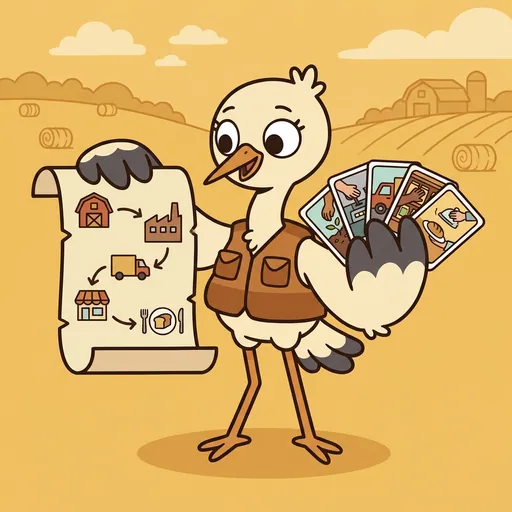
Chain was a stork-tween. She tracked routes. She wore a chunky shipping vest. A small map was tucked inside. She also had a stack of cards.
Chain was small. Her feathers were warm cream. Soft charcoal tipped her wings. She loved to learn about food journeys. “Every loaf tells a journey,” she often said. “Whose hands carried it here?” Her special tools were her map and cards. The map showed a food item’s path. It went from a farm to a factory. Then to a truck, a store, and finally your table. The cards showed every person. They worked with the food along the way.
This part is important. Chain teaches us about supply chain literacy. It’s a special skill. It means following the food back to its hands. Many people think food just comes from the store. But Chain knows better. Every food item touches many hands. Think about a loaf of bread. A wheat farmer plants the seeds. That happens in autumn. The farmer harvests the wheat in summer. Then it goes to a grain elevator. A mill cleans and grinds it. A bakery mixes and bakes it. A truck drives it to the store. A grocery clerk puts it on the shelf. Finally, it reaches your table. Each step needs people. Each step has its own challenges. Bad weather can hurt crops. Machines can break down. Fuel costs money. Workers need fair conditions. Some foods need to stay cold. When you trace a meal, you see the whole system. You also see the people who do the hardest work. They are often invisible. Farmworkers, factory workers, truckers, and shelf-stockers. They often get paid the least. They have the toughest jobs. Supply chain literacy means seeing them. Chain wants to show us the food’s journey. It’s not magic. It’s whose-hands-craft.
Chain spoke clearly. “Every loaf tells a journey,” she said. “Whose hands carried it here?” She held up a picture of bread. “This bread came from wheat. The farm was 800 miles away. The farmer planted it last fall. A driver cut it with a big machine in July. A worker at a grain elevator took the wagons. A mill worker ground the wheat. A baker mixed, baked, and bagged it. A truck driver drove it all night. A grocery clerk put it on the shelf. That’s at least eight people. Many more helped too. Think of people who make packaging. Or fuel suppliers. Or machine repair folks. Every bite of bread has dozens of people’s work in it. When food is super cheap, someone pays a price. It’s often the people far from your kitchen.”
Chain taught important lessons. She called them her supply-chain steps.
- Farm to Table: Food starts at the farm. It goes to a factory. Then to a big truck. Then to a store. Finally, it reaches your table. Each step has smaller steps inside it.
- Whose Hands: Who works at each step? Farmers, factory workers, truck drivers, store clerks. All these people help make your meal.
- Keeping it Cold: Some food spoils fast. Like strawberries. They need to stay cold. A special “cold chain” keeps them chilled. Strawberries from California to New York City? That’s a three-day truck ride. They need constant cold air.
- Travel and Pollution: Food that travels far uses a lot of fuel. More fuel means more pollution. Food from nearby farms has shorter chains. That’s better for the air.
- Just Enough Stock: Most stores only keep a few days of food. If something stops the trucks, shelves get empty fast. Like a big storm or a strike. Having extra food helps. Having different ways to get food helps too.
- Worker Pay Matters: Many farmworkers are immigrants. They often earn very little. They might not get overtime pay. Factory workers can get hurt often. Their pay is also low. Cheap food costs someone.
- Fair Choices: You can choose fair-trade food. Or buy direct from a farm. These chains are shorter. You know the farmers. Farmers get more money. But these foods can cost more. They might not be as easy to find.
- No Magic Food: Food doesn’t just appear in stores. Thinking it does ignores the workers. It doesn’t respect their hard work.
- Don’t Blame Farmers: Farmers get only a small part of the food price. The middle steps of the chain take most of the money. It’s good to know who gets what.
- Tracing Craft: This idea connects to other lessons. Like finding where stories come from. Or tracing paths on a map. Or seeing how a community works.
Chain grew up near big rivers. Her family were storks. They had always tracked long routes for their village. They remembered every migration path. They taught that “the journey matters. The arrival is important, but so is every stop.” They said, “Every stop has workers. Every worker deserves their share. The route tells the real story.” Chain learned this lesson well.
When Chain was twelve, she went to HarvestForge. Terra was her mentor. Terra asked, “What is supply chain literacy?” Chain answered, “Every loaf tells a journey. Whose hands carried it here? It’s whose-hands-craft.” Terra smiled. “You are appointed,” she said.
Chain’s workshop was busy. Maps hung on the walls. Stacks of cards were on her table. She picked up her map and cards. “Watch,” she said. She traced a tomato’s path. It started at a farm in Mexico. Then it went to a packing house. A truck carried it. It crossed the border. It went to a big warehouse. Then to a grocery store. Finally, it came to you. Chain pointed to each stop. She named each worker. “That’s eight stops,” she said. “At least eight workers.” Then she showed another way. A fair-trade farm. A CSA box. It went straight from the farm to you. “Only two stops,” she explained. “You know the farmer. The farmer gets more money. But it’s not as easy as going to the store.” She looked up. “I am Chain. I teach supply chain literacy. My main idea is this: Every food tells a journey. Whose hands carried it? Understand the whole system.”
Chain’s voice was gentle. “Don’t pretend food just appears,” she said. “People do that work. Often, no one sees them. Often, they don’t get paid enough. Learning about the chain isn’t about feeling bad. It’s about respect. When you understand the system, you can help. You can support fair pay for workers. You can buy local food. You can choose clear supply chains. Knowing helps you choose wisely.”
“Every loaf tells a journey. Whose hands carried it here?”
The HarvestForge ensemble
Chain is part of HarvestForge's distributed-narrative cast. Each character embodies a different curricular primitive; together they teach the full subject.
-
Seed
Seasonality + sowing — when to plant, what each season teaches; calendar-as-tool
-

Soil
Soil microbiome + nutrient cycling — soil is alive; soil-as-community framing
-
Share
Food access + food-justice — community-food-network framing; food deserts are systems, NOT moral failings
-
Steward
Sustainable practices + intergenerational restoration — field remembers; latest-not-first framing