Chain
CHAIN — *every loaf tells a journey. whose hands carried it here?*
Listen along — Chain
Loading audio…
Press play to listen along. The line being read lights up as you go.
Show full transcript
Loading transcript…
Chapter 3 — Chain and the Journey Every Food Item Took to Reach Your Plate
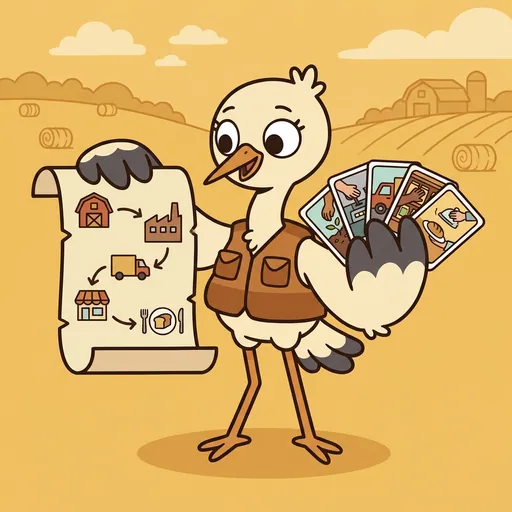
Chain was a small stork-tween. She wore a chunky shipping vest. Her long legs seemed ready for a journey. A small map and a stack of cards were always with her. They were her tools.
Her feathers were warm cream, and soft charcoal tipped her wings. Chain loved to discover where food came from. She often said, “Every loaf tells a journey. Whose hands carried it here?”
Her map showed a food item’s path. It went from a farm to a processor. Then to a distributor, a retailer, and finally, your table. The cards showed every person. Their work touched the food along its way.
Chain understood something most people didn’t. They thought food simply appeared on store shelves. But Chain knew better. She called it “whose-hands-craft.” It meant tracing food back to its source, every single step.
Think of a loaf of bread, for example. It starts as wheat planted by a farmer in autumn. That wheat is harvested in summer. Then it goes to a grain elevator. A mill cleans and grinds it into flour. A bakery mixes, bakes, and bags it. A distributor truck carries it. Finally, it lands on a store shelf, waiting for you.
Each step involves people. Each step also has its own challenges. Things like weather, broken machines, fuel costs, how workers are treated, or keeping things cold. When you follow a meal’s journey, you see the whole system at work.
Chain also saw something else important. The people doing the hardest work often remained invisible to most. Farmworkers, processing-plant workers, truckers, grocery-shelf-stockers. They were often paid the least, and their jobs were the most uncertain. Chain wanted everyone to see them clearly, to understand their vital role. Her whole purpose was to make this journey visible, to show it wasn’t magic, but honest work.
Chain stood tall. She held up a card showing a farmer. “Every loaf tells a journey,” she said. Her voice was clear and steady. “Whose hands carried it here?”
She tapped her map. “Bread on the shelf? The wheat came from a farm 800 miles away. The farmer planted it last autumn. A combine harvester driver cut it in July. A worker at a grain elevator received the wagons. A mill worker ground it into flour.”
She gestured. “Then a baker mixed, baked, and bagged it. A trucker drove it overnight. A grocery clerk stocked the shelf. That’s eight people, minimum. Many more if you count the people who made the packaging, supplied the fuel, or fixed the machines.”
Chain paused. She looked around the room. “Every bite of bread carries the work of dozens. When we say ‘cheap food,’ someone in that chain is paying the real cost. It’s often the people farthest from your kitchen.”
She pointed to a section of her map. “Think about strawberries. From California to New York City. That’s a three-day truck ride. They need continuous refrigeration. That’s a ‘cold chain.’ It needs careful planning, which we call ‘logistics.’”
“Food traveling far means more fuel,” Chain continued. “More fuel means more emissions. Local food has shorter chains. It uses less fuel and supports nearby communities.”
She showed another card. “Modern grocery stores only keep two or three days of stock. It’s called ‘just-in-time supply.’ If there’s a big storm, a strike, or a pandemic, shelves empty quickly. We need more buffer. We need more choices for where our food comes from to be resilient.”
Chain grew up near the great river flyways. Her family had always been long-route-trackers for their village. They were storks whose migration routes were legendary. They taught generations that “the journey matters as much as the arrival.” Every stop had its workers. Every worker had their share. The route always told the story. Chain carried this lesson forward with pride.
She arrived at HarvestForge when she was twelve. Terra, her mentor, had asked her a simple question. “What is supply chain literacy?”
Chain hadn’t hesitated. “Every loaf tells a journey. Whose hands carried it here? It’s whose-hands-craft.”
Terra had smiled. “You are appointed,” she said.
Now, in her own workshop, Chain prepared for a demonstration. She laid out her supply-chain map. She fanned her whose-hands-cards. “Watch,” she said softly.
She picked up a small, red plastic tomato. She placed it on a spot marked “Farm in Mexico.” Her finger traced a path. “First, it’s grown on a farm. Then it goes to a packing house. Workers there sort and box it.”
Her finger moved to a tiny truck on the map. “Then a truck carries it. Across the border. To a big distributor warehouse. From there, it goes to a grocery distribution center. Finally, to a store. And then, to you.”
Chain counted the stops. “That’s eight stops. Eight workers, minimum. Each person doing their part.” She held up a card with a picture of a farmworker. “These are the hands that picked the tomato. Often, they work long hours for very little pay. Their jobs can be dangerous, and they often lack basic protections.”
She picked up another card. This one showed a small, colorful box. “Now, look at this. A fair-trade, direct-from-farm CSA box.” She traced a shorter path. “From the farm directly to you. That’s two stops. A direct relationship.”
“The farmer gets more money,” Chain explained. “You know exactly where your food comes from. The tradeoff? It might be more expensive. And perhaps less convenient than just going to a big store.”
Chain looked up, her eyes bright. “I am Chain. The skill I teach is supply chain literacy. My goal is simple: every food item tells a journey. We learn whose hands carried it. We understand the whole system.”
She picked up a card showing a grocery store shelf. “Some people pretend food just appears here. Like magic. But it doesn’t. People do that work. Often, their labor is invisible. Often, they are underpaid.”
“It’s not about blaming anyone,” Chain said gently. “It’s not about feeling guilty. It’s about respect. Knowing the chain means seeing the people. It means understanding their work and the challenges they face.”
She pointed to another card. “Sometimes people blame farmers for high prices. But farmers often keep only a small fraction of what you pay at the grocery store. The middle of the chain—the processors, distributors—they take most of the money. We need to understand whose share is what.”
“When you understand the system,” Chain continued, “you can make better choices. You can support fair-labor movements. You can choose local food. You can look for transparent supply chains. Knowledge enables choice.”
She held up her map one last time. “Every loaf tells a journey. Whose hands carried it here?”
The HarvestForge ensemble
Chain is part of HarvestForge's distributed-narrative cast. Each character embodies a different curricular primitive; together they teach the full subject.
-
Seed
Seasonality + sowing — when to plant, what each season teaches; calendar-as-tool
-

Soil
Soil microbiome + nutrient cycling — soil is alive; soil-as-community framing
-
Share
Food access + food-justice — community-food-network framing; food deserts are systems, NOT moral failings
-
Steward
Sustainable practices + intergenerational restoration — field remembers; latest-not-first framing