
Lady Skewer
The SKEWER — attacking a more valuable piece in front to force it to move, exposing a less valuable piece behind it (the mirror of the PIN)
Press play to listen along. The line being read lights up as you go.
Show full transcript
Loading transcript…
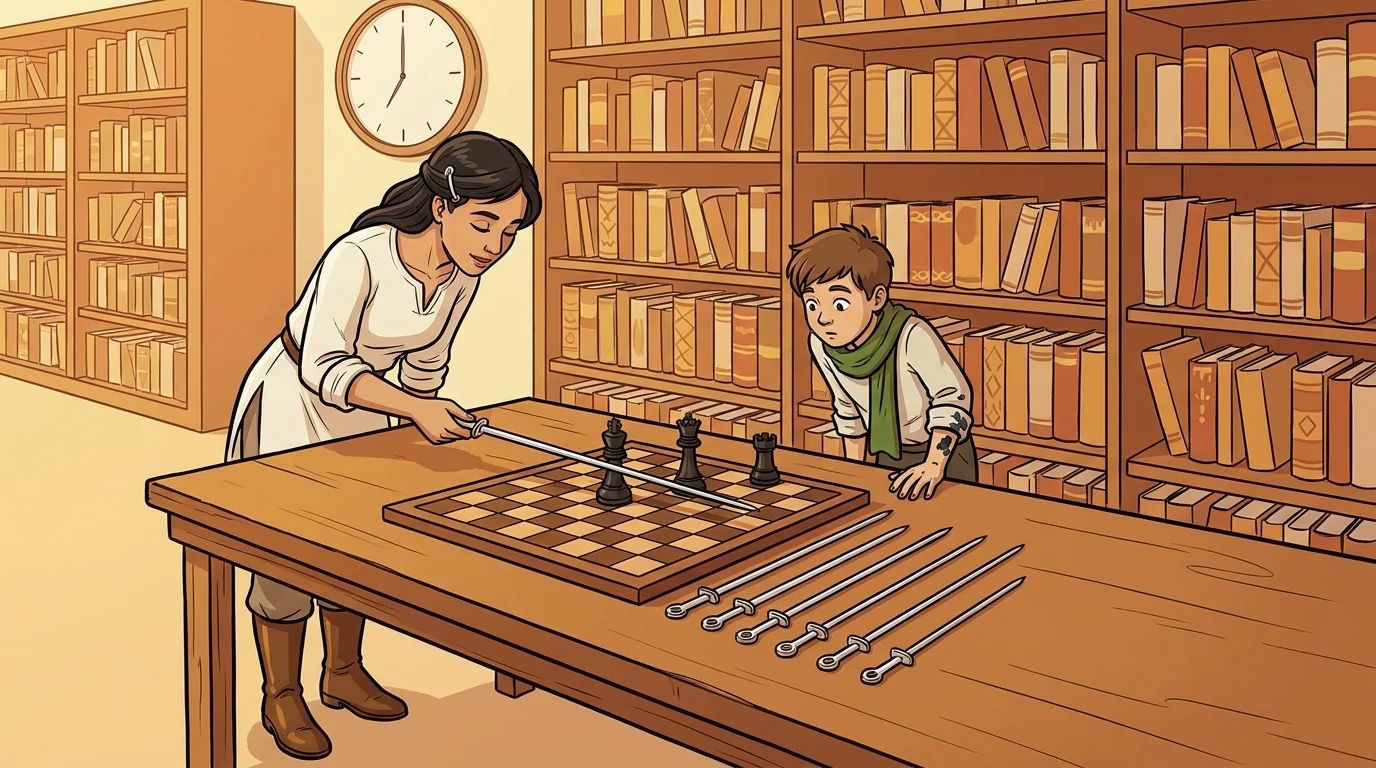
The southwest wall of the academy library has a long oak table that nobody else uses, because nobody else needs a long oak table to teach chess. Lady Skewer needs one. She has, laid out along it this morning, an entire roast-skewer set — five thin metal pins of graduated length, polished, lined up like the keys of a small flute. Beside the pins, on a wooden board, she has placed three pieces from a chess set: a rook, a queen, and a king. The king is in the front. The queen is behind.
A small student, eleven years old, leans on the table to look. He has a green scarf and ink on one cuff. He says, "Lady Skewer, what are the cooking skewers for?"
Lady Skewer picks up the longest pin. She holds it lightly — not like a weapon, more like a tool whose properties she has always understood. She lays the pin flat on the board so that one end touches the king and the other end touches the queen. The pin's silver line bridges the two pieces.
"This," she says, "is the line."
She bows slightly when she says it. She bows slightly when she says most things. She is in her late twenties and she looks a little like a duchess on holiday — clean linen tunic, polished boots, dark hair pinned at the back of her neck with a thin silver clasp. Other teachers at the academy have tried, occasionally, to seem more relaxed in front of the children. Lady Skewer has never seen the point.
"The king is in the front," she goes on. "The queen is behind. They are joined by the line. If I attack the king" — and she taps the pin's tip gently against the wooden base of the king — "the king has to move. That is what kings do when they are attacked. They get out of the way."
The boy nods, slowly.
"And when the king moves," she says, "what do you suppose happens to the queen?"
The boy says, after a moment, "She's just sitting there."
"Yes," says Lady Skewer. "She is sitting there. With nothing in front of her. With my pin still pointing at her."
She smiles, politely, courteously, and waits for the boy to catch up.
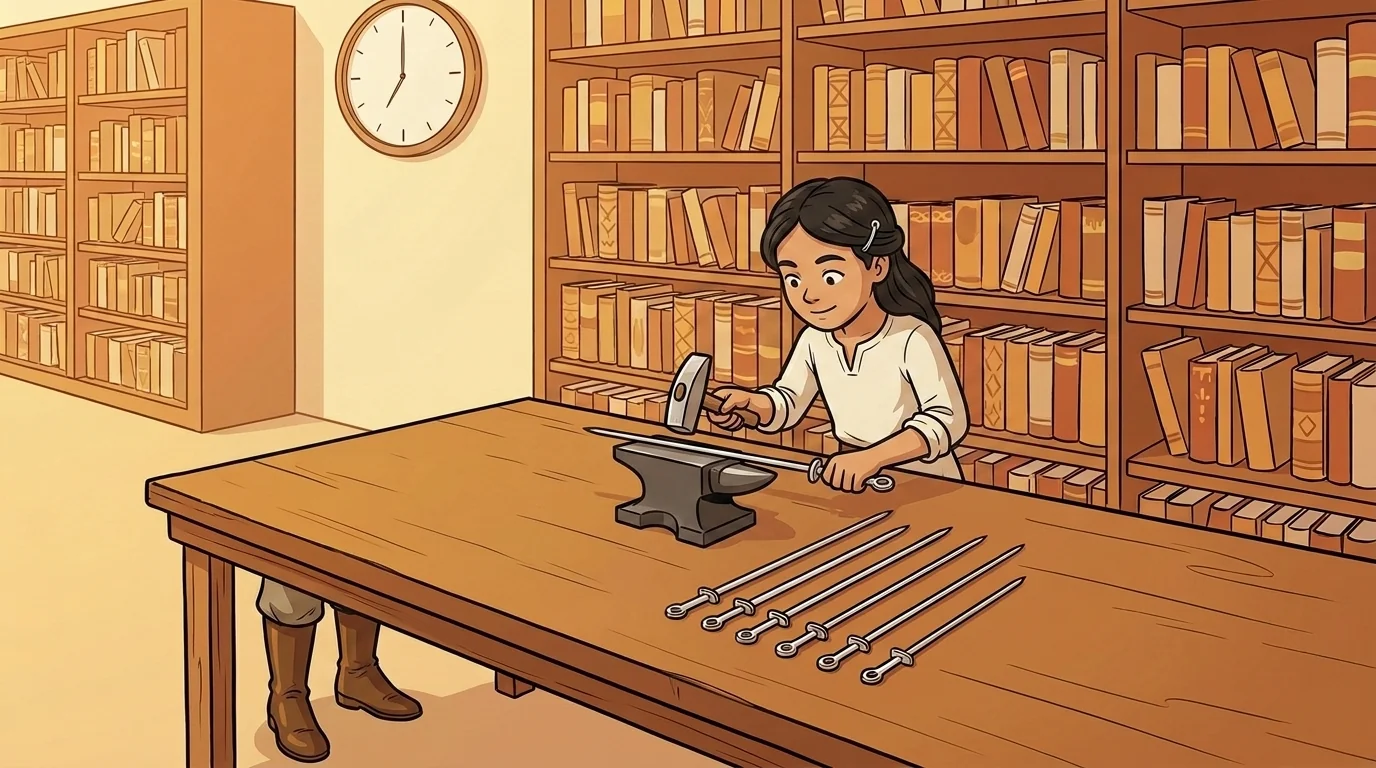
She was not born knowing the line. She was born into a family that made cooking skewers, which is a different thing, though it turned out, much later, to be the same thing.
Skewer House — her grandfather's name for the family workshop — sits in the foothills of the eastern range, about three days' walk from the Slow Lake. (The Slow Lake, as it happens, is also the village Sir Pinwell came from, though neither of them knew this until they were both grown.) Adela Marrowstone of Skewer House grew up watching her grandfather hammer skewers, her father hammer skewers, her mother run the family books, and her aunt manage the shipping crew. She was, until the age of eleven, a perfectly normal Marrowstone child. Competent. Polite. Slightly bored.
Then, at eleven, she became interested.
She used the word "interested" the way other children would use the word "amazing." It was the strongest word she allowed herself. What she was interested in was the line. She had watched ten thousand skewers being made and noticed something the rest of her family had stopped noticing: a skewer, as a tool, has a peculiar property. The front of it pierces. The back of it supports. The line between is what makes the whole thing work. If the back is heavy, the front has to go where the back sends it.
Adela began to look for the line in other places. She watched her aunt's shipping crew load barrels onto a cart. A heavy barrel placed behind a light one pushed the light one forward, whether the light one liked it or not. She watched her mother sort the accounts. A number written here changed a number written three lines down. She watched her father's apprentice carry a long board through a narrow doorway — the back of the board, swinging, decided where the front of the board had to point.
She wrote, at twelve, a notebook entry that her family still has on a shelf at Skewer House:
The piece behind decides what the piece in front has to do. If the piece behind is heavier, the piece in front has to move. The piece in front does not get to choose.
Her family thought this was charming. They did not realise they were watching the early career of one of the kingdom's premier chess tacticians.
She was sixteen the first time she saw a chess game. Two old men at a fair, playing on a board outside a bakery. She watched for an hour and understood most of it not at all. She understood the bishop instantly. The bishop moved along a line — that was all she needed to know. When the bishop attacked the rook, and the rook had to move, and the queen was three squares behind on the same diagonal, she saw it before the players did.
She walked back to Skewer House. The walk took her ten days. She told her grandfather, who was that day hammering skewer number nine hundred and seventy-four thousand, that she was leaving in the morning to become a chess player.
Her grandfather considered this. He set down the hammer. He said, "Adela. Have you ever played chess?"
"No," she said. "But I understand the line. It is the same line."
He looked at her for a long moment. Then he reached for the longest skewer on his workbench — a polished outdoor-roasting pin, the kind they sold for cooking lamb — and put it into her hand.
"Take this," he said. "If anyone ever asks you what you are doing, hold this up. People will understand."
She took it.
She walked to the capital. It took ten days. Her boots were new at the start and not at the end. The academy gates were taller than she had imagined and the courtyard inside was smaller. There was nobody to receive her. The academy did not formally admit students; you simply turned up, and someone, eventually, agreed to play with you.
A clerk at a high wooden desk asked her name.
"Lady Skewer," she said.
She had decided this on the walk. Adela Marrowstone of Skewer House was too long, and Adela by itself sounded like somebody's daughter, which she was, but which she had not come here to be. Lady Skewer told the truth about what she had come to do.
The clerk wrote it down. He did not look up.
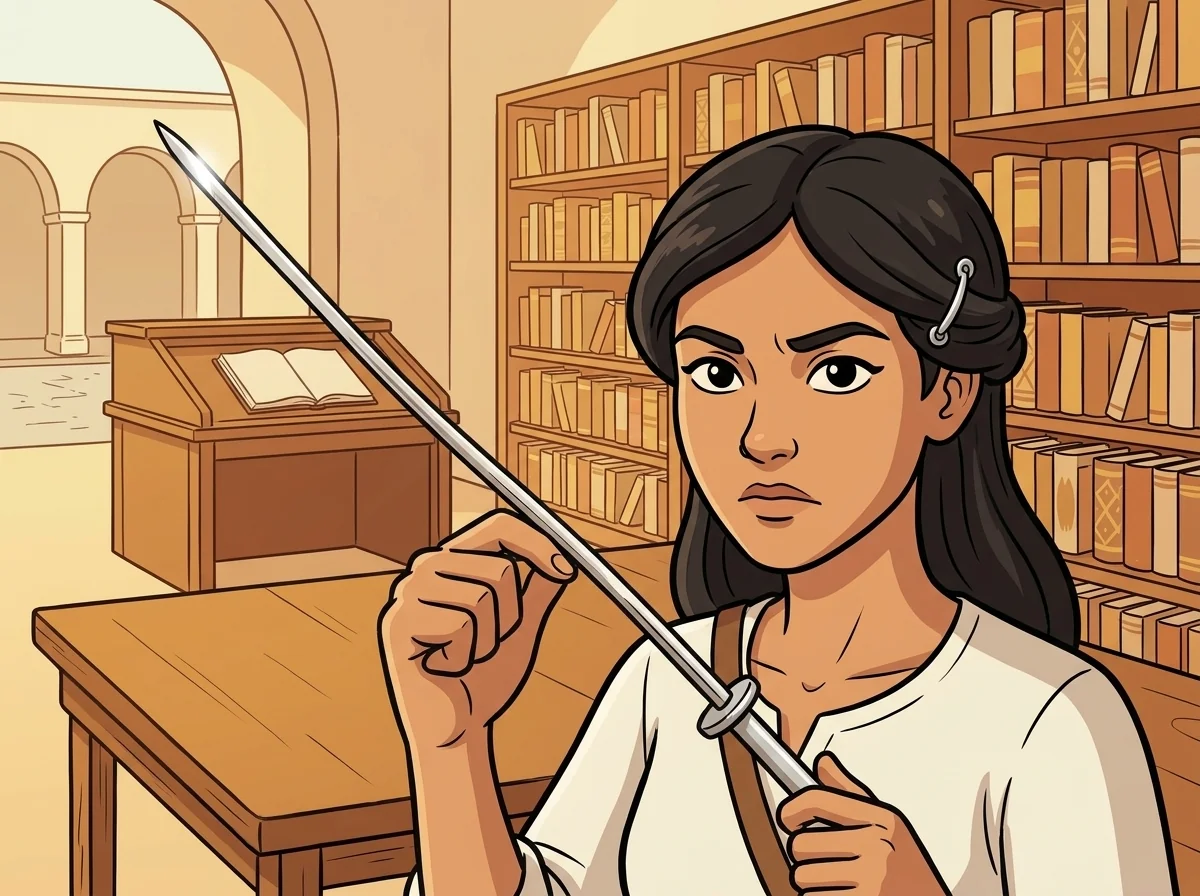
She unfastened her satchel. She drew out her grandfather's cooking skewer and held it up — silver, thin, a little over a foot long, polished to a mirror at the tip. The clerk looked up.
He laughed. Adela did not. After a moment, the clerk stopped.
He found her a board, and an opponent, and she played three games. She lost the first one, because she did not yet know the names of the pieces. She drew the second one, because she had figured most of them out. She won the third one, with a bishop and a rook, by attacking a queen and capturing the king behind it on a diagonal so clean that her opponent set his pieces back up, looked at her, and said, "Do that again."
The academy master had wandered over during the third game. He watched from over her shoulder. When the game ended he stood quietly for a moment, his hands clasped behind his back. Then he said, to nobody in particular: "Oh. Good. Another one."
He had been doing his job for twenty-seven years. He had seen many of these. He still smiled when he saw one.
Adela bowed slightly. She put the cooking skewer back in her satchel — in the velvet pouch her aunt had stitched for her on the night before she left, which she had not, until that moment, used. She has used it every day since.
She has been Lady Skewer ever since.
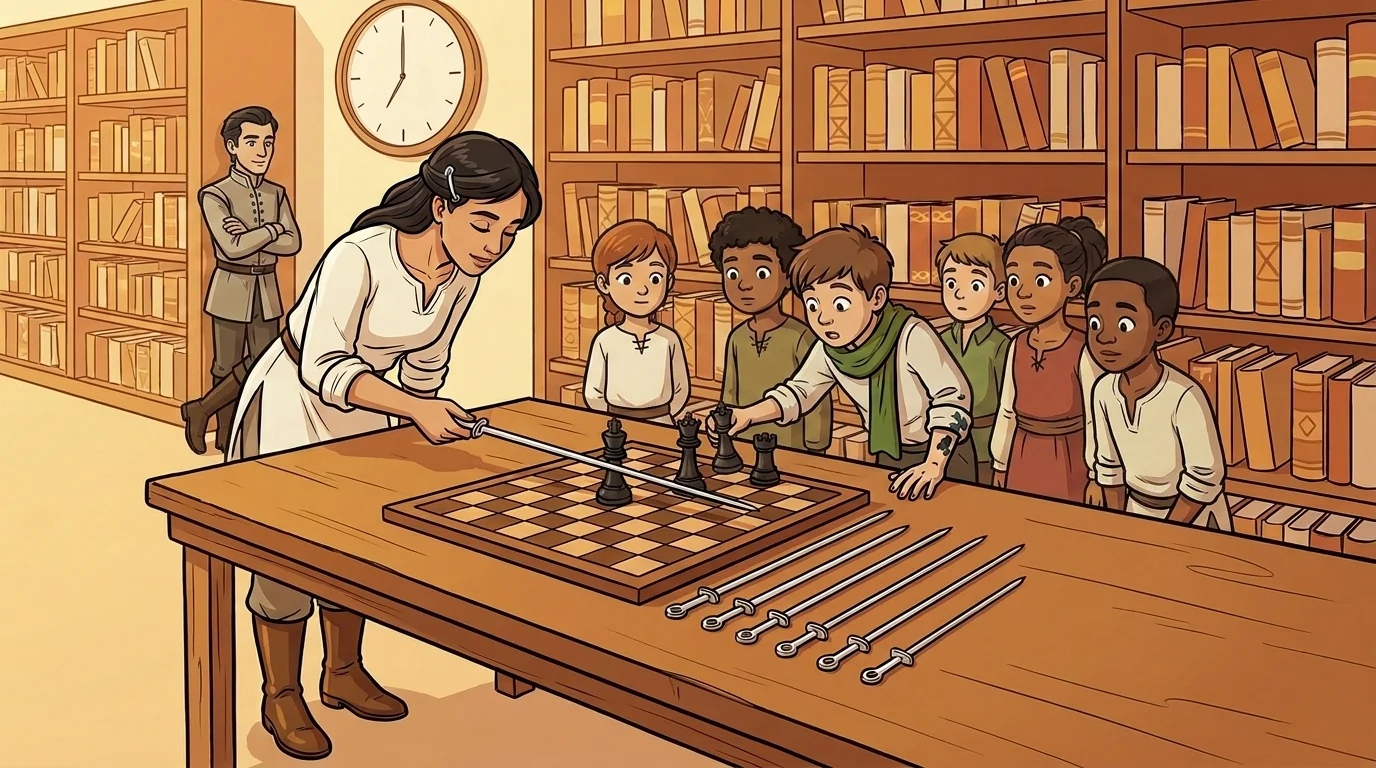
This morning, in the library, with the cooking skewers laid out and the boy in the green scarf still looking at her, she does what she always does when she teaches the skewer pattern for the first time. She moves the king-piece off its square, slowly, so the boy can see exactly what happens. She lifts the pin clear of the king. She lays the pin's tip against the queen.
"The line," she says, "did not move. I did not move. The king moved. And now the queen is at the end of the line."
The boy looks at the queen.
"Take it," Lady Skewer says, politely.
The boy reaches over and picks up the queen. He sets it carefully aside.
"That," Lady Skewer says, "is the skewer."
By now four other students have drifted over to the table, attracted by the cooking skewers, which are not what children expect to see in a chess library. Sir Pinwell is there too, leaning on the doorframe at the far end of the room, watching with his arms folded. He has been watching for a while. He does not interrupt her lesson. He never does.
Lady Skewer continues, as if to the whole room now. "You will see this pattern again. You will see it on diagonals. You will see it on ranks. You will see it on files. You will see it with bishops, with rooks, with queens. You may, sometimes, see it with a king in the front — and when you see that, remember: the king must move. There is no choice. That is the absolute version of the pattern."
She places the king back on the board. She lays the pin against the king once more.
"The piece in front," she says, "does not get to choose. That is the whole craft."
A girl, eight years old, with a fork-shaped pin in her hair, asks, "Lady Skewer, but what if the front piece is small? What if it isn't the king or the queen? What if it's a pawn?"
Lady Skewer considers this. She likes the question. She looks at the longest cooking skewer on the table.
"You would not skewer a single mushroom alone," she says. "You need something worth moving. If the front piece is small, the line still exists — but nobody minds losing the front piece, so the line does no work. You skewer when the front is valuable. That is the rule of the kitchen, and it is the rule of the board."
The girl writes this down in a small notebook. (The notebooks at this academy are spreading, Lady Skewer thinks, the way ivy spreads on a stone wall — slowly, then all at once.)
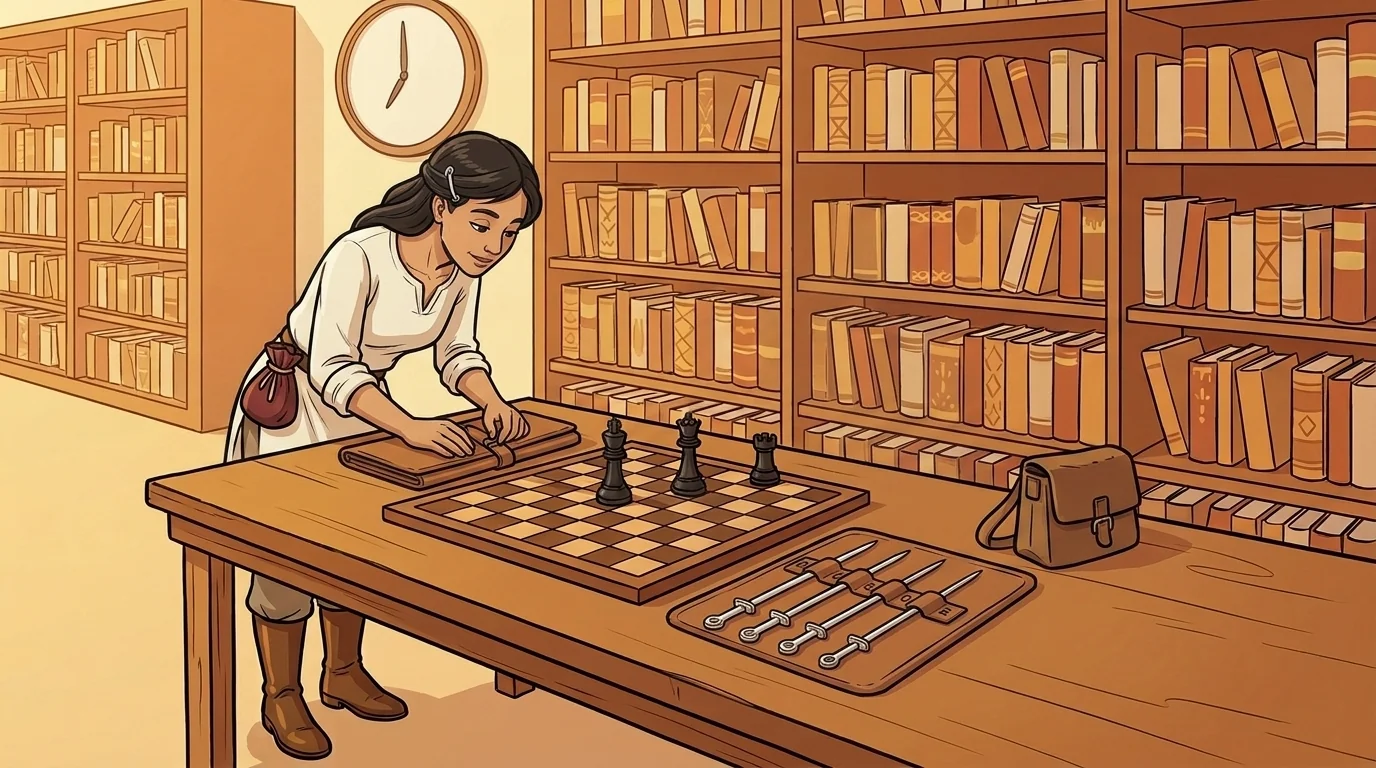
After the children file out for lunch, Lady Skewer remains at the long oak table, packing the cooking skewers back into their flat leather case. Sir Pinwell pushes off the doorframe and crosses the room.
He stops at the table. He looks at the chessboard, which still has the rook and the queen on it, and at the empty square where the king used to be.
He says, "Clean."
"Thank you," she says.
He nods. After a moment he says, "The lantern was watching. From the gallery."
Lady Skewer looks up. The gallery — a small wooden balcony along the south wall of the library, where the older students sometimes sit and read — is empty now. But it would not have been empty during the lesson.
"What did she think?" Lady Skewer says.
"You will have to ask her."
"I will."
She buckles the leather case shut. She slides the case into her satchel. Her grandfather's cooking skewer, the one she has carried since she was sixteen, lives in a separate velvet pouch tied to her belt; she pats it gently, the way some people pat a dog they have known for a long time.
She says, half to Pinwell and half to nobody, "She thinks the simultaneous is more elegant than the sequential."
"I know," says Pinwell.
"I have told her," says Lady Skewer, "that she is wrong."
"I know," says Pinwell.
"But politely."
"Always politely," says Pinwell.
They walk together out of the library, towards the dining hall. At the door Sir Pinwell asks — because he has not yet had the chance — what she will be teaching this afternoon. Lady Skewer thinks about it. Then she smiles, the small pleased smile of somebody placing a thing on a shelf where it belongs.
"I move the front piece," she says. "Then I take the back one."
"Yes," says Pinwell.
They go in to lunch.
The GambitTales ensemble
Lady Skewer is part of GambitTales's distributed-narrative cast. Each character embodies a different curricular primitive; together they teach the full subject.
-

Sir Pinwell
Pin pattern — freezes pieces along a line
-

Twin Knights of Fork Hill
Fork pattern — attack two targets at once
-

Veil & Vow
Discovered attack — step aside to reveal a hidden threat
-

Captain Crossfire
Double attack — one move threatens two targets
-

The Glass Lantern
X-ray attack — light pierces through to the piece behind
-

King Pumble & King Sable
Two kings — librarian and gardener; one step at a time
-

Queen Vesper
Queen — ranger-messenger; any direction, any distance
-

Captain Castle
Mentor + narrator — rook archetype; the mascot who introduces the cast + scaffolds the lesson
-

The Pawn Cohort
Ensemble piece — the four pawn-paired sets (Pawn Patrol + Sienna & Bran + Trotter & Trundle + Gable & Garrett) acting as one in the world layer