
King Pumble and King Sable
The KING — moves one square at a time in any direction; cannot enter check; the piece you must protect
Press play to listen along. The line being read lights up as you go.
Show full transcript
Loading transcript…
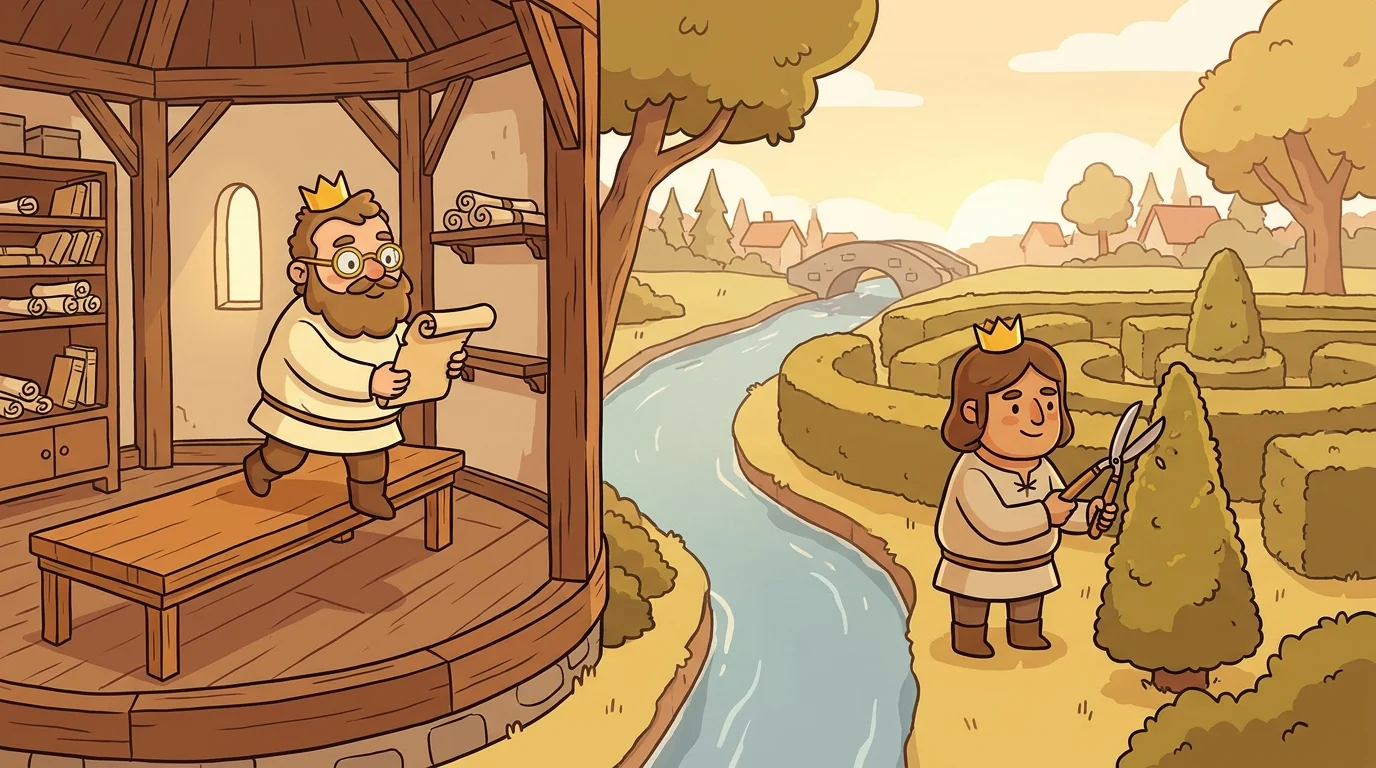
Across the river from each other, on the morning of the academy visit, the two kings are doing what they do every morning.
In the library tower above Marrowbridge, King Pumble is reshelving books. He has been at it since before sunrise. He moves from the long oak table to the wall shelf, one careful step, holding a single rolled scroll between both hands like a thing that might break. He sets it on the shelf. He turns. He walks back to the table. One step. Another step. He takes the next scroll. He does not rush. If he rushes, the scrolls scatter — they have done it before, twice, when he was younger and thought he was faster than he was. He learned. Now he moves the way the books need him to move, which is shelf to shelf, one shelf at a time, never two at once.
His brass-rimmed reading-glasses slide down his nose. He pushes them back up with a knuckle. He smiles at no one. The library is empty except for him and the scrolls and the morning light through the high east window.
Across the contested river, in the maze-garden of the lesser palace, King Sable is pruning. He stands at the first topiary — a wide soft cone of dark hedge that wants to be a sphere — and he makes one snip. He inspects. He steps to the next hedge. One step. He makes one snip. He inspects. He does not snip twice in a row. He has tried that, in his youth, and he has lost two hedges that way: cut a second time too soon, took off the new bud, ruined the year. He moves the way the maze-garden needs him to move, which is one hedge at a time, one cut per visit, never a second cut in haste.
His worn straw hat shades his eyes. His garden shears hang from his belt between snips. He does not whistle. He is not the whistling kind. The maze hums faintly in the morning warmth, all hedge and bird and the small dry sound of one snip per hedge.
At ten o'clock they each set down their work — Pumble the scrolls, Sable the shears — and they each walk to the boat-house that the academy keeps at the river's middle bank. They cross from opposite sides. They meet at the academy door. They walk in together. They walk slowly.
The academy hall, this morning, has two thrones at the front of the room. They are not really thrones. They are two large wooden chairs that somebody (probably Captain Castle) has dragged out of the staff library and pushed up against the chalkboard. But the two kings sitting in them are very real, and the children sitting on the floor in front of them are looking up with the careful attention of children who have been told, beforehand, that today they will meet both kings at the same time.
The two kings do not look alike.
Pumble is on the left, in a green coat with too many buttons. He keeps fiddling with them. He is sixty-two years old. He has a kind round face and very tired eyes. He smiles when nervous, which is almost always.
Sable is on the right, in a dark grey coat with no buttons at all — he had them all removed, last spring, because he was tired of doing them up. He is sixty-two years old, exactly the same age as Pumble. He has a thinner face, neat short white hair, and the small steady frown of a man who is not unhappy but is also not, at this particular moment, smiling.
A child in the front says, "Are you really cousins?"
"Yes," says Pumble immediately. "And I am very glad to be — that is to say, I'm sorry, that's a strange way to put it — I just mean — yes. We are cousins. I love him. Sorry."
Sable says, after a small pause, "Yes."
The child says, "Whose mother was whose mother's sister?"
Pumble blinks. He looks at Sable. Sable looks at Pumble.
"His mother," says Sable, pointing across, "was my mother's sister."
"And his father," Pumble adds, recovering, "was my father's brother."
The child considers this. Several other children behind her also consider this. There is a small thoughtful silence.
Captain Castle, leaning against the doorframe at the back of the hall, sighs gently. He has explained this to children before. He has stopped trying to make it sound less unusual than it is.
"This is unusual," Pumble says to the children, with great seriousness. "Even in royal families. It led to a particular set of cheekbones that both my cousin and I still resent."
Sable touches his own cheek and nods, once.
The children laugh. Then a small boy near the back, with chalk on his sleeve, says, "Why do you both walk so slowly?"
Pumble and Sable look at each other. Sable lifts a single eyebrow at his cousin, the way you lift a single eyebrow when somebody you have known for sixty-two years has just asked exactly the right question.
"Because," Pumble says, choosing his words, "kings move one square at a time. We are practising. All our lives."
"And so are our kingdoms," Sable adds.
The children look at their feet. Then they look at the square tiles of the academy hall floor. Several of them quietly try walking one tile at a time without picking up their feet too high. The kings watch this without comment, the way grown-ups watch children doing the small private experiment of becoming.
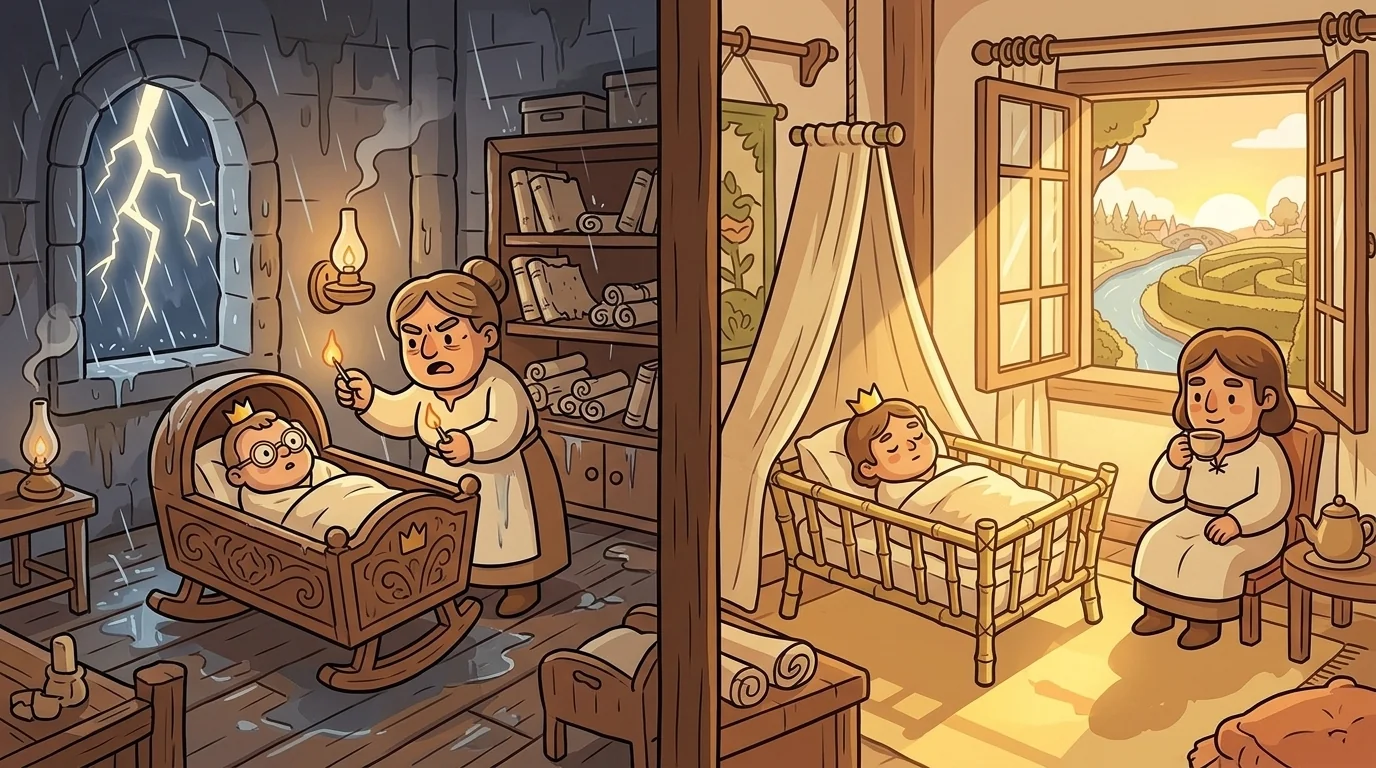
They were born in the same week of the same year, in two palaces on opposite sides of the river that the cartographers have never quite agreed on the name of.
Pumble was born during a thunderstorm. The wind shook the palace windows and the midwife had to relight the lamps three times. He cried more or less continuously for the first hour, and was a quiet baby ever after — as if he had used up his entire allotment of crying on that first thunderstorm.
Sable was born during a sunrise. The midwife at the other palace had been up all night and was, by the time of the birth, in the kind of mood where nothing surprised her. She delivered Sable with three words of conversation and a pot of tea on the side table. He did not cry. He simply looked at the morning light through the window and went to sleep.
Their grandmother — who was the kind of person who made pronouncements — said, when she heard about both births in the same week:
"One will be loud, and one will be quiet, and they will both move one careful step at a time, and so will their kingdoms — because the kingdoms will be theirs, and a king who hurries is a king who falls."
She was, more or less, right.
She was also, in her way, instructing the family. She had spent her own years as queen of the smaller kingdom learning the same lesson — that a crown is not a sprint, that to do the king's work is to do one thing at a time and to do it before doing the next. She had been a librarian's daughter before she was a queen. She believed in the slowness of careful hands.
So she made arrangements.
Pumble would be raised next to the library tower above Marrowbridge — among the scrolls and the long oak tables and the librarian-aunts who would teach him the patience of one-shelf-at-a-time. Sable would be raised next to the maze-garden at the lesser palace — among the hedge-rows and the gardener-uncles who would teach him the patience of one-snip-per-visit.
By the time they were nine, both boys could do their work without scattering scrolls and without losing hedges. By the time they were fifteen, they could do it without thinking. By the time they were thirty, they could not imagine doing it any other way.
The two kingdoms had a long-standing diplomatic non-relationship — they were not at war, exactly, but they were also not entirely at peace. The boys were not allowed to meet until they were nine. When they did meet, on the neutral middle bank of the river, what each cousin recognised in the other was not, at first, family. It was cadence. The way the other one moved. One step. Then another. Never rushed. Both of them, even at nine, already moving like kings.
They got on, mostly because of this. They have got on ever since, mostly because of this.
The grandmother, who watched the first meeting from a folding chair on the riverbank, was not surprised at the outcome. She had planned for it. She wrote later in a private letter to her own sister: "They have learned slowness from different gardens. They will be enough alike to trust each other and enough different not to bore each other. This is the most I can give them."
She also, that same year, instituted what she called the Letter Game. Each week, on Sunday morning, each cousin would write a letter to the other. The letters could be about anything. The only rule was that they had to include one fact about the day and one fact about themselves. She personally read every letter for the first six years to make sure neither cousin was being lazy. (She was a very thorough grandmother.) After year six, she trusted them.
The letters went, eventually, to the post office at Marrowmile. From there they were carried — often by ranger-messengers, sometimes by ordinary couriers, occasionally by a particularly determined trader who happened to be passing through — across the contested river to the other kingdom. The Letter Game taught the boys the same thing the library and the maze-garden had taught them: one careful step a week is more than enough, if you keep stepping.
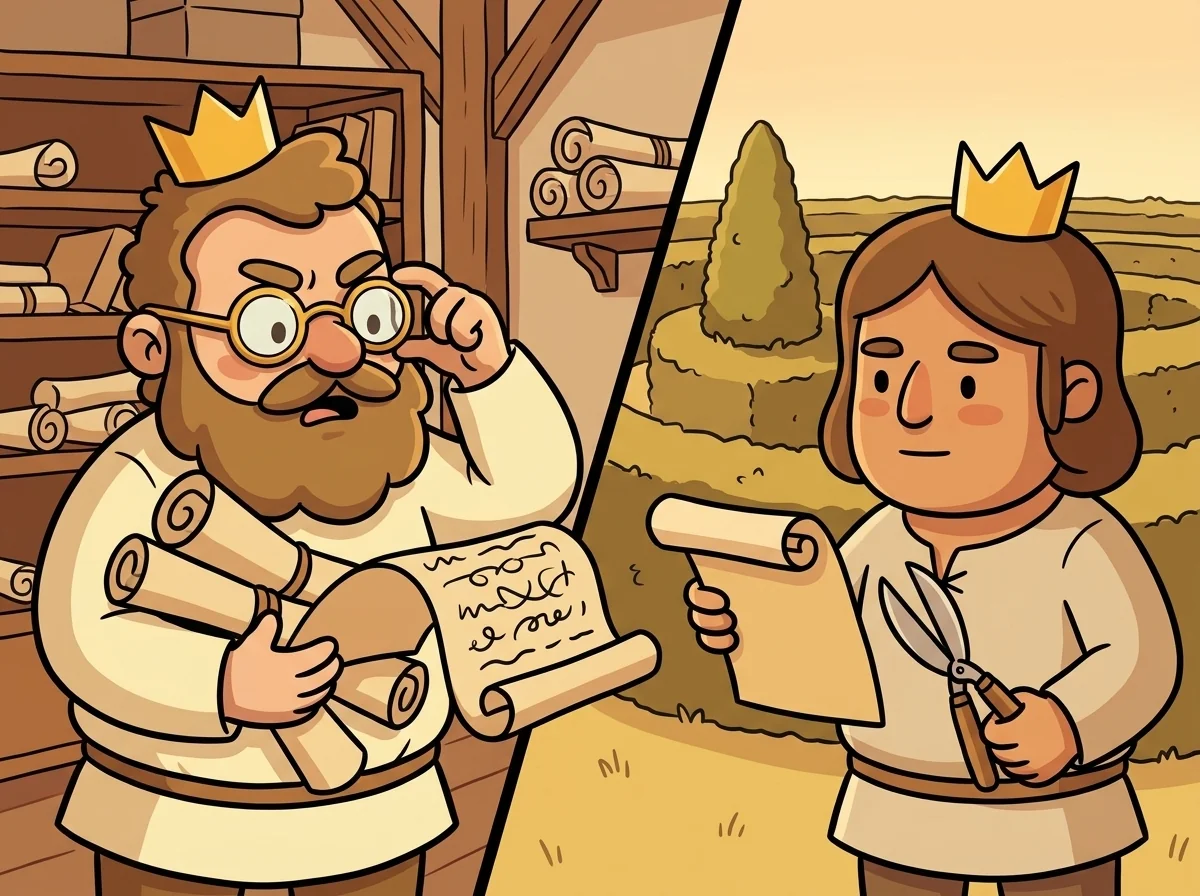
The Letter Game has, by now, been going on for forty-two years. The kings have written each other approximately two thousand one hundred and eighty-four letters. Their grandmother died eleven years ago. They have not stopped.
The two letter-styles diverged early — and the divergence is, if you look at it the right way, the rule on paper.
Pumble's letters are warm and slightly worried. He asks a lot of questions. He apologises for the questions. He apologises for the apologies. They contain six or seven moves in a single letter — a thought, a worry, a small joke, an apology, a question, a goodbye, a postscript that reopens the question. He cannot help it. He has never quite learned to make one letter say one thing. He is, in this single small respect, still learning to be the king he is trying to be. He knows it. He keeps trying. He has written letters his entire life that say six things when one would have served him better.
Sable's letters are shorter, calmer, and occasionally devastating. They sometimes contain only one line: "The wheat came in. Twice." That is the entire letter. One step. One square. One fact. He does not add a postscript. He does not apologise for the brevity. He has learned to write a letter the way he prunes a hedge — one snip per visit, no second cut in haste. Pumble has been known to read these short letters fifteen times in a row, trying to understand if Sable is angry. (Sable is almost never angry. Sable is just doing what a king does, which is one thing per page.)
This is the divergence, and it is also the lesson.
Pumble keeps every letter Sable has ever sent him, in a small cedar chest at the foot of his bed. The chest is now full. He has, this year, ordered a second one. He has counted them — two thousand one hundred and twelve — and each one is one careful step Sable took on a Sunday.
Sable keeps Pumble's letters in a slightly disorderly stack in a desk drawer. He has, twice in his life, gone back and re-read every letter Pumble has ever sent him, in chronological order. He has not told Pumble that he has done this. He is not sure why. (He suspects it would make Pumble cry. He is, in this, probably correct.) Each Pumble-letter, when he re-reads it, takes him five minutes — not because the letter is long but because Pumble keeps doubling back, retracting, apologising, reaffirming. Each letter is, in Sable's mind, Pumble trying to move one square and accidentally moving four at the same time. He loves Pumble for the trying. He loves him for the trying even more than for the eventual success.
Captain Castle has read a sample of these letters with permission (the cousins gave him three each from the early years). He keeps them in a folder. He has told children, more than once: "This is the King Rule, written down. Sable's letter is one careful step. Pumble's letter is the cost of forgetting the step. Both are honest. Both belong to the game."
This is, in a small way, the story of how Pumble and Sable have stayed friends despite leading enemy armies. It is also the story of how each cousin has spent forty-two years practising the one-square-at-a-time rule on a piece of paper before practising it again on a board.
There is, however, a larger story, and it is one neither cousin tells very often.
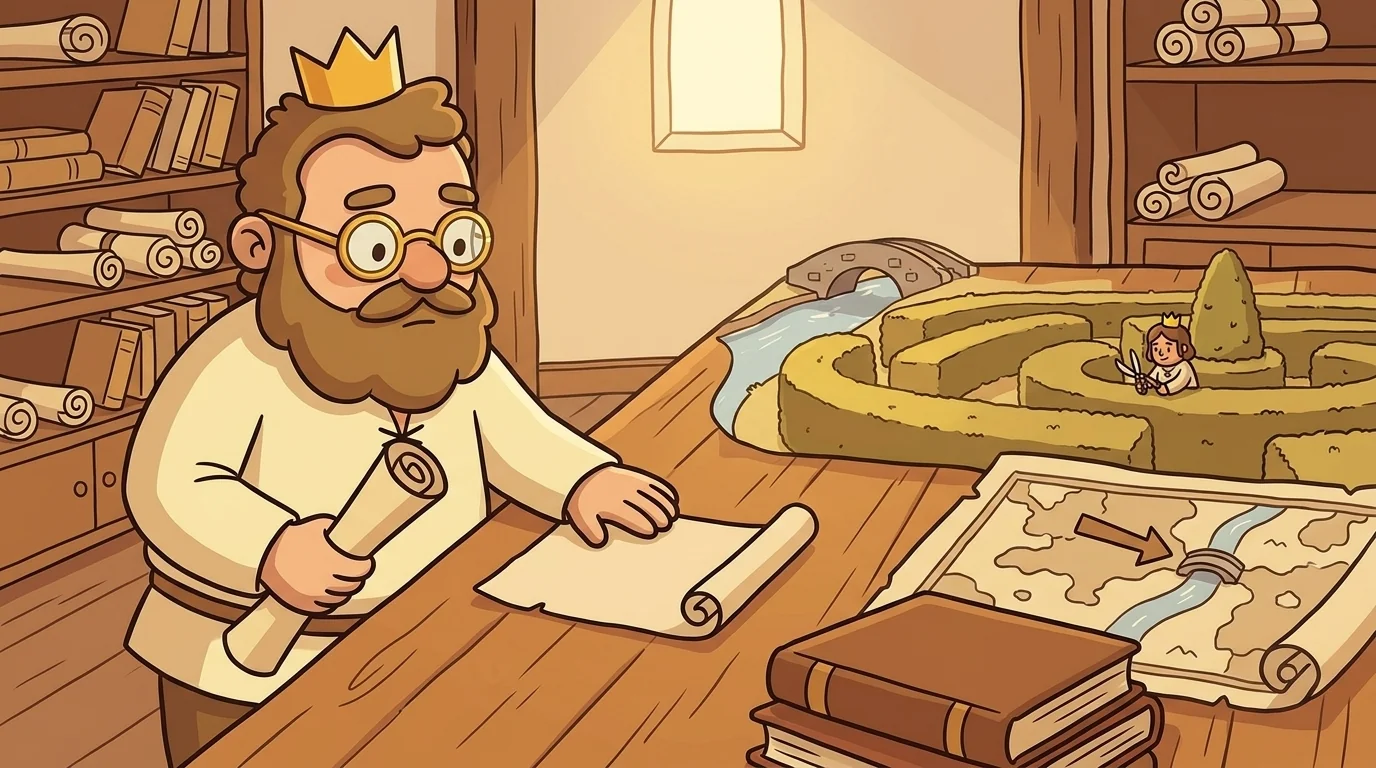
When they were thirty-seven, both kingdoms were in trouble at the same time.
Different troubles, on opposite sides of the same river, in the same brutal winter. (The same brutal winter, in fact, that Queen Vesper rode across on a stolen horse — yes, that one.) The outposts that were overrun were each other's outposts. They held the same river crossing from opposite shores.
The letters that Vesper carried — those urgent letters that arrived at Marrowmile at the same time — were, in different handwriting and different ink, the same letter. Each general had told each king the same thing: "Your Majesty, the eastern crossing is the choke point. The kingdom rises and falls with you. If you fall, the kingdom falls. We must protect you."
Pumble read his letter alone in the library tower. He set it down on the long oak table next to the scroll he had been about to reshelve. He stared at it for a long time. He had known, in some abstract way, that this was true of being a king. He had not, until that letter, felt it in his chest. He had not understood, until that letter, that the entire game of being a kingdom was protect the king or end the game. He had thought it was about armies. It is about armies. It is also, more deeply, about him.
He understood, then, why he could only move one square at a time.
A king who could run would be lost in a week. A king who could leap would be cornered by Tuesday. The slowness was not a limitation. The slowness was the gift. It was the thing that let the rest of the pieces — the queen who ran, the bishops who swept, the knights who jumped, the rooks who marched in straight lines — organise themselves around him. If he stayed still, they could move. If he moved carefully, they could move faster. He was the centre of the gravity. He was the piece they were protecting.
He cried, briefly, sitting at the long oak table. Then he stood up. He took one careful step to the shelf. He put the scroll back where it belonged. Then he took one careful step to his writing desk. He sat down. He wrote one careful sentence.
"Cousin. I have just been asked to reinforce my eastern crossing. I will do it. I am sorry."
Across the river, at the same hour, Sable read his version of the same letter in the maze-garden. He read it standing up, between two hedges, with the garden shears still in his free hand. He read it twice. He did not cry — he is not the crying kind — but he set the shears down on the hedge-edge and he sat on the bench he kept at the maze's centre for exactly this kind of moment, and he stayed there for a long time.
He understood, then, what the maze-garden had been teaching him his entire life.
The maze was not a maze for him to walk through. The maze was a defensive geometry — a slow careful structure that the gardener-uncles had been growing for three hundred years to make the palace approachable only by people who would not hurry. He had always thought the maze was beautiful. It was beautiful. It was also a kingdom protecting its king by being slow on purpose, by being impossible to rush through, by forcing every visitor to move the way he had been taught to move — one careful step at a time, one hedge at a time, one path at a time.
The cannot-enter-check rule was not an arbitrary prohibition. It was the same rule the maze enforced. You do not walk into the danger. You stop one square short of it. You let the others step in for you, if they can. If they cannot, you go around. But you do not walk in.
He wrote one sentence, in his even hand, before he went inside to call the general.
"Cousin. I have just been asked to reinforce my eastern crossing. I will do it. I am also sorry."
The two letters crossed in the post.
The reinforcements arrived on both sides. The outposts both held. The river crossing did not change hands — which is to say, it did not change hands in either direction, which is to say, both armies fought to a tired standstill, and several hundred soldiers went home that spring who would otherwise have not.
Neither king has ever told this story publicly.
Pumble, when asked about the bad winter, says: "It was cold."
Sable, when asked about the bad winter, says: "It was cold for everyone."
But each year, on the anniversary of those two letters that crossed in the post, both kings independently write each other an extra Sunday letter. Always the same one.
It says: "Still here. Still sorry. Still writing."
The letters are short. They do not need to be long. Each is one careful step, taken once a year, by a king who learned at thirty-seven what the king-rule actually was.
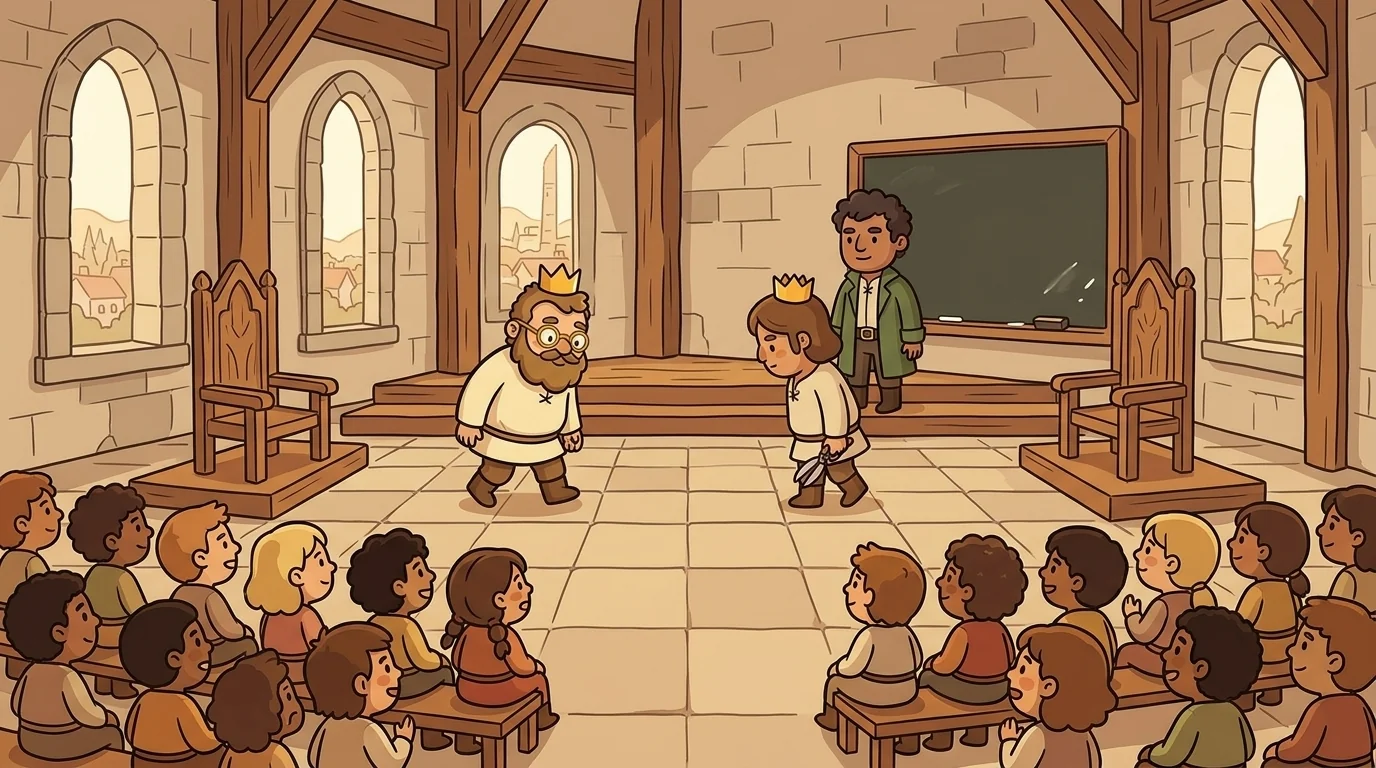
Back in the academy hall, this morning, the children have asked about the bad winter only obliquely. They have asked, instead, about Sunday letters and cheekbones and how it can possibly be that two kings are also cousins. Captain Castle has answered some questions himself, in his short way. The kings have answered the rest.
Now, for the last ten minutes of the visit, Captain Castle pushes himself off the doorframe and walks to the chalkboard.
"Both of you," he says to the kings, with affection. "Show them how a king moves."
Pumble stands. He smooths the front of his green coat. He looks at the square tiles of the academy hall floor, and he takes one careful step from his throne towards the chalkboard. He pauses. He takes one more. He pauses. He takes one more. Six steps. Six pauses. He arrives at the chalkboard. He turns. He bows, slightly, to the children.
"That," he says, "is a king's morning walk. It is also a king's afternoon walk. And — if I am being honest about it — a king's evening walk."
The children laugh, quietly.
Sable stands. He does not smooth anything. He does not adjust his coat. He simply walks the same six careful steps from his throne to the chalkboard. He pauses between each one. He arrives. He stands next to Pumble. He does not bow. He nods at the children.
"That," he says, "is the same morning walk. In a different garden."
Captain Castle taps the chalkboard. "One square at a time. Any direction. Never two squares in one move. That is how every king in this game moves, on every turn, for every kingdom, in every match." He turns to the kings. "Now show them check."
Pumble and Sable look at each other. They have done this before. They know the choreography.
Sable takes one careful step forward — towards Pumble. Pumble looks at the space between them and the place his foot would land if he kept walking towards Sable. He does not take the step. He stops. He turns. He takes one careful step to the side, instead — out of the line that Sable's step has drawn.
"That," Captain Castle says, "is what a king does when he cannot enter check. He stops before the danger. He goes around. He does not walk in. Not ever. Not even when he is angry. Not even when he is brave. The king stops."
The children think about this.
Captain Castle taps the chalkboard once more. "And now," he says, "the last thing about the king."
Pumble walks one careful step back towards his throne. Sable walks one careful step back towards his. Captain Castle reaches into his coat and produces a small cluster of pawn pieces — eight of them — which he sets on the floor around the two thrones in a loose circle, each pawn between the kings and the children.
"The pawns," he says, "stand where they stand because the king is behind them. The bishops sweep, the knights jump, the rooks march, the queen runs. They do all that for the kings. The kings move one careful step at a time, and never into danger, because the kings are the piece every other piece is protecting. Lose the king and the game ends. So the king moves carefully. So the king lets the others move fast. That is the trade. That is the rule. That is the whole game in one sentence."
He turns to the kings.
"Cousins. One more time. Together."
Pumble and Sable walk one careful step towards the children, then stop. They walk one step back. They sit down on their thrones. They look across at each other across the foot of empty space between the chairs.
The girl with the fork-pin in her hair says, "So you both move slowly, all the time, on purpose."
"Yes," says Pumble.
"Yes," says Sable.
"And you can't help each other on the board."
"No," says Pumble, more quietly.
"No," says Sable.
"But you write letters on Sundays."
Pumble looks at Sable. Sable looks at Pumble. Sable lifts the single eyebrow again.
"Yes," says Pumble. "We write letters on Sundays. One careful sentence at a time, mostly — at least for one of us. On Sundays we are not opposite kings. On Sundays we are just two old men who have been moving slowly together for a long time. The board doesn't get those Sundays. The board only gets the weekdays. We keep the rest."
The children file out for the next class. Pumble waves at them as they go. Sable raises one hand.
Captain Castle, standing by the door, watches the kings. They sit in their thrones for one quiet moment longer, side by side, looking at each other across the foot of empty space. Then Pumble stands. He takes one careful step towards the door. Then another. Then another. Sable follows, one careful step behind.
Across the river, the scrolls are waiting on the long oak table. Across the river, the topiary is waiting at the bench at the maze's centre. The two kings will go back to work this afternoon.
The grandmother, who was right about most things, was right about this: one is loud and one is quiet, and they will both move one careful step at a time, and so will their kingdoms.
One step. Always deliberate. Same step. Different garden. Different boards. Same king-rule.
The Letter Game is still going. Sunday is in three days.
The GambitTales ensemble
King Pumble and King Sable is part of GambitTales's distributed-narrative cast. Each character embodies a different curricular primitive; together they teach the full subject.
-

Sir Pinwell
Pin pattern — freezes pieces along a line
-

Twin Knights of Fork Hill
Fork pattern — attack two targets at once
-

Lady Skewer
Skewer pattern — force a valuable piece out of the way
-

Veil & Vow
Discovered attack — step aside to reveal a hidden threat
-

Captain Crossfire
Double attack — one move threatens two targets
-

The Glass Lantern
X-ray attack — light pierces through to the piece behind
-
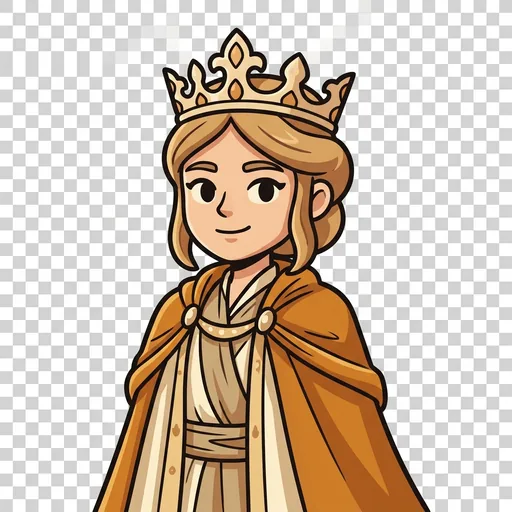
Queen Vesper
Queen — ranger-messenger; any direction, any distance
-

Captain Castle
Mentor + narrator — rook archetype; the mascot who introduces the cast + scaffolds the lesson
-

The Pawn Cohort
Ensemble piece — the four pawn-paired sets (Pawn Patrol + Sienna & Bran + Trotter & Trundle + Gable & Garrett) acting as one in the world layer