
Captain Crossfire
The DISCOVERED ATTACK — moving one piece to reveal an attack from a different piece behind it
Press play to listen along. The line being read lights up as you go.
Show full transcript
Loading transcript…
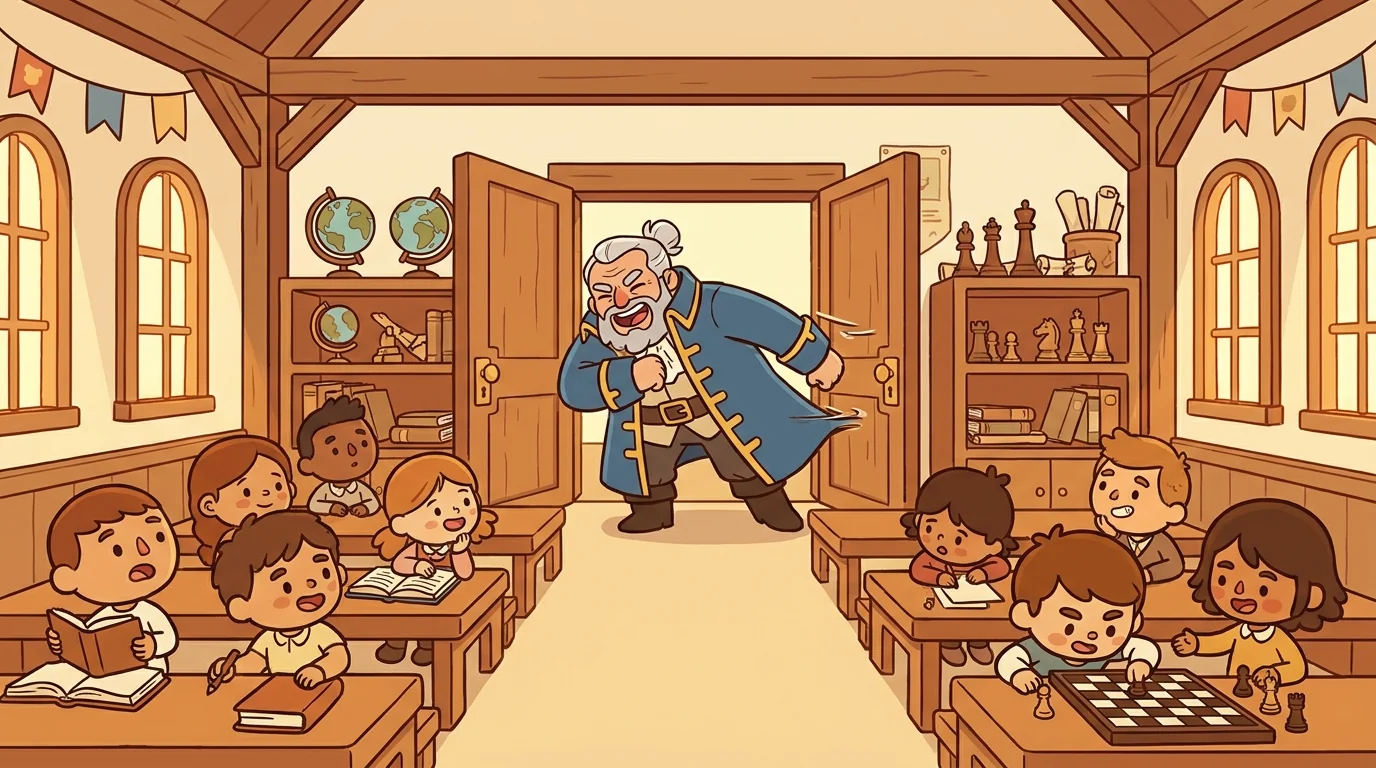
There is a particular kind of silence in the academy hall that happens only when Captain Crossfire is about to enter. The children, who have been informed in advance that he is coming, are not by any reasonable definition quiet — they are reading, fidgeting, swinging their legs under the bench, and conducting an argument about whether a knight or a bishop is the more interesting piece (it is the knight; it is always the knight) — but they have lowered their voices the way people lower their voices in a stairwell when they hear a particularly large coat being hung up on the floor below.
The double doors at the back of the hall swing inward without any particular gentleness.
"GOOD MORNING, CHILDREN!"
The voice arrives several seconds before the man does. Captain Crossfire follows it in, bowing slightly under the lintel because he is tall and the lintel is not, his long blue coat catching for a moment against the doorframe and then unsticking with a flourish that he definitely meant to perform. He has white hair tied back at the neck in the manner of a previous decade's officers. He has a beard that is precisely as tidy as a beard can possibly be when its owner waves his arms a great deal. He is sixty-one years old, and he has not had what most people would call an indoor voice since he was twenty-four.
"WATCH THIS!" he announces to the room, before he has even reached the front of it. The children sit up straighter in their benches. They cannot help it. He has trained them for it over a great many months.
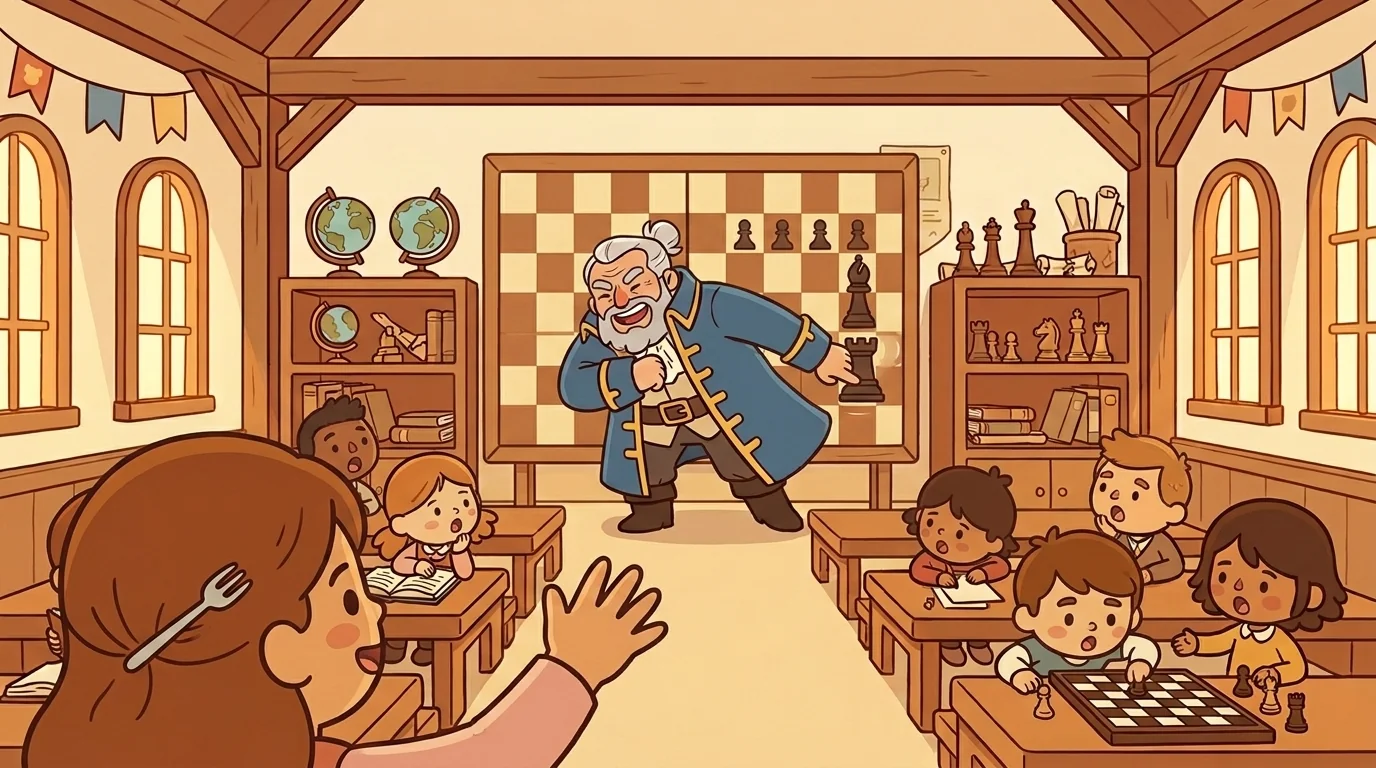
He arrives at the chessboard at the head of the hall, where the position has already been set up by Captain Castle, who is sitting on a stool to one side with the patient face of a man who has been an adult around children for a long time. Castle nods at Crossfire. Crossfire nods back. Their nods are precisely the same height, which is a coincidence they have practised for over a period of several weeks.
Crossfire turns the board so the children can see it properly. There are five pieces on it: a white knight on c3, a white bishop on b2 sitting cleanly behind the knight on the long diagonal, a black queen on g7, and two black pawns on the side of the board that do not matter to anybody.
"What," Crossfire says, with appropriate gravity, "is the knight about to do?"
A child in the front says, "Move?"
"YES!" Crossfire says. "EXACTLY! Move where?"
Another child says, "Anywhere?"
"ANYWHERE!" says Crossfire. "Wherever it likes! The knight is free! And — watch this — it doesn't matter where the knight goes. It only matters that the knight moves at all. Because behind the knight" — he points, very theatrically, at the bishop — "is my dear friend the bishop. And the bishop sees" — his finger traces the long diagonal all the way across the board — "all the way to the queen."
The children look. They see it. They lean in slightly, as a unit, without noticing they are doing so.
The knight moves. The bishop sits perfectly still, as bishops do when they are about to demonstrate something important. The bishop has not moved an inch. But suddenly the bishop is attacking the queen from three squares away, along a diagonal that was always there but that had been quietly obscured by the knight standing in front of it.
"AHA!" says Crossfire, with the full satisfaction of a man whose lesson has landed.
Captain Castle, on his stool, exhales the small sigh of a man who has heard AHA in this room approximately four thousand times over the course of his teaching career. He is not, however, frowning. He never frowns at Crossfire. He could not if he tried.
Crossfire was not born loud, but he was born early, and he has been making up for it ever since.
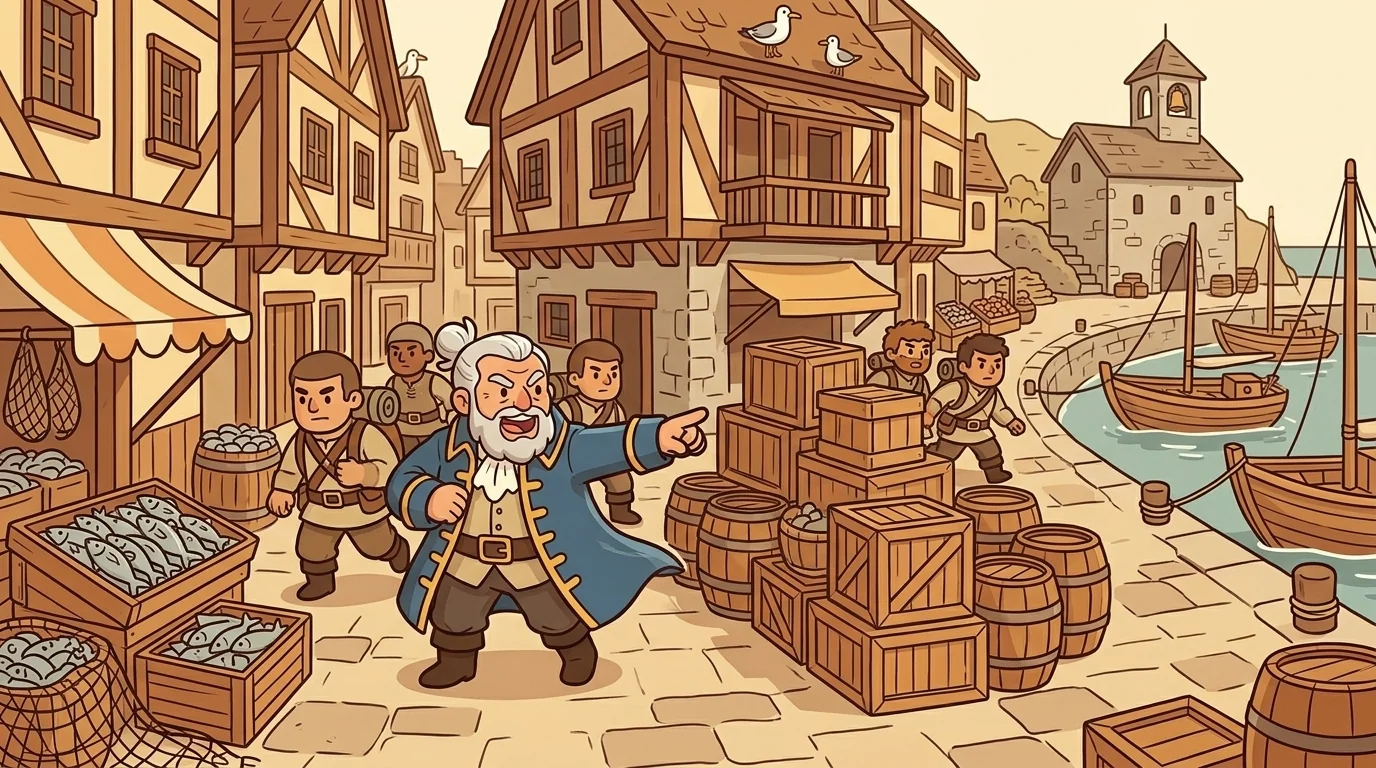
His actual name is Henrik Vohrn. He came from a southern garrison town called Vohrnmouth — narrow streets, a long curving harbour, a fish market at one end and a watch-barracks at the other. His parents were both fishmongers. They are still fishmongers, after forty years of fishmongering. They write him letters once a month and address them to Henrik, not Captain Crossfire, because they have refused, on principle, to acknowledge that the new name is the official one. He keeps the letters in a small wooden box at the academy.
He joined the watch at nineteen. He was promoted twice in his first three years, both times against his commanding officer's recommendation, because his commanding officer thought he was — and this is a direct quote from the personnel file — "insufferable, but reliable."
His job as a junior officer was to lead a small unit of watch-soldiers on patrols through the harbour district, which was a logistical nightmare for several reasons at once. Warehouses pressed against each other along narrow lanes. Market stalls appeared in the morning and disappeared by evening, like a tide that obeyed the calendar rather than the moon. There were, in summary, a great many ways for a person to get jumped from behind by an opportunistic thief.
Vohrn lost two soldiers to such jumpings during his first six months. They had not been seriously hurt. But they had been profoundly embarrassed, which Vohrn took personally because he was their commanding officer and embarrassment, he believed, was preventable in a way that bruises were not. He thought about this problem a great deal. He thought about it loudly. He thought about it on long walks, on short walks, at breakfast, and once — memorably — during a wedding. The wedding was his cousin's. The cousin has forgiven him, mostly, in the years since.
The conventional answer — the answer his commanding officer kept patiently suggesting from across the room — was the obvious one: patrol in tighter formation. Put the soldiers closer together. Have them watch one another's backs. Reduce the gaps.
Vohrn tried it. It mostly worked. The thieves adjusted. They started aiming at the very front of the formation instead of the very back, and the back of the formation could not turn around fast enough to provide useful support. The unit had become a closer cluster, but the front of the cluster was now exposed in a new and equally embarrassing way.
Vohrn was, by this point in his career, very frustrated. He swore a great deal. He wrote angry letters that he then crumpled up and discarded before posting. He stomped through the harbour at night with his hands clenched behind his back and his coat dragging through the puddles, and he thought, over and over again, in a slowly tightening loop:
The problem is that we're all moving at the same time.
This thought, when it eventually arrived in completed form, was so quiet that even Vohrn (who is, as has been mentioned, loud) heard it as a whisper. He stopped walking. He looked at the harbour. He sat down.
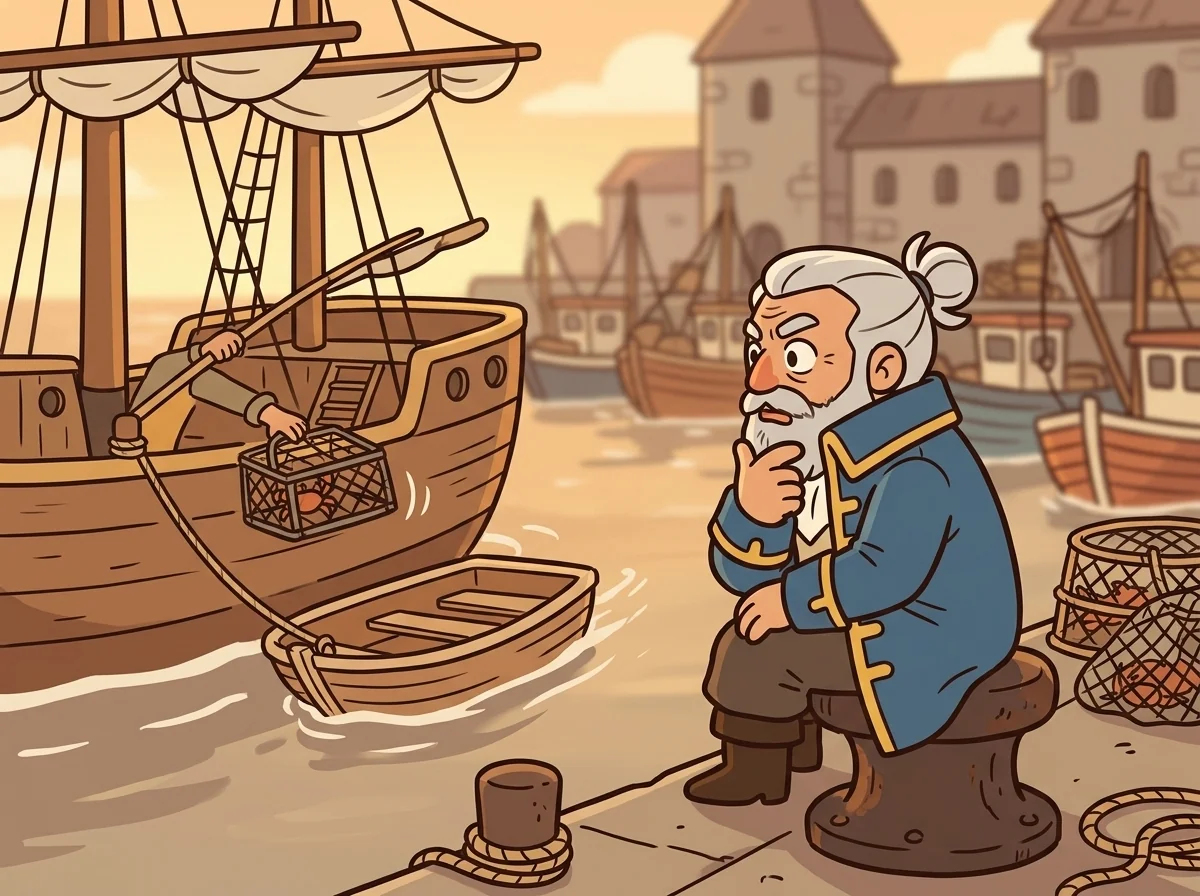
The harbour had a long row of bollards along its edge — short fat iron posts that fishermen tied their boats to in all kinds of weather. Vohrn sat on one of them.
He sat for nearly an hour without moving. He watched the boats come in. He watched the deckhands hopping between vessels with the casual confidence of people who fall into water for a living. He watched, in particular, a small dinghy moored alongside a much larger trade-ship. The dinghy was tied to the trade-ship with a single rope. When the wind shifted, the dinghy moved — but the trade-ship did not. The trade-ship had been there all afternoon. The trade-ship had appeared, to anybody walking by on the dock, to be a permanent part of the landscape.
And from behind the trade-ship, every now and then, a fisherman with a long pole would casually reach out and check a crab pot that the dinghy's movement had revealed.
The trade-ship hadn't moved.
The dinghy had.
The crab pot got checked.
Vohrn stood up so suddenly that he nearly fell into the harbour. He walked home. He drew a diagram by lamp-light, several diagrams in fact, each one labelled with increasingly enthusiastic exclamation marks. He did not sleep that night, although he tried briefly around three in the morning.
The next morning he proposed, to his commanding officer, a new patrol formation. It was not tighter. It was, in fact, looser. He proposed that the unit move in a staggered pattern — one or two soldiers visibly walking through the district, the others positioned at fixed posts, hidden behind market stalls and warehouse corners, not moving at all. When a thief approached the visible soldiers, the visible soldiers would simply move aside — and reveal, behind them, a line of fixed posts with crossbows already aimed at the place the thief was standing.
The commanding officer said, after a long thoughtful silence, "That is the most absurd plan I have heard this year."
The commanding officer let him try it.
It worked spectacularly. Two thieves were apprehended in the first week. Three more in the second. The total apprehensions for the month were higher than the previous year's annual total for the harbour district. The commanding officer, who had been doing his job for thirty-one years and was not a fool, promoted Vohrn again. He also, after consulting with his deputy over a long lunch, gave him a nickname.
Captain Crossfire.
"Because," the commanding officer said dryly, over the soup course, "you stand still, and the attack comes from behind you, and the thief never sees the second line until it is too late."
The nickname stuck immediately, the way the best nicknames do. Vohrn liked it. He used it on his next promotion paperwork. By the time he was thirty, Captain Crossfire appeared on every official document in the kingdom, and Henrik Vohrn appeared only on his mother's monthly letters.
He retired from the watch at thirty-eight, with full honours and several commendations he did not display in his office because he found them embarrassing. He had, by then, become a famous tactician in certain circles. The kingdom's chess academy invited him to come and teach. They had, they explained in their letter of invitation, recently identified the discovered attack — the move where you shift one piece aside to reveal an attack from a second piece behind it — as one of the most under-taught tactical patterns in the kingdom's training programmes. The academy needed someone to teach it. They wanted a teacher who understood it in his bones.
Captain Crossfire said, "HA!"
He said this loudly.
He has been teaching the discovered attack ever since, with no apparent decrease in volume or enthusiasm.
He has, this morning in the academy hall, just finished his fourth demonstration of the day. The children are still leaning forward in their benches. He likes that about children. They never get tired of AHA. He sometimes wonders, privately, in the quiet moment before he falls asleep at night, whether the adults in his life have ever leaned forward in quite the same way. He suspects, on the balance of evidence, that they have not. He does not mind.
A small student — eight years old, with a fork-pin in her hair — raises her hand carefully.
"Captain Crossfire," she says, "what if the front piece is also a piece I want to keep? What if I don't want it to move?"
Crossfire grins. It is the slow, deliberate grin of a man who has been quietly waiting for this exact question all morning.
"AHA!" he says. "AHA — but — listen. The front piece doesn't have to die. The front piece just has to get out of the way. It can move to another square. A safe square. A useful square. The discovered attack is not a sacrifice. It is a reveal. The trade-ship doesn't sink. The dinghy doesn't drown. The crab pot just gets checked."
Glass Lantern, sitting near the back of the hall in her usual spot by the window, smiles very faintly. Glass Lantern's smile is a thing that requires close attention to see at all. The Captain has, over the years of their partnership, learned to look for it. He nods at her across the hall. She nods back. They are co-teaching this kit. She is the quietest person he has ever respected.
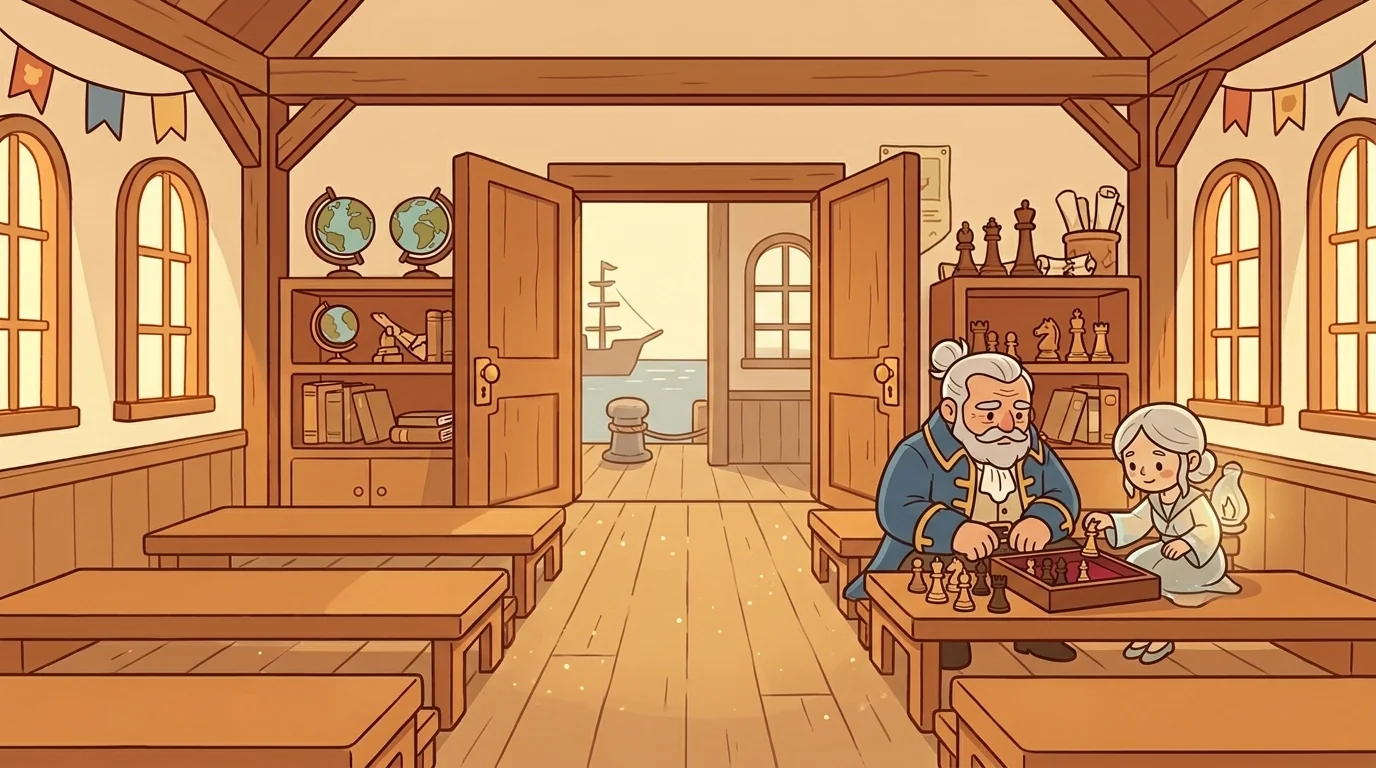
After the lesson, Crossfire sits at the back of the hall on a low wooden bench, helping Glass Lantern pack up the demonstration pieces for the evening. He is unusually quiet while he does this. He is always unusually quiet around the Lantern; he likes the way silence feels when somebody else is in it with him.
"You hinted at the king-version," the Lantern says, after several minutes have passed.
"I did," says Crossfire.
"The double-check. You hinted at it twice."
"I did."
"They'll ask you about it next week."
"They will."
The Lantern places a small wooden bishop carefully into a velvet-lined box. She closes the lid with a soft click. She says, very softly: "Tell them about the bollard."
Crossfire considers this proposition for a long moment. The bollard is something he does not, as a general rule, mention to the children. The bollard is the moment when he sat down by the harbour and realised that the problem was that everybody had been moving at the same time. The bollard is the actual beginning of his career. He has been a captain for nearly forty years now, but the boy who sat on that bollard was twenty-four and very frustrated, and the captain in the academy hall knows, in a place he does not often visit, that the boy is still doing the thinking for him.
"All right," he says.
He says it quietly. The Lantern hears.
They walk out of the hall together, towards the staircase that leads down to the kitchen-yard for the evening meal. Captain Castle, still on his stool at the side of the room, watches them go. He shakes his head slowly, in the way of a man who has watched the same people do the same kind thing many times. He is, despite everything, fond.
The trade-ship doesn't move. The dinghy does. The crab pot gets checked.
He is the captain who stood still and won.
The GambitTales ensemble
Captain Crossfire is part of GambitTales's distributed-narrative cast. Each character embodies a different curricular primitive; together they teach the full subject.
-

Sir Pinwell
Pin pattern — freezes pieces along a line
-

Twin Knights of Fork Hill
Fork pattern — attack two targets at once
-

Lady Skewer
Skewer pattern — force a valuable piece out of the way
-

Veil & Vow
Discovered attack — step aside to reveal a hidden threat
-

The Glass Lantern
X-ray attack — light pierces through to the piece behind
-

King Pumble & King Sable
Two kings — librarian and gardener; one step at a time
-

Queen Vesper
Queen — ranger-messenger; any direction, any distance
-

Captain Castle
Mentor + narrator — rook archetype; the mascot who introduces the cast + scaffolds the lesson
-

The Pawn Cohort
Ensemble piece — the four pawn-paired sets (Pawn Patrol + Sienna & Bran + Trotter & Trundle + Gable & Garrett) acting as one in the world layer