
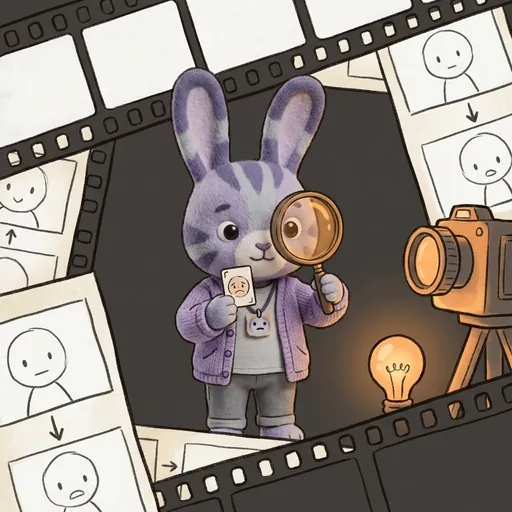
Beam
BEAM — how do they feel? show their face.
Listen along — Beam
Loading audio…
Press play to listen along. The line being read lights up as you go.
Show full transcript
Loading transcript…
Chapter 4 — Beam and the Face That Shows the Feeling
In the animation room at Framequest, a small rabbit-tween in a soft purple cardigan set a tiny clay figure under the lights, leaned in close, and gently pressed its eyebrows up.
“There,” Beam said softly. “Now watch.”
A cluster of kids crowded around the table. On the screen above them, a short film was frozen on a single frame — a clay dog, sitting by a door.
“Play it,” Beam said.
The dog’s ears lifted. Its eyes went wide. Its mouth opened just a little. And every kid in the room said the same word at the same time, without being asked: “Surprised!”
Beam beamed. “You didn’t read that in a caption. Nobody wrote surprised on the screen. You read it off the face.” Beam touched the little face-card-charm at their necklace. “How do they feel? Show their face. That’s the whole trick. Move the face right, and a person watching just knows.”
A boy near the back squinted. “But how do you know which face is which?”
Beam picked up the clay dog and turned it toward him, slow and patient. “You learn it,” Beam said. “The same way you learn anything. One face at a time.” And Beam pressed the dog’s mouth into a soft downward curve, let its eyes go droopy, and held it up. The boy didn’t even hesitate.
“Sad,” he said.
“Sad,” Beam agreed. “See? You already knew. You just didn’t know you knew.”
Beam had not always known.
When Beam was small, faces had felt like a language everyone else already spoke. The other kids seemed to catch feelings out of the air — one glance and they’d whisper she’s upset or he’s joking — and Beam would stand there, honestly lost, watching mouths and eyebrows move without a key to read them by.
It made Beam feel behind. Like there was a rule everyone had been handed except them.
Then, one afternoon, an old animator at the studio had noticed Beam staring hard at a paused frame and sat down beside them — not to fix anything, just to look too.
“You watch faces really carefully,” the animator said. “Most people don’t. They just guess and move on. You actually look.”
Beam admitted the truth, quiet and a little ashamed. “I look because I can’t tell. Everyone else just knows.”
The animator shook their head slowly. “Nobody’s born knowing. It only feels like they are. You know what animators do? We take a feeling and we break it into pieces. Eyes wide, mouth open — that’s surprise, every single time. Eyebrows down, mouth tight — that’s angry, every single time. We build a dictionary.” The animator smiled. “And people who build the dictionary on purpose? They end up reading faces better than the ones who only guess.”
Something loosened in Beam’s chest right then. The lost, behind feeling didn’t vanish — but it got a shape. It wasn’t that Beam couldn’t. It was that Beam hadn’t built the dictionary yet. And a dictionary was something you could build.
Beam came to Framequest at twelve, cardigan and charm and all, because Framequest was where people animated feelings on purpose.
Beat, who ran the workshop, met them at the door. Beat had heard Beam liked faces, and asked a testing question. “Show me a scared face.”
Beam didn’t describe it. Beam picked up a clay figure off the shelf, pushed its eyes as wide as they’d go, dropped its jaw, and pulled its whole little body back and small. Then Beam held it up beside their own face — same wide eyes, same open mouth, same pulled-back shoulders.
“Scared,” Beat said before they could stop themselves.
“Scared,” Beam said. “Every time. That’s why it works.” Beam set the figure down gently. “A clear face isn’t fake. It’s honest. It shows the feeling so plainly that nobody watching has to guess.”
Beat looked at the little clay figure, still frozen mid-fright, and then at the steady, watchful rabbit holding it.
“You belong here,” Beat said.
Beam’s corner of the studio was full of faces waiting to be understood.
One morning a girl came in frustrated. She’d animated a whole story — a ball rolling down a hill, hitting a rock, bouncing, stopping in the grass — but it fell flat. “It’s boring,” she said. “It’s just a ball. Nobody cares.”
“Add a watcher,” Beam said. “Someone standing at the side of the hill, watching the ball. And every time the ball does something, we ask one question.” Beam took out the face-card-charm. “How do they feel? Show their face.”
They went beat by beat.
“Ball at the top — the watcher is curious. Eyes wide, mouth a little open.” The girl pressed the clay face into curious.
“Ball hits the rock — surprised. Eyes very wide, mouth open.” She did it.
“Ball bounces high — worried. Eyebrows up and tight.” She did that too, biting her lip.
“Ball stops safe in the grass — relieved. Soft smile, eyes calm.”
She played it back. The ball did exactly what it had done before — but now there was a little clay watcher on the hillside whose face rose and tightened and softened, and suddenly the whole thing wasn’t boring at all. It was a story.
“That’s the dictionary,” Beam said quietly. “Same face shapes, same feelings, every time. Predictable. Learnable. And any kid who watches your film learns to read a real face a little better — because you labeled the feelings for them, plain as day.” Beam smiled. “You didn’t just animate a ball. You taught somebody how to see.”
Later, when the room had emptied, the girl came back with one more question, softer this time.
“When someone’s real face is complicated,” she said, “and it’s not one clear feeling — how do you even start?”
Beam thought about the paused frame, and the old animator, and the lost feeling that had finally gotten a shape.
“You start clear,” Beam said. “Always. One feeling, one clear face — that’s the foundation. The complicated ones come later, and they’re just clear ones layered together.” Beam touched the charm. “Nobody’s born able to read faces. It only looks that way. It’s a skill, and skills grow. So you build your dictionary one honest face at a time, and you’re patient with yourself while it fills up.”
The girl nodded slowly, and Beam watched something ease in her shoulders — the same quiet loosening Beam had felt years ago, sitting beside a paused frame, when lost had turned into not yet.
“How do they feel?” Beam said, gentle as anything. “Show their face.”
And for the first time all day, Beam wasn’t watching a clay figure or a screen. Beam was just watching the girl — her calm, unlost, about-to-understand face — and feeling, warm and steady and sure, that she was going to be all right.
The FrameQuest ensemble
Beam is part of FrameQuest's distributed-narrative cast. Each character embodies a different curricular primitive; together they teach the full subject.